
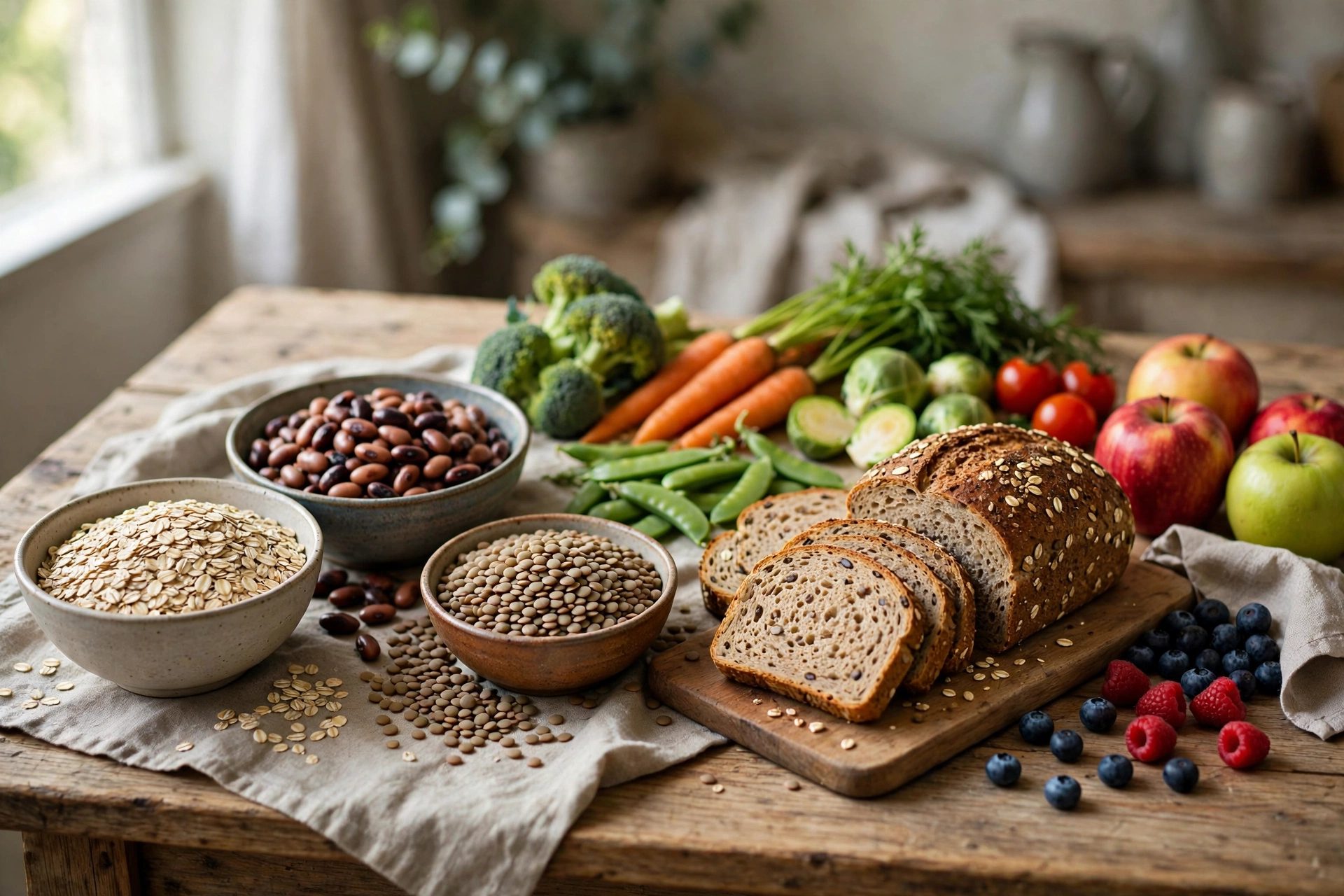
Fibre foods are the simplest fix in healthy eating, and most of us are not getting enough of them. The NHS notes that most adults eat an average of about 20g of fiber a day, while government guidelines say intake should increase to 30g a day as part of a healthy balanced diet. That 10g gap sounds small, but closing it changes how full you feel, how steady your digestion is, and how well your overall diet works. You do not need a special diet or expensive products to get there: fibre foods are ordinary foods such as oats, whole-wheat bread, beans, lentils, fruit, vegetables, nuts, and seeds. This article explains what fibre foods are, how much fiber to aim for, and how to add them to breakfast, lunch, dinner, and snacks without turning your meals upside down.
What Fibre Foods Are and Why They Matter
Fiber is the term for the parts of plant foods the body cannot fully digest, sometimes called roughage. It is found only in plant foods: whole grains, beans, peas, lentils, fruit, vegetables, nuts, and seeds. Animal foods such as meat, fish, eggs, and dairy contain none, so a diet built mostly on them can leave fiber low even when calories are high.
Fiber matters for a few plain reasons. The NHS states that eating plenty of fiber is associated with a lower risk of heart disease, stroke, type 2 diabetes, and bowel cancer. Choosing foods with fiber also helps digestion and can prevent constipation, because fiber draws fluid into the bowel and helps keep its contents soft and easy to pass. Foods rich in fiber also tend to make you feel fuller, which makes it easier to avoid constant snacking. The British Heart Foundation makes a similar point about whole grains: their fiber can help lower “bad” LDL cholesterol and keep you fuller for longer. No single food protects health on its own; a varied diet with plenty of fibre foods supports the body in ways low-fiber eating does not.
There are two broad types of fiber, and most plant foods contain a mix. Soluble fiber dissolves in water and forms a gel-like substance during digestion; oats, beans, lentils, and many fruits are useful sources. Insoluble fiber adds bulk and helps food move through the digestive system; whole-wheat bread, whole grains, and the skins of fruit and vegetables are good examples. You do not need to track the two types separately: eating a variety of fibre foods across the day covers both.
How Much Fiber You Need Each Day
For adults aged 17 and over, government guidelines say dietary fiber intake should increase to 30g a day, as part of a healthy balanced diet. Children need less than adults, but the NHS notes that they still need more than they currently get. The recommended amounts are about 15g a day for children aged 2 to 5, about 20g for children aged 5 to 11, and about 25g for young people aged 11 to 16. On average, children aged 11 to 18 are getting only 16g a day, so the shortfall starts early.
These figures are general guidance, not a personal target. People with digestive conditions, people advised to follow a low-fiber diet, and people taking certain medicines may need different advice from their GP or a registered dietitian. For most healthy adults, the message is simple: aim toward 30g, build up slowly, and mix sources.
Food labels can help you judge whether a food is a useful source. The NHS notes that foods with 6g or more of fiber in every 100g count as high in fiber.
Fibre Foods for Breakfast That Keep You Full
Breakfast is the easiest place to add fiber. Porridge made with oats is one of the most reliable choices, and a bowl with sliced banana or berries adds fruit fiber and keeps you full well into the morning. Plain whole-wheat biscuit cereals and plain shredded whole grain cereals are also strong choices; choose versions without added sugar.
Whole-wheat toast is another easy start. The NHS gives a useful illustration: two slices of whole-wheat toast with peanut butter, followed by a medium-size orange, should give you around 8.3g of fiber. That is more than a quarter of the 30g daily guideline before you have left the house. If you usually drink fruit juice at breakfast, eat the whole fruit instead: juice removes most of the fiber, while the whole fruit keeps it and the fullness that carries you to lunch.
Fibre Foods for Lunch and Dinner
Lunch and dinner are where fibre foods do most of their work, because the main dishes are bigger and offer more room for beans, lentils, whole grains, and vegetables. The NHS illustrates this with a lunch of whole-wheat spaghetti with lentil and tomato sauce, which should give around 11g of fiber. A dinner of grilled chicken breast with a skin-on baked potato, carrots, and green beans should give around 11.2g. Ordinary meals chosen with fiber in mind can cover most of the daily guideline without special effort.
Beans, lentils, and chickpeas are among the most useful fibre foods of all. They are low in fat, filling, and rich in both fiber and protein, and they fit easily into stews, curries, soups, and salads. Adding a can of kidney beans to a chili, lentils to a tomato sauce, or chickpeas to a salad can lift the fiber of a familiar meal by several grams. Potatoes count too when you keep the skins on: a baked potato or boiled new potatoes with their skins supply more fiber than the same potato peeled. The same idea applies to grains. Swapping white rice for brown rice, white pasta for whole-wheat pasta, and white bread for whole-wheat bread raises the fiber of the whole meal, because the whole grain keeps the outer layers that refining removes.
Vegetables deserve a generous place on the plate at lunch and dinner. The NHS advises including plenty of vegetables with meals, either as a side dish or cooked into sauces, stews, and curries. Aim for variety across the week: different beans, grains, and colors of vegetables, rather than depending on a single standout food.
Fruit, Vegetables, Nuts, and Seeds That Add Fiber
Fruit and vegetables are a natural source of fiber, and eating at least five portions of a variety a day supports fiber intake as well as vitamin and mineral intake. Eating the skins where possible adds fiber, so an apple eaten whole supplies more than the same apple peeled and sliced. Berries, pears, apples, and oranges are all useful, and dried fruit can help too, though the NHS notes that dried fruit is sticky and can increase the risk of tooth decay, so it is better eaten as part of a meal rather than as a between-meal snack.
Broccoli, carrots, peas, sweetcorn, and green beans all add fiber, and they work best spread across meals: a side salad at lunch, vegetables in an evening curry, and fruit after dinner add more than one large portion eaten once. Nuts and seeds also contribute: a small handful of unsalted nuts, such as almonds, or seeds stirred into porridge or yogurt adds fiber along with healthy fats. Nuts are energy-dense, so a small handful is enough, and unsalted versions without added sugars are the better choice.
Fruit juice and smoothies do not replace whole fruit for fiber: juice is limited to a combined 150ml a day in general guidance because the fiber is largely removed and the sugars are freed from the fruit. The simplest rule is to eat fruit, drink water, and treat juice as an occasional extra.
How to Read Food Labels for Fiber
Labels are the quickest way to tell a genuinely high-fiber food from one that only sounds healthy. Most pre-packaged foods show dietary fiber per 100g and per serving on the nutrition label. The NHS notes that high-fiber foods have 6g or more per 100g, a useful line when comparing two loaves, cereals, or ready meals.
Start with the fiber line, then check the rest of the label. A cereal can be high in fiber and still high in added sugar, and a seeded loaf can look wholesome while carrying a lot of salt. The traffic light system on the front of many packs helps here: green and amber for fat, saturated fat, salt, and sugar are generally better choices than red. Words on the front of a pack such as “multigrain” or “made with whole grains” do not always mean high in fiber, so the numbers on the back are more reliable than the claims on the front. Bread listing whole-wheat flour first with 6g or more of fiber per 100g is a solid choice; a cereal listing added sugars before any whole grain probably is not, however healthy the box looks.
Simple Swaps That Add Fibre Foods to Meals You Already Eat
Small swaps to meals you already enjoy can close most of the gap between 20g and 30g. Swap white bread for whole-wheat bread, white rice for brown rice or bulgur wheat, and white pasta for whole-wheat pasta. Keep the skins on potatoes. Add lentils to soup, beans to stew, or chickpeas to a salad you already make, and choose porridge or a plain whole-wheat biscuit cereal over a low-fiber refined cereal.
Snacks offer another easy opening. Fresh fruit, vegetable sticks with hummus, rye crackers, oatcakes, and a small handful of unsalted nuts or seeds all add fiber, replacing snacks that offer little besides salt, sugar, and fat. When you bake at home, try whole-wheat flour for some or all of the white flour. Each swap adds only a few grams, but three or four across a day can add the 10g most adults are missing.
Build Fiber Up Gradually and Drink Enough Fluid
Fiber works best when you build it up slowly. A sudden jump from very little fiber to a lot can cause bloating, gas, and stomach discomfort, because the digestive system needs time to adjust. Add one higher-fiber food at a time, keep the change for a few days, and then add another. This steady approach also makes the habit easier to keep, because each change is small enough to become routine before the next one arrives.
Fluid matters as much as fiber: fiber draws water into the bowel, so drinking enough as you increase fiber helps it work and helps prevent constipation. Spread drinks through the day rather than making up for a dry day in one evening. People with digestive conditions such as irritable bowel syndrome may find some types of fiber cause more symptoms, and larger amounts of fermentable fiber can bring on bloating or loose stools. If that sounds familiar, or you take regular medicine, speak to your GP or a registered dietitian before making big changes. This article is general information only, not personal medical advice.
Common Mistakes With Fibre Foods
The most common mistake is relying on a single food. Eating a large bowl of bran every morning and little else does not give a balanced diet, and the NHS warns that eating too much of one type of food may not provide healthy balanced eating. Variety is what makes a high-fiber diet work: different grains, beans, fruit, and vegetables across the week supply a wider mix of nutrients and keep meals interesting.
A second mistake is confusing fiber claims with health claims. A snack bar labeled high in fiber may also be high in added sugar or fat, and a juice labeled with added fiber is not the same as eating whole fruit. Reading the label, rather than trusting the front of the pack, avoids this trap. A third mistake is adding fiber without fluid, which can leave you feeling blocked rather than comfortable. A fourth is expecting instant results: fiber supports digestion and fullness over time, as part of a balanced diet, not as a quick fix. New, persistent, or worrying symptoms, such as ongoing pain, bleeding, or unexplained weight loss, need a GP visit rather than diet changes alone.
Frequently Asked Questions
How much fiber should I eat each day?
For adults aged 17 and over, government guidelines say dietary fiber intake should increase to 30g a day as part of a healthy balanced diet. Children need less: about 15g a day at ages 2 to 5, about 20g at ages 5 to 11, and about 25g at ages 11 to 16. Most adults currently eat only about 20g a day.
Can I get enough fiber from food alone?
For most healthy adults, yes. A mix of whole grains, beans, lentils, chickpeas, fruit, vegetables, nuts, and seeds across the day can reach 30g without supplements. Supplements are not a substitute for a varied diet, and anyone with a health condition or taking regular medicine should ask their GP or a registered dietitian before using them.
Do fibre foods help with weight management?
Fibre foods can help, because they tend to make you feel fuller and usually have fewer calories than low-fiber alternatives, as the British Heart Foundation notes. They are not a weight loss treatment on their own; weight depends on the whole diet and activity level.
What should I do if extra fiber upsets my stomach?
Build up slowly, add one higher-fiber food at a time, and drink enough fluid through the day. Bloating and gas are common when fiber increases quickly. If symptoms persist, are painful, or come with other worrying signs, speak to your GP or a registered dietitian rather than pushing through.
Are frozen and canned fruit and vegetables as good for fiber?
Yes, in general. Frozen and canned fruit and vegetables count toward a varied diet, and they make it easier to eat fibre foods all year round. Choose versions canned in natural juice or water rather than syrup, and check labels for added salt and sugar.
Conclusion
Fibre foods are not a trend or a special purchase: oats and whole-wheat bread at breakfast, beans and lentils at lunch and dinner, fruit and vegetables through the day, and a small handful of nuts or seeds as a snack. Closing the gap between 20g and 30g takes small swaps, built up gradually, with enough fluid and variety rather than one magic ingredient. Start with one change this week and let the next follow when the first feels normal.
General information note: This article is general information only and is not medical advice. It does not diagnose, treat, or advise on any health condition. If you have a health condition, a digestive condition, or you take regular medicine, speak to your GP or a registered dietitian before making significant changes to your diet.