
Introduction
Electroslag remelting, commonly shortened to ESR, is a secondary refining process used to improve steel and other high-performance alloys. It does not produce metal from raw materials. Instead, it remelts an existing metal electrode under controlled conditions to create a cleaner, more uniform ingot.
Manufacturers use ESR when ordinary steelmaking cannot provide the required level of purity, strength, or reliability. It is especially valuable for tool steels, stainless steels, bearing steels, and nickel-based alloys used in demanding industries.
The Purpose of Electroslag Remelting
The main purpose of electroslag remelting is to reduce unwanted inclusions, control sulfur, improve chemical uniformity, and create a dense ingot with a carefully managed internal structure.
These improvements can increase fatigue resistance, toughness, polishability, and performance under heavy loads or high temperatures. However, the exact benefit depends on the alloy, slag, equipment, and operating conditions.
How the Electroslag Remelting Process Works
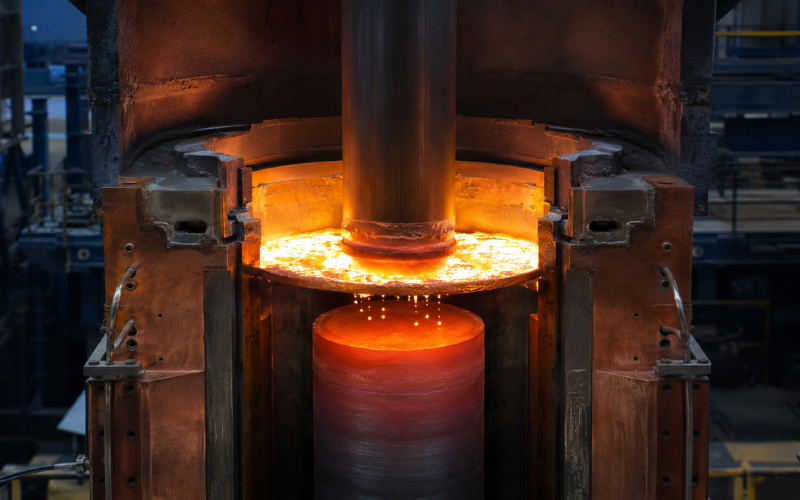
The process begins with a solid metal electrode made from the alloy that needs refining. This electrode is lowered into a layer of molten slag inside a water-cooled copper mold.
An electric current passes through the slag. Its electrical resistance produces intense heat, which gradually melts the electrode tip. Small metal droplets travel through the slag and collect in a liquid metal pool below.
Essential Equipment and Furnace Components
An ESR furnace normally includes a consumable electrode, electrical power supply, electrode-feeding system, molten slag bath, water-cooled copper mold, base plate, and monitoring equipment.
Modern systems may also include an enclosed chamber filled with an inert gas such as argon. This protective atmosphere helps prevent the hot metal and slag from reacting with air.
The Role of Molten Slag in Metal Refining
Molten slag performs several jobs at the same time. It generates heat, protects the liquid metal, absorbs certain impurities, and controls how heat moves through the furnace.
The slag also forms a thin layer between the cooling ingot and the copper mold. This layer supports controlled solidification and can help produce a smoother ingot surface.
Step-by-Step Journey from Electrode to Refined Ingot
First, the selected slag is melted inside the mold. The prepared electrode is then lowered into the slag, and electrical power is applied.
The electrode melts slowly, drop by drop. Each droplet passes through the active slag before joining the metal pool. Cooling water removes heat through the mold walls, causing the metal to solidify upward. The finished ingot is later removed, inspected, and prepared for forging or further processing.
Key Process Parameters and Their Effects
Important electroslag remelting parameters include electrical current, voltage, melting rate, electrode position, slag depth, mold size, and cooling rate.
If the melting rate is too high, the liquid metal pool may become too deep, increasing the risk of segregation. If it is too low, productivity falls and energy use may rise. Stable control is therefore essential.
Slag Composition and Chemical Reactions
Common ESR slags contain different amounts of calcium fluoride, calcium oxide, aluminum oxide, magnesium oxide, and other compounds. The formula is selected for the alloy and the required refining result.
Slag composition affects electrical resistance, melting temperature, fluid movement, sulfur removal, and inclusion behavior. Research confirms that changing the slag can significantly affect both metal cleanliness and energy consumption.
How Electroslag Remelting Removes Impurities
As molten metal droplets move through the slag, sulfur and some nonmetallic particles can transfer from the metal into the slag. Large oxide and sulfide inclusions may be dissolved, captured, or prevented from entering the growing ingot.
Research shows that much of the sulfur removal occurs near the melting electrode and around the falling droplets. ESR is not equally effective at removing every impurity or dissolved gas. Applied Thermal Engineering research
Solidification, Grain Structure, and Ingot Quality
Careful solidification can reduce large internal cavities, severe chemical separation, and uneven grain patterns. The resulting ingot is usually more consistent across its length and width than a conventionally cast ingot.
Metals and Alloys Commonly Processed Through ESR
Electroslag remelting is widely used for tool steel, die steel, bearing steel, stainless steel, heat-resistant steel, and selected nickel-based alloys.
These materials often need exceptional cleanliness because even a small inclusion can shorten the service life of a highly stressed component. The process and slag must always be matched to the alloy’s chemical properties.
Industrial Applications of Electroslag-Remelted Materials
ESR materials are used in aerospace, energy production, heavy engineering, transportation, and high-quality manufacturing.
Typical products include turbine and generator parts, large shafts, bearings, pressure-related components, cutting tools, forging dies, and plastic injection molds. The process is most valuable when component failure would be expensive or dangerous.
Major Advantages of Electroslag Remelting
The main advantages include improved cleanliness, lower sulfur content, controlled solidification, better chemical uniformity, and a dense internal structure.
ESR can also produce ingots with relatively smooth surfaces. For tool and mold steels, improved cleanliness may support better polishing, more predictable machining, and longer service life.
Limitations, Costs, and Production Challenges
Electroslag remelting requires specialized equipment, skilled operators, carefully prepared electrodes, large amounts of electricity, and continuous water cooling. These factors make it more expensive than using conventionally produced steel.
The process also cannot correct every problem in a poor-quality starting electrode. Incorrect slag chemistry or furnace settings may introduce new inclusions or change important alloying elements.
Common ESR Defects and Their Causes
Possible defects include chemical segregation, unwanted inclusions, surface marks, internal cracking, shrinkage near the ingot top, and channel-like segregation sometimes called freckles.
These problems may develop when the melt pool is too deep, the cooling pattern is uneven, the melting rate changes suddenly, or the slag and alloy react in an uncontrolled way.
Process Monitoring and Quality-Control Methods
Operators continuously monitor current, voltage, power, electrode movement, melting rate, slag behavior, and cooling-water conditions. Modern furnaces collect this information digitally so that changes can be identified quickly.
After remelting, the ingot may undergo chemical testing, ultrasonic inspection, surface examination, microscopic analysis, and mechanical testing before approval.
Electroslag Remelting Compared with Vacuum Arc Remelting
VAR is especially effective when removing dissolved gases or controlling highly reactive materials is important. ESR offers strong inclusion control, sulfur removal, and uniform properties. Neither method is automatically better; the alloy and final application determine the correct choice.
Electroslag Remelting Compared with Conventional Steelmaking
Conventional steelmaking creates the original alloy and produces large quantities efficiently. Electroslag remelting is an additional refining stage for selected material.
Because the entire electrode must be melted again, ESR is generally reserved for products requiring higher cleanliness and structural control than standard production can economically provide.
Energy Use and Environmental Considerations
ESR is energy-intensive because metal is reheated above its melting temperature while the mold is actively cooled. Slag selection, furnace design, and electrode size strongly influence efficiency.
Fluoride-containing slags can also create environmental concerns. Current research is examining lower-fluoride alternatives, better heat control, and improved operating methods that reduce energy losses without sacrificing quality.
Recent Developments in Electroslag Remelting Technology
Recent work focuses on computer-based process models, predictive controls, protective atmospheres, improved sensors, and carefully designed slags. A 2025 study explored data-driven control for handling slow temperature responses during ESR.
Researchers are also testing rotating and vibrating electrodes to influence droplet size, temperature distribution, sulfur removal, and inclusion movement. These ideas are promising, although their industrial value depends on further testing and practical cost.
Choosing When Electroslag Remelting Is Necessary
ESR is most suitable when the required cleanliness, internal structure, or reliability cannot be achieved consistently through conventional production.
Manufacturers should consider the component’s operating stress, temperature, expected service life, inspection requirements, and cost of failure. For ordinary applications, standard steel may already provide sufficient performance at a lower price.
Conclusion
Electroslag remelting transforms an existing electrode into a cleaner and more uniform ingot through controlled melting, slag refining, and directional cooling. It plays an important role in producing critical steels and nickel-based alloys.
FAQs
1. What is electroslag remelting in simple terms?
Electroslag remelting is a process that melts an existing metal electrode through a hot slag layer. The metal is cleaned and then cooled inside a copper mold to form a refined ingot.
2. Is electroslag remelting the same as electroslag welding?
No. Electroslag remelting refines an alloy and produces an ingot. Electroslag welding is a joining process used to connect thick metal sections.
3. Does ESR make steel stronger?
ESR can improve cleanliness, uniformity, and internal structure. These changes may improve toughness, fatigue life, and reliability, but the final properties also depend on the alloy and later heat treatment.
4. Which materials are commonly remelted through ESR?
Common materials include tool steels, stainless steels, bearing steels, heat-resistant steels, and certain nickel-based alloys used in demanding industrial components.
5. Is ESR better than vacuum arc remelting?
Not in every situation. ESR is effective for inclusion control, sulfur removal, and structural uniformity, while VAR is often preferred for dissolved-gas removal and highly reactive alloys.