
Introduction
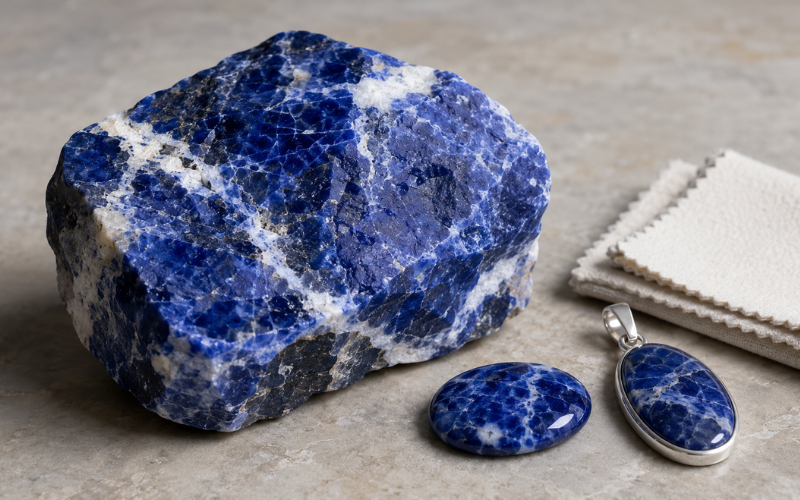
Sodalite is a striking blue mineral valued for its rich color, white markings, and smooth polished appearance. It is commonly used in jewelry, carvings, decorative objects, and mineral collections.
Although royal blue is its best-known color, sodalite can also appear in white, gray, green, yellow, pink, and violet shades. Beyond its beauty, the stone has attracted traditional associations with communication and clear thinking. This guide explores its scientific properties, formation, history, meaning, uses, value, identification, and care.
Sodalite at a Glance
Sodalite is a sodium-rich tectosilicate mineral belonging to the feldspathoid group. Its chemical formula is generally written as Na₈(Al₆Si₆O₂₄)Cl₂.
It has a hardness of approximately 5.5 to 6 on the Mohs scale, making it harder than calcite but softer than quartz. Sodalite has a cubic crystal system, although visible crystals are uncommon. Most material occurs in large, solid masses that are opaque or slightly translucent. These properties are documented in the Mindat mineral database.
How Sodalite Forms in Nature
Sodalite normally develops in silica-poor alkaline igneous rocks. These rocks form when molten material cools beneath or near Earth’s surface. It may also occur in alkaline pegmatites, carbonatites, volcanic material, and rocks altered by heat or mineral-rich fluids.
Minerals found alongside sodalite can include nepheline, calcite, cancrinite, aegirine, and feldspar. Important occurrences have been recorded in Canada, Greenland, Brazil, Namibia, Afghanistan, Russia, Italy, and the United States. The Wisconsin Geological and Natural History Survey describes it as a mineral of silica-undersaturated rocks and their altered equivalents.
The Colors, Patterns, and Varieties of Sodalite
Classic sodalite has a royal-blue to dark navy background, often crossed by irregular white calcite veins. These markings may look cloudy, patchy, or web-like, and every natural specimen has a slightly different pattern.
The mineral can also be colorless, gray, green, yellow, pink, or violet. One remarkable variety is hackmanite, which may temporarily change color after exposure to sunlight or ultraviolet light. This reversible reaction is called tenebrescence. Depending on its origin, hackmanite may change from pale cream to violet or from purple to a lighter shade.
Sodalite’s History and Cultural Significance
European mineralogists identified sodalite in 1811 at Greenland’s Ilímaussaq complex. Its name refers to its high sodium content. The stone became much more important as an ornamental material after high-quality deposits were discovered in Ontario, Canada, during the late nineteenth century.
Sodalite has since been shaped into beads, bowls, boxes, sculptures, tiles, and architectural decorations. Its bold color made it popular among jewelers and artists seeking a more affordable alternative to certain expensive blue stones.
Sodalite Meaning and Symbolism
In modern crystal traditions, sodalite is associated with clarity, truth, communication, calmness, and self-expression. Some people carry it during stressful situations or use it as a personal reminder to think carefully and speak honestly.
Its symbolic meaning is strongly influenced by its blue color. Across different cultures, blue is often connected with calm skies, deep water, wisdom, trust, and peaceful reflection. These meanings are cultural and personal interpretations rather than scientific properties of the mineral.
Sodalite Healing Claims in Context
Supporters of crystal practices sometimes claim that sodalite can reduce anxiety, improve confidence, support communication, or create emotional balance. It is also associated with the throat chakra and, in some traditions, the third-eye chakra. People may hold it during meditation or place it in a quiet space.
However, there is no reliable scientific evidence that sodalite can diagnose, prevent, or treat physical or mental health conditions. It can be enjoyed as a decorative object or spiritual aid, but it should never replace qualified medical or mental health care.
Physical and Visual Properties of Sodalite
Polished sodalite usually has a glassy, greasy, or softly waxy luster. Rough pieces can look duller and may have uneven surfaces. Most decorative material is opaque, while rare crystals can be translucent or transparent.
Its streak—the color of its powdered material—is white. Natural sodalite commonly contains uneven color zones, veins, patches, small fractures, and mineral inclusions. These irregular features can help distinguish it from glass or overly uniform imitations.
Sodalite vs. Lapis Lazuli
Sodalite and lapis lazuli may look similar, but they are not the same material. Sodalite is a mineral, while lapis lazuli is a rock made from several minerals, mainly lazurite, calcite, and often pyrite.
Lapis commonly contains metallic golden pyrite flecks. Sodalite usually has more obvious white or gray calcite veining and rarely shows much pyrite. Its blue may also look cooler or more violet. The Gemological Institute of America confirms the mixed-mineral composition of lapis lazuli.
Sodalite Compared With Other Blue Stones
Azurite usually has an intense blue color but is softer and may occur with green malachite. Blue calcite tends to be lighter, softer, and more cloudy or waxy than sodalite.
Dyed howlite commonly shows thin, dark, web-like veins, with dye sometimes collecting inside cracks. Blue quartz is harder and usually has a clearer, more glass-like appearance. Because color alone can be misleading, buyers should consider texture, hardness, markings, and seller information together.
Common Uses of Sodalite
Sodalite is frequently cut into cabochons, beads, pendants, earrings, bracelets, and statement rings. Its relative softness allows artists to turn larger pieces into animal figures, spheres, towers, bowls, and other ornaments.
It is also used for decorative inlay, tabletop accessories, bookends, and display specimens. Schools and collectors may keep rough samples to study mineral color, composition, and formation.
Choosing High-Quality Sodalite
Quality depends largely on color, pattern, polish, condition, and craftsmanship. Many buyers prefer a deep, saturated blue, although attractive white veining can give a piece more character. Others favor nearly uniform blue material with minimal calcite.
A polished stone should have a smooth surface without unwanted chips or deep scratches. Natural pits and veins are not always defects, but major fractures may reduce durability. In jewelry, the setting and quality of the cutting also influence value.
Identifying Real Sodalite and Avoiding Imitations
Examine the stone under normal daylight. Genuine sodalite often displays natural color variation and irregular white markings. Extremely bright color, identical patterns, dye gathered in cracks, or a plastic-like surface may suggest treatment or imitation.
Online buyers should be cautious when sellers use edited photographs, make medical claims, or provide no information about size, treatment, or origin. Avoid destructive home tests involving acids or scratching. For an expensive or unusual specimen, identification by a qualified gemologist is safer.
Sodalite Value, Pricing, and Rarity
Ordinary blue sodalite is generally affordable and widely available. Price depends on color richness, size, pattern, finish, source, and the quality of any carving or jewelry setting.
Small tumbled stones and rough pieces usually cost less than detailed carvings or carefully made jewelry. Transparent crystals and attractive hackmanite specimens can be more valuable because they are less common. Collector value may rise when a specimen has clear origin records or unusual crystal development.
Cleaning and Caring for Sodalite
Clean sodalite gently with a soft cloth, lukewarm water, and a small amount of mild soap. Rinse it briefly and dry it completely. Avoid long soaking, harsh household cleaners, acids, bleach, steam, and sudden temperature changes.
Ultrasonic cleaners are best avoided, especially when the stone contains fractures or may have been dyed or treated. Store sodalite separately from harder stones such as quartz, sapphire, and diamond to prevent scratches.
Wearing and Displaying Sodalite
Pendants, earrings, and brooches are practical choices because they receive fewer knocks than rings or bracelets. A sodalite ring can still be worn, but a protective setting and occasional use will help reduce damage.
Its dark blue works well with silver-toned metals, white, gray, cream, and warm natural colors. Decorative pieces should be kept away from unstable shelves, strong heat, harsh chemicals, and places where they may be easily knocked over.
Ethical and Responsible Sodalite Buying
Responsible buying begins with a seller who clearly explains the stone’s origin, treatments, dimensions, and return policy. Ask whether it is natural, dyed, stabilized, or reconstructed.
Origin information is not always available for inexpensive stones, but honest sellers should admit when it is unknown. When possible, choose businesses that discuss working conditions, environmental practices, and supply-chain transparency instead of relying only on vague claims such as “ethical” or “natural.”
Sodalite Facts Worth Remembering
Sodalite is a sodium-rich mineral best known for its royal-blue color and white calcite markings. It measures about 5.5 to 6 on the Mohs scale and usually occurs as opaque, massive material.
Hackmanite is its color-changing variety, while lapis lazuli is a separate rock that often contains pyrite. Sodalite is attractive and useful, but it needs gentle cleaning and protection from scratches and hard impacts.
Conclusion
Sodalite offers more than an appealing deep-blue surface. Its unusual geological formation, natural patterns, varied colors, decorative uses, and color-changing hackmanite variety make it an interesting mineral for jewelry owners and collectors.
Understanding its genuine properties also helps separate mineral facts from unproven healing claims. With careful purchasing, proper handling, and gentle cleaning, sodalite can remain an attractive part of a jewelry or mineral collection for many years.
FAQs
1. Is sodalite a rare stone?
Common blue sodalite is not considered particularly rare and is usually affordable. However, transparent crystals, fine collector specimens, and strong color-changing hackmanite can be harder to find and more valuable.
2. Can sodalite be worn every day?
Sodalite can be worn, but its moderate hardness means it may scratch or chip. Pendants and earrings are better suited to frequent wear than exposed rings or bracelets.
3. Can sodalite go in water?
Brief cleaning with lukewarm water is generally acceptable for untreated sodalite. Avoid soaking it because fractures, dyes, surface treatments, and jewelry settings may be affected.
4. How can I tell sodalite from lapis lazuli?
Sodalite commonly has white calcite veins and little or no visible pyrite. Lapis lazuli often contains metallic golden pyrite flecks and is a rock composed of several minerals.
5. Does sodalite have proven healing properties?
No reliable scientific evidence shows that sodalite treats medical or psychological conditions. Its healing associations belong to spiritual and crystal traditions rather than evidence-based healthcare.