
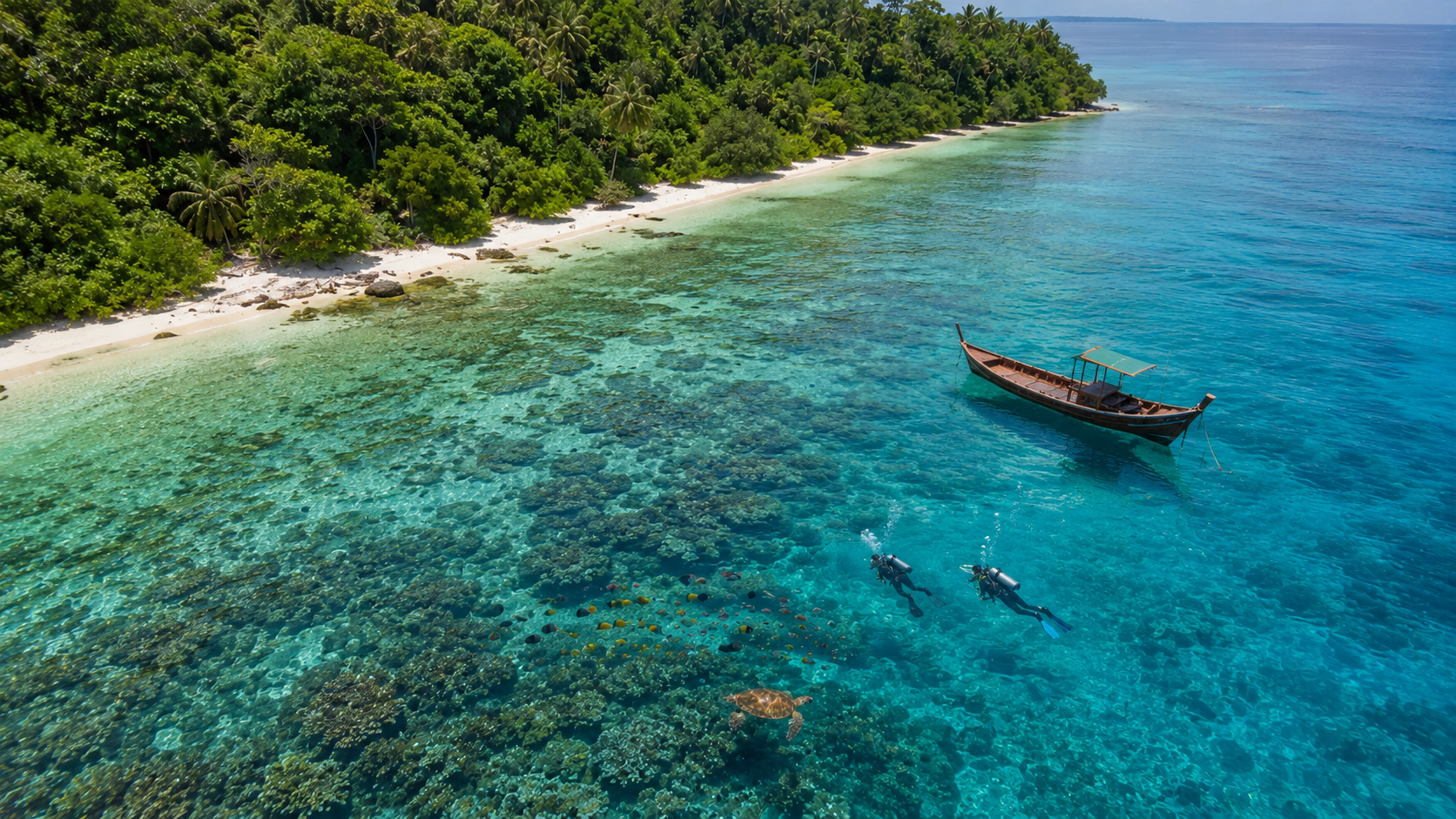
Lucipara is a remote group of small islands and coral atolls in Indonesia’s Banda Sea. It belongs to Maluku Province, a region known for scattered islands, deep ocean waters, and rich marine life. Lucipara is far from major towns and regular tourist routes, making it one of Indonesia’s least-visited island groups.
The area is best known for clear water, coral reefs, sea turtles, sharks, seabirds, and large ocean fish. Its isolated location has helped protect much of its natural environment, although fishing and coral damage remain concerns.
Lucipara at a Glance
Lucipara is commonly called the Lucipara Islands or Kepulauan Lucipara. Other names found in maps and historical records include the Maisel Islands, Lousapara Islands, Lucapin Islands, and Lusipari Islands. Different sources sometimes use Lucipara for the core southern atolls, while broader conservation studies include nearby islands in the Penyu group.
Modern conservation surveys describe Lucipara as seven islands divided between two groups. The Penyu group includes Bingkudu, Kadola, and Mai. The Maisel group includes Maisel, Selatan, Karaungka, and Laponda. All are located in Maluku Province and surrounded by the Banda Sea.
Recent expedition accounts describe the islands as having no established permanent community. However, people with traditional connections to the area may return for fishing, coconut harvesting, lighthouse work, or other temporary activities.
Location and Geography of Lucipara
Lucipara lies in eastern Indonesia, within the Maluku Islands. It sits south of Seram and Ambon, far from the region’s main population centers. The Coral Triangle Center places the islands about 110 nautical miles from Ambon and around 100 nautical miles from the nearest community on Rhun Island.
The group contains low islands, reef flats, shallow lagoons, and coral formations surrounded by much deeper water. In some places, reef edges fall sharply into the open sea. This mix of shallow coral habitat and deep ocean creates suitable conditions for both small reef animals and large traveling species.
The islands’ present shape developed through long periods of coral growth, wave movement, and the collection of sand and broken coral. These natural processes formed narrow beaches, reef platforms, and protected lagoon areas.
The Islands That Form Lucipara
The islands in Lucipara are small compared with Indonesia’s better-known destinations. Some contain sandy beaches, coconut trees, shrubs, and thick coastal plants. Others are little more than low strips of land surrounded by reef.
Mai and Maisel have stronger links to earlier human activity. Families connected to the islands have reportedly returned at times to collect coconuts and use local fishing grounds. Most islands, however, lack normal tourist facilities, roads, shops, fresh-water systems, and permanent accommodation.
This limited development is part of what makes Lucipara special. It also means visitors cannot expect the services available in Bali, Komodo, or Raja Ampat.
Marine Life Around Lucipara
Lucipara’s coral reefs support a wide range of marine life. Divers and researchers have reported reef fish, groupers, coral trout, trevally, barracuda, tuna, Napoleon wrasse, and several types of sharks. Rays and other open-water animals may also pass through the surrounding channels and reef edges.
Sea turtles are among Lucipara’s most important animals. They feed around the reefs and use quiet sandy beaches as nesting areas. Turtle tracks have been observed on some islands, showing the value of these places as breeding habitat.
Sharks are also an important part of the ecosystem. Their presence can indicate that a reef still supports a strong food chain. However, shark sightings are never guaranteed, and visitors should not treat Lucipara like a wildlife park.
Blue whales have been seen during sea journeys near the islands. Dolphins and other whales may also cross the wider Banda Sea, but encounters depend on season, location, and luck.
Birds and Wildlife Above the Water
Lucipara provides resting, feeding, and breeding space for seabirds. Red-footed boobies, frigatebirds, and other ocean birds have been observed around the islands. Some feed over areas where currents bring fish close to the surface, while others use trees and quiet land for nesting.
The land and sea environments are closely connected. Bird droppings add nutrients to island soil, coastal plants hold sand in place, and healthy beaches give turtles space to nest. Damage to one part of this system can affect the rest.
Lucipara’s History and Human Connections
Lucipara has appeared in sailing records for centuries, although written information remains limited. American traveler Edmund Roberts visited the area during the 19th century and recorded the name as “Lucepara” in an account from 1832.
The islands have also been connected to Maluku communities through traditional fishing, sailing, and coconut harvesting. People who once lived on or used Mai and Maisel may continue to hold family or customary claims. These connections should not be ignored simply because the islands appear empty to visitors.
Lucipara forms part of Maluku’s wider maritime heritage. Its story is tied to movement across the Banda Sea, local knowledge of weather and reefs, and the long relationship between island communities and marine resources.
Visiting Lucipara
There is no airport, regular public ferry, or tourist town in Lucipara. Most visitors arrive on organized expedition vessels, research boats, fishing charters, or diving liveaboards. Ambon is a common departure point because it has an airport, port facilities, hotels, and access to the wider Banda Sea.
A direct crossing from Ambon may take around 14 to 15 hours in suitable conditions, although the real travel time depends on the boat, route, waves, and weather. Expeditions may also combine Lucipara with the Banda Islands or other remote destinations.
Accommodation is normally provided aboard the vessel. Travelers should expect changing schedules, limited internet access, basic communications, and few opportunities to buy supplies after departure.
Diving and Snorkeling in Lucipara
The reefs around Lucipara include coral walls, shallow flats, lagoon channels, and steep outer edges. These environments may offer colorful coral, schooling fish, turtles, sharks, and large pelagic species.
Conditions vary between sites. General Banda Sea diving guides report visibility of roughly 15 to 40 meters and water temperatures near 27–29°C during common cruising periods. Currents can be mild at one location and strong at another, especially around channels and exposed reef corners.
Lucipara is best explored with an experienced operator that understands local tides and weather. Divers should carry suitable certification, remain within their training limits, and follow the guide’s instructions. Emergency oxygen, reliable communication equipment, and a clear evacuation plan are essential because professional medical assistance is far away.
Fishing Around Lucipara
The waters around Lucipara attract anglers interested in giant trevally, dogtooth tuna, bluefin trevally, barracuda, grouper, triggerfish, and other strong reef or open-water fish. Methods may include fly-fishing, popping, jigging, trolling, and casting from suitable shallow areas.
Fishing in such an isolated location requires strong equipment, spare parts, sun protection, first-aid supplies, and an experienced crew. Sudden weather changes, sharp coral, powerful fish, and limited rescue support can create serious risks.
Travelers must check current Indonesian regulations, local restrictions, protected zones, and permit requirements before fishing. Catch-and-release methods should be used where suitable, and threatened or protected species must never be targeted.
Best Time to Explore Lucipara
Access to Lucipara depends heavily on monsoon winds and sea conditions. Banda Sea expeditions commonly operate during the calmer periods between major seasonal weather patterns. March and April, followed by September through November, are often considered the most practical windows.
These periods may bring better visibility and safer crossings, but conditions can change quickly. A normal seasonal pattern does not guarantee calm water on a particular day. Travelers should leave extra time in their schedule and accept that captains may alter or cancel a route for safety.
Conservation and Environmental Challenges
Lucipara is ecologically important because its reefs, beaches, deep-water features, and open-ocean location support many connected species. Field observations have recorded strong numbers of sea turtles and sharks, along with coral conditions ranging from damaged to very healthy.
The main concerns include destructive fishing, pressure on large fish, damage to coral, turtle disturbance, and weak enforcement caused by the islands’ remote location. Even a small amount of careless tourism could create lasting harm if anchors, waste, or uncontrolled landings affect sensitive areas.
In March 2026, the Maluku Marine Affairs and Fisheries Department, Coral Triangle Center, and Yayasan Konservasi Alam Nusantara discussed a management roadmap for Lucipara through 2028. The current conservation process includes scientific surveys, stakeholder consultation, institutional planning, and steps toward formal marine protected-area management. Visitors should check the latest official status because zoning and access rules may change.
Responsible Travel in Lucipara
Anyone visiting Lucipara should avoid touching coral, chasing turtles, feeding wildlife, collecting shells, or walking across living reef. Boats should use safe moorings or anchor only in approved sandy areas away from coral.
All rubbish should return with the vessel, including food packaging, batteries, fishing line, and plastics. Visitors should also avoid leaving soap, fuel, or other pollutants in the water.
Traditional claims and local customs deserve respect. A beach that looks unused may still have cultural, family, or economic importance. Responsible operators should communicate with relevant communities and authorities before arranging landings.
Essential Planning and Safety Information
A Lucipara trip requires more preparation than a normal island holiday. Travelers should confirm permits, vessel condition, crew experience, insurance coverage, emergency procedures, and the exact services included in the expedition.
The boat should carry satellite communication, navigation equipment, emergency oxygen for diving, life jackets, first-aid supplies, spare fuel, drinking water, and backup equipment. Passengers should bring personal medicine, sun protection, suitable footwear, seasickness treatment, and enough essential supplies for possible delays.
Independent travel is difficult because there is no regular transport network or reliable support on land. Joining a properly equipped expedition is normally the safest and most practical option.
Common Questions About Lucipara
Is Lucipara permanently inhabited?
Recent expedition reports describe Lucipara as having no stable permanent population. However, earlier records reported a small number of residents, and people with traditional ties may visit for fishing, coconut harvesting, maintenance work, or other temporary activities.
Can tourists visit Lucipara?
Yes, but tourism is limited. Visitors normally reach Lucipara through an organized liveaboard, diving expedition, research vessel, or fishing charter. There are no regular tourist services on the islands.
How long does it take to reach Lucipara?
A boat journey from Ambon may take approximately 14 to 15 hours in suitable conditions. Travel time can be longer when waves, wind, vessel speed, or changes to the planned route affect the crossing.
What makes Lucipara’s marine life special?
Its remote reefs support sea turtles, sharks, Napoleon wrasse, trevally, tuna, seabirds, and many smaller reef species. The surrounding deep water also creates opportunities to see whales, dolphins, and other traveling marine animals.
Is Lucipara suitable for beginner divers?
Some sheltered sites may suit less-experienced divers, but Lucipara as a destination is challenging. Strong currents, open water, deep reef edges, and distance from emergency care make good training and close supervision especially important.
Conclusion
Lucipara is one of Indonesia’s most isolated and environmentally valuable island groups. Its coral atolls, turtle beaches, seabirds, sharks, and deep surrounding waters create a remarkable natural setting. Its history also reflects the close relationship between Maluku communities and the Banda Sea.
Reaching Lucipara requires careful planning, reliable equipment, and respect for local rules. Thoughtful conservation and responsible travel will be essential if these remote islands are to remain healthy for future generations.