
Introduction
Pastorizasyon is a controlled heating process used to make food and drinks safer while keeping their natural qualities as much as possible. The product is heated to a set temperature, held there for a specific time, and usually cooled quickly afterward.
The keyword “pastorizasyon” is commonly used as a simplified spelling of pastörizasyon, the standard Turkish term for pasteurization. Both forms generally refer to the same food-safety process.
Controlled heat helps destroy or reduce harmful microorganisms that may cause illness or spoilage. However, pastorizasyon is not the same as complete sterilization. It does not remove every microorganism, chemical contaminant, or heat-resistant spore. Correct packaging, refrigeration, and handling may still be necessary.
The process is widely associated with milk, but it is also used for juice, liquid eggs, sauces, beer, and other products. Different methods are chosen according to the food, its acidity, and the desired shelf life.
The Purpose of Pastorizasyon in Food Safety
The main purpose of pastorizasyon is to reduce harmful microorganisms to a safer level. Raw foods can become contaminated during production, collection, transport, or processing. Careful heating lowers this risk before the product reaches the consumer.
For example, raw milk may contain germs such as Salmonella, E. coli, Listeria, Campylobacter, and Brucella. Pasteurization is an important public-health measure because it effectively destroys many of these disease-causing organisms. The CDC explains the risks associated with unpasteurized milk.
The process also slows spoilage by reducing yeast, mold, bacteria, and certain enzymes. As a result, products may remain usable for longer. This supports safer storage, transport, and distribution, although the exact shelf life depends on the treatment and packaging.
How the Pastorizasyon Process Works
Preparing the Food or Drink
The product must first be collected, filtered, mixed, or otherwise prepared under clean conditions. Good hygiene matters because heavy contamination can make any heat treatment less reliable.
Heating It to a Controlled Temperature
Special equipment heats the product evenly. The goal is to make sure every part receives enough heat. Uneven heating may leave cold areas where harmful microorganisms can survive.
Maintaining the Required Holding Time
Once the correct temperature is reached, the product stays at that level for a set period. A lower temperature normally requires more time, while a higher temperature may work within seconds.
Rapid Cooling After Treatment
Many pasteurized products are cooled quickly. This helps protect flavor and texture while reducing the chance that surviving microorganisms will multiply.
Hygienic Packaging and Storage
The treated product must be placed in clean, suitable packaging. Poor handling after pastorizasyon can introduce new contamination, so the processing area, containers, and storage conditions all matter.
Time and Temperature: The Essential Balance
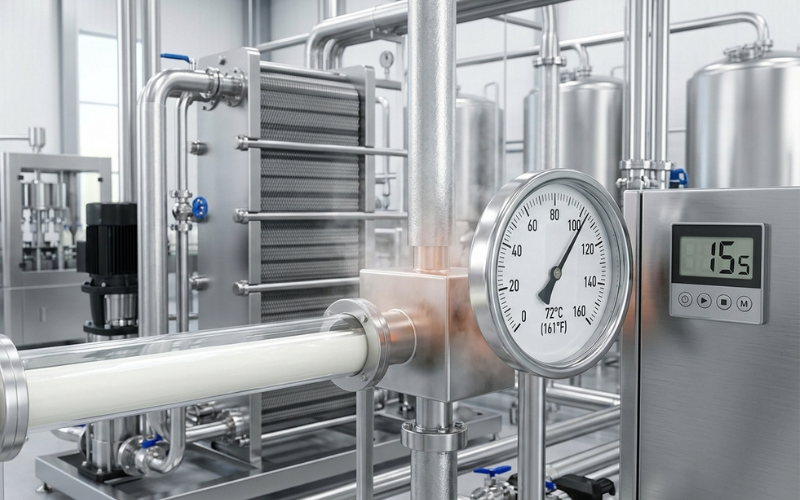
Temperature alone does not show whether pastorizasyon has been successful. Time and temperature must work together. For milk, recognized treatments include heating to about 63°C for 30 minutes or 72°C for 15 seconds. These figures are product-specific standards, not universal instructions for every food. FDA guidance lists approved milk pasteurization time-and-temperature combinations.
The correct treatment can change according to acidity, thickness, composition, and likely microorganisms. Thick sauces may heat differently from milk, while acidic juice has different safety concerns from liquid eggs.
Manufacturers try to apply enough heat for safety without causing unnecessary changes in taste, color, texture, or nutrients. More heat is not automatically better if a shorter, carefully controlled treatment can achieve the required result.
Main Types of Pastorizasyon
Low-Temperature, Long-Time Treatment
Low-temperature, long-time treatment, often called LTLT, uses moderate heat for a longer period. It is commonly performed in a tank or batch system and may be suitable for smaller production volumes.
High-Temperature, Short-Time Treatment
HTST uses higher heat for a much shorter period. The product normally moves through a continuous system that heats, holds, and cools it rapidly. This method is widely used for commercial milk because it allows efficient processing while limiting quality changes.
Ultra-Pasteurization
Ultra-pasteurization uses a higher temperature for a very short time. It can provide a longer refrigerated shelf life when combined with clean processing and suitable packaging.
Batch and Continuous Processing
In batch pastorizasyon, a fixed amount of product is treated together in one container. In continuous processing, the product flows through heating and cooling equipment without stopping. Both methods can be effective when the correct controls are followed.
Foods and Drinks Commonly Treated with Pastorizasyon
Milk and dairy products are the best-known examples, but pastorizasyon has many other applications. Cream, some cheese ingredients, ice-cream mixes, and other dairy products may receive heat treatment during production.
Most commercially sold juice is pasteurized or treated through another approved process to control harmful bacteria. The FDA advises consumers to check whether juice has been pasteurized or otherwise treated for safety.
Liquid, frozen, and dried egg products may also be pasteurized. In the United States, egg products distributed for consumption must receive pasteurization treatment. USDA guidance explains how pasteurized egg products are processed.
Pastorizasyon Compared with Similar Heat Treatments
Pastorizasyon vs Boiling
Boiling heats a liquid to its boiling point and may noticeably change its taste, texture, or appearance. Pastorizasyon usually uses a lower or more carefully controlled temperature and does not aim to boil the product.
Pastorizasyon vs Sterilization
Sterilization is designed to destroy a much wider range of microorganisms, including resistant forms. Pastorizasyon is milder and does not make food completely sterile.
Pastorizasyon vs UHT Processing
UHT, or ultra-high-temperature processing, uses very high heat for a few seconds and is usually combined with sterile packaging. An unopened UHT product may remain safe at room temperature for months. Ordinary pasteurized milk normally requires refrigeration.
Pastorizasyon vs Homogenization
Homogenization does not mainly control microorganisms. It breaks large fat droplets into smaller ones so they remain evenly mixed. Milk can be both homogenized and pasteurized, but the two processes serve different purposes.
How Pastorizasyon Affects Food Quality
Because pastorizasyon uses heat, small changes in flavor, aroma, color, or texture are possible. The amount of change depends on the product and the processing method. A short high-temperature treatment may affect a food differently from a longer low-temperature treatment.
Some heat-sensitive nutrients can decrease slightly, but pasteurization does not remove the overall nutritional value of food. According to the FDA, research shows no meaningful nutritional difference between pasteurized and unpasteurized milk. The FDA addresses milk nutrition and pasteurization in its raw-milk guidance.
What Pastorizasyon Does Not Remove
Pastorizasyon does not eliminate every microorganism or bacterial spore. It also cannot correct all problems caused by spoiled ingredients, poor sanitation, or unsafe storage.
Some chemical hazards may remain after heating. For example, pasteurizing contaminated apple juice may control living bacteria but does not necessarily remove heat-stable toxins. This is why producers must begin with suitable ingredients and follow good hygiene throughout production.
Products can also become contaminated again after treatment. A damaged container, dirty filling equipment, or careless handling may introduce new microorganisms.
Refrigeration and Shelf Life After Pastorizasyon
Many pasteurized foods still require refrigeration because some microorganisms can survive the process or enter the product later. Low temperatures slow their growth.
Sealed packaging protects the product until it is opened. After opening, contact with air, utensils, hands, and surrounding surfaces increases the chance of contamination. Consumers should follow the label’s refrigeration and use-by instructions.
Warning signs may include an unusual odor, swelling, leaking, curdling, mold, or an unexpected change in color or texture. However, harmful germs do not always change a food’s appearance or smell. When safety is uncertain, the product should not be tasted.
Industrial and Home Pastorizasyon
Commercial pastorizasyon systems use accurate temperature controls, timers, flow monitors, and testing procedures. Equipment is designed to heat the entire product evenly and prevent untreated food from mixing with treated food.
Home processing is more difficult because household equipment may not maintain a precise temperature. Different foods also require different treatments. A method intended for milk cannot automatically be used for juice, sauces, or canned vegetables.
Anyone preserving food at home should follow a tested recipe from a trusted food-safety authority. The National Center for Home Food Preservation provides research-based guidance for home preservation methods.
Conclusion
Pastorizasyon is a carefully controlled heat treatment that improves food safety and helps delay spoilage without fully cooking or sterilizing the product. Its success depends on the right combination of time, temperature, rapid cooling, clean packaging, and proper storage. Although the process offers major safety benefits, it cannot replace good hygiene, refrigeration, or responsible food handling.
FAQs
1. Does pastorizasyon kill all bacteria?
No. It is designed to destroy or reduce important harmful microorganisms, but some resistant organisms and spores may survive.
2. Is pasteurized food fully sterile?
No. Pasteurized food is not the same as sterilized food. Many pasteurized products still require refrigeration and careful handling.
3. Does pastorizasyon reduce nutritional value?
It may cause small changes in certain heat-sensitive nutrients, but the overall nutritional effect is generally limited. The exact result depends on the food and treatment.
4. Why does pasteurized milk still need refrigeration?
Ordinary pasteurization does not remove every microorganism. Refrigeration slows the growth of organisms that survive or enter after processing.
5. Can pastorizasyon be performed at home?
Some products can be treated at home, but only with a tested method, accurate temperature control, clean equipment, and reliable food-safety guidance.