
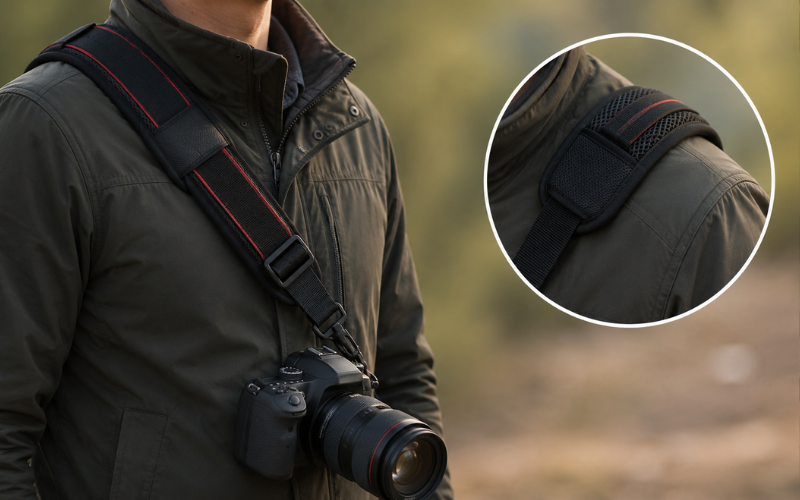
The Canon ER-L1 camera strap is a neck and shoulder strap made for carrying a Canon camera securely. It was introduced for the Canon EOS R3, but its traditional lug-based design may also work with other camera bodies that have suitable mounts. Canon describes it as a compact strap designed for mirrorless camera bodies. Canon’s official ER-L1 product page provides the basic product positioning.
Unlike a wrist strap, the ER-L1 can leave both hands available when needed. It can be worn around the neck or over one shoulder, with an adjustable length for a better carrying position.
The ER-L1 does not include quick-release clips or thick padding. This guide explains its design, compatibility, comfort, installation, maintenance, and practical limits.
Canon ER-L1 Design and Key Features
The Canon ER-L1 has a black body with red details and visible Canon branding. It does not display a specific camera model name, so it can look natural on another compatible Canon body.
The main strap is about 1.38 inches, or 3.51 centimeters, wide. Its adjustable length lets the user raise or lower the camera. Narrower sections connect it to the camera’s two lugs; B&H lists these ends as 3/8 inch wide. The detailed ER-L1 specifications confirm that it is an adjustable neck or shoulder strap.
Its flexible woven material folds easily into a camera bag, but it has no thick padding or quick-release system. Removal requires unthreading the ends from the camera lugs.
Camera Compatibility and Fit
The Canon ER-L1 camera strap was designed for the Canon EOS R3, but many Canon EOS bodies have similar lugs. If its narrow ends pass through those lugs and sit securely in the adjusters, the strap may fit.
Check compatibility before buying. Some compact cameras use small eyelets that require thin cords or metal rings. Review the camera manual and compare the current strap’s attachment end with the ER-L1.
Retailer guidance lists some models beyond the EOS R3, including the EOS R8 and EOS 6D Mark II. Still, perform a physical fit check. Never force the strap through a lug.
Comfort During Everyday Use
Comfort depends on the camera, lens, strap length, and clothing. The ER-L1’s 1.38-inch width offers more contact area than a thin cord, but its lack of thick padding can become noticeable with heavy equipment.
Its simple shape adds little bulk and may feel convenient during short sessions. Over a long day, changing the carrying position and taking breaks can reduce repeated pressure.
A smooth jacket may allow the strap to slide, while textured clothing can provide grip. Keeping the camera close reduces swinging, but setting it too high can limit movement.
How to Attach the Canon ER-L1 Correctly
Correct attachment is essential because the strap supports the camera’s weight. Place the camera on a stable surface and make sure the strap is not twisted.
Feed one end through the camera lug, guide it through the retaining piece, and return it through the adjuster as shown in the camera manual. Repeat on the other side. Each loose end should sit flat and remain firmly held. Canon’s strap attachment instructions provide general guidance, but owners should follow the manual for their exact model.
Adjusting the Strap for a Better Carrying Position
A useful length keeps the camera easy to reach without excessive swinging. Start around the upper stomach or lower chest, then adjust both sides evenly.
Neck carrying offers quick access but can create pressure. Shoulder carrying may feel more relaxed, although the strap can slip. Cross-body comfort depends on strap length and body size.
For travel, a shorter setting usually improves control. A longer position may help when wearing a thick coat. Hold the camera when moving through crowds, climbing stairs, or leaning forward.
Real-World Performance and Durability
The ER-L1’s simple design suits normal indoor and outdoor photography. Once correctly threaded, the camera remains connected through its webbing and adjusters.
Regular checks remain important. Look for thinning, frayed edges, loose stitching, cuts, or damaged adjusters, especially near the attachment points.
A heavy lens can make the camera tilt forward and feel less balanced. For large lenses or long sessions, a padded strap or harness may provide better support. Consider the complete equipment weight, not the camera body alone.
Canon ER-L1 Compared With Other Camera Straps
Compared with many standard manufacturer straps, the Canon ER-L1 remains familiar and uncomplicated. It uses traditional camera lugs, has an adjustable length, and folds easily for storage. Its Canon colors and branding may appeal to owners who want an accessory that visually matches their EOS equipment.
Padded straps can provide better pressure relief with heavy gear, but they are usually bulkier. Quick-release straps are easier to remove when placing a camera on a tripod or video rig, yet their connectors add extra parts that must be checked. Wrist straps are smaller and less noticeable, but they do not allow hands-free shoulder or neck carrying.
The ER-L1 is therefore best viewed as a simple general-use option rather than a solution for every photographer. Someone who changes straps often, carries two cameras, hikes for hours, or uses a large telephoto lens may benefit from a different design. Someone who wants a compact, branded strap with no detachable connection points may prefer the ER-L1.
Cleaning, Storage, and Basic Maintenance
Light dust can usually be removed with a clean, dry cloth or soft brush. For marks caused by sweat or normal handling, gently wipe the affected area with a slightly damp cloth. Avoid strong cleaners, bleach, and harsh scrubbing because they may weaken the material or affect its color.
If the strap becomes wet, let it dry fully in a ventilated place before storing it. Keep it away from direct high heat, which may damage the webbing or plastic adjusters. Do not pack a damp strap tightly against the camera, as trapped moisture can affect both the strap and nearby equipment.
Store the strap loosely rather than folding the attachment ends sharply. Inspect it before important shoots and after rough travel. Replace it if the webbing is badly frayed, the adjusters are cracked, the stitching is opening, or either end begins to slip after correct threading.
Who the Canon ER-L1 Camera Strap Is Best For
The Canon ER-L1 camera strap suits EOS owners who want a simple neck and shoulder strap with official Canon styling. It is a natural match for the EOS R3 and may be useful with other EOS bodies that have compatible lugs. Its compact form also makes sense for photographers who dislike thick padding or large quick-release parts.
It may be less suitable for people who need fast strap removal, extra cushioning, or a very long cross-body fit. Photographers carrying heavy lenses for extended periods may find a wider padded strap or harness more comfortable. Buyers should think about how long they carry their camera, what lens they normally use, and whether they regularly switch between handheld, tripod, and video setups.
What to Check Before Buying
The ER-L1’s manufacturer product number is 4898C001, which is useful when comparing listings. Check that the seller names the exact model rather than using a general description such as “Canon camera strap.” Product photographs should show the correct black-and-red design, Canon branding, adjusters, and narrow attachment ends.
When buying used, look closely for fraying, stains, stretched sections, damaged adjusters, and loose stitching. Confirm what is included, because the standard package contains the strap itself rather than extra quick-release connectors.
Availability requires special attention. As of July 2026, Canon U.S.A. marks the ER-L1 as discontinued, while B&H lists it as temporarily out of stock at about $30. These details can change, and remaining stock may still appear through authorized dealers or used-equipment sellers. Compare the final price, shipping cost, seller reputation, and return policy before ordering. A low price is not useful if the strap is worn, incorrectly identified, or incompatible with the camera.
Final Thoughts
The Canon ER-L1 camera strap is a compact, traditional carrying option built around an adjustable length and secure lug attachment. Its main strengths are simplicity, recognizable Canon styling, and easy storage. Its main limits are the lack of quick-release connectors and substantial padding.
For an EOS R3 owner—or another Canon user with compatible strap lugs—the ER-L1 can be a practical choice for normal photography. Comfort will depend on the full camera setup and how long it is carried. Checking compatibility, attaching both ends correctly, and inspecting the strap regularly are more important than branding alone. The right strap is ultimately the one that keeps the camera secure while fitting the photographer’s body, equipment, and everyday routine.
FAQs
1. Is the Canon ER-L1 camera strap made only for the EOS R3?
The ER-L1 was designed for the Canon EOS R3, but it may fit other Canon cameras with compatible strap lugs. Retailer guidance lists models such as the EOS R8 and EOS 6D Mark II as compatible. Always compare the camera’s mounting points with the strap ends before attaching it.
2. Does the Canon ER-L1 have a quick-release system?
No. The Canon ER-L1 uses traditional webbing that threads through the camera’s lugs and strap adjusters. Removing it takes longer than removing a quick-release strap, but there are no detachable clips between the strap and camera.
3. How wide is the Canon ER-L1 camera strap?
The main strap is approximately 1.38 inches, or 3.51 centimeters, wide. This provides a reasonable contact area while keeping the strap compact enough to fold into a camera bag.
4. Can the Canon ER-L1 be worn across the body?
Cross-body use may be possible, but comfort depends on the adjusted length, the user’s body size, and clothing. Test the position with the camera over a soft surface before relying on it outdoors. If the strap feels too short or restricts movement, use a longer cross-body model.
5. Is the Canon ER-L1 camera strap discontinued?
Canon U.S.A. currently lists the ER-L1 as discontinued. However, some camera retailers may still have remaining inventory or expect limited stock, and used straps may be available. Check the exact product number, condition, seller, and return policy before buying.