
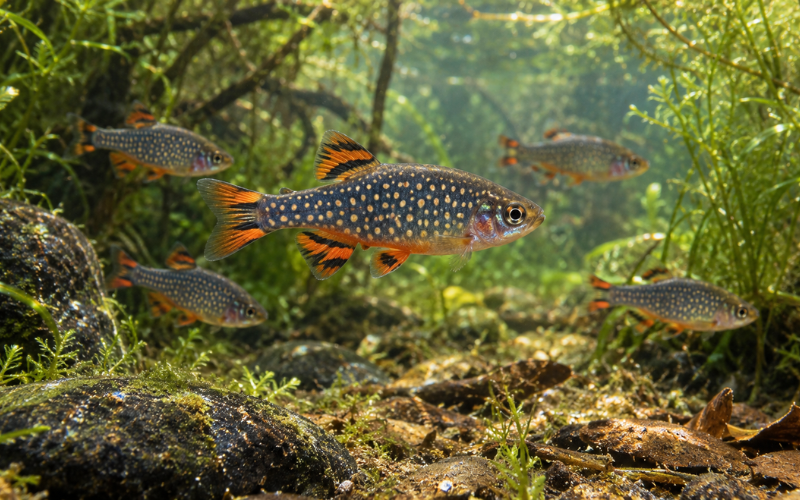
Celestichthys is a scientific name closely connected with one of the most colorful small freshwater fish in the aquarium hobby. The fish was originally described as Celestichthys margaritatus, but it is now widely classified as Danio margaritatus. Most people know it as the celestial pearl danio or galaxy rasbora.
The older name still appears in aquarium shops, care guides, scientific records, and online discussions. This can make it seem as if several different fish are being discussed. In most cases, however, these names refer to the same species.
Understanding Celestichthys requires a look at its name, scientific history, appearance, natural habitat, behavior, and care. It also provides a useful example of how fish classifications can change when researchers examine new physical and genetic evidence.
What Celestichthys Means
The name Celestichthys combines words associated with “heavenly” and “fish.” It is therefore often translated as “heavenly fish.” The name suits the animal’s dark body, pale pearl-like spots, and bright red-orange fins.
The complete original name, Celestichthys margaritatus, can be understood as “heavenly fish adorned with pearls.” The species name margaritatus refers to the small light spots covering its sides.
Celestichthys is commonly pronounced approximately as “seh-LES-tik-this.” Pronunciation may vary slightly because it is a scientific name built from classical word roots.
The word is spelled Celestichthys, with “ichthys” at the end. That ending comes from the Greek word for fish. Although the genus name has a complicated taxonomic history, it remains strongly associated with the celestial pearl danio.
The Discovery of Celestichthys margaritatus
The fish became known to the wider aquarium community after its discovery in Myanmar in 2006. It was found near Hopong, east of Taunggyi, in shallow freshwater pools at an elevation of roughly 1,040 meters.
Its unusual pattern immediately attracted attention. Males displayed a dark blue body covered with pale spots, along with bold red and black markings on their fins. Photographs spread quickly among fishkeepers, and specimens soon entered the international aquarium trade.
Before receiving a formal scientific name, the fish was commonly called the galaxy rasbora or galaxy microrasbora. These names reflected its star-like markings and its assumed relationship with small rasboras.
In 2007, ichthyologist Tyson R. Roberts formally described it as a new genus and species, Celestichthys margaritatus. The original scientific description documented its body shape, coloration, fin structure, jaw features, and native locality.
Why the Scientific Name Changed
When the species was first studied, its combination of features appeared distinctive enough to justify a new genus. That is why Roberts placed it in Celestichthys instead of an existing group.
Further research soon challenged this decision. In 2008, Kevin Conway, Wei-Jen Chen, and Richard Mayden examined both physical structures and molecular evidence. Their study published in Zootaxa concluded that the celestial pearl danio belonged within the genus Danio.
As a result, Celestichthys margaritatus became Danio margaritatus. Parentheses were added around the original author’s name in the formal citation—Danio margaritatus (Roberts, 2007)—to show that the species had been moved to a different genus.
The California Academy of Sciences’ Catalog of Fishes currently treats Danio margaritatus as the accepted combination. However, Celestichthys continues to appear because it was the original published genus and remains familiar within the aquarium trade.
Celestichthys, Danio, and Galaxy Rasbora Compared
Celestichthys margaritatus is the fish’s original scientific name, while Danio margaritatus is its widely accepted current name. Celestial pearl danio and galaxy rasbora are common names rather than formal scientific classifications.
These four names usually identify the same species. A shop may advertise a galaxy rasbora, while a modern fish database lists Danio margaritatus. An older book may instead use Celestichthys margaritatus.
The name galaxy rasbora can be misleading because later evidence placed the species among danios, not true rasboras. However, familiar trade names often remain in use long after scientific classifications change.
The related fish now commonly called Danio erythromicron has also been placed in Celestichthys by some authors. Its changing placement reflects wider disagreements about how closely related miniature danios should be grouped. Readers should therefore check which taxonomic system a source follows.
Appearance and Distinctive Features
Celestichthys is a remarkably small fish. Adults are generally around 2 to 2.5 centimeters long, although measurements can differ depending on whether total length or standard body length is used.
The body is compact, with a short snout and rounded profile. Pale cream or golden spots cover the darker sides, creating the pearl-like pattern behind the common name. The unpaired fins carry striking bands of red or orange and black.
Adult males are usually more intensely colored. Their bodies can appear deep blue, and their fin markings become especially vivid during displays. Females tend to have a softer blue-green or bronze tone, paler fins, and a fuller abdomen. Mature females may also show a small dark marking near the anal opening.
Young fish are less dramatic. Their colors and spotted pattern become clearer as they mature. Stress, poor nutrition, unsuitable surroundings, or illness may also cause an adult’s colors to fade.
Natural Habitat and Geographic Range
The original Celestichthys specimens came from pools near Hopong in Myanmar’s Shan State. These waters belong to the Salween, or Thanlwin, river system. Later reports suggested a wider regional distribution, including additional areas of Myanmar and possibly nearby northern Thailand.
Its natural environment is different from the fast-flowing rivers many people imagine when they hear the name danio. The species lives in very shallow ponds, wetlands, and spring-fed waters. FishBase describes habitats that may be only about 30 centimeters deep.
Aquatic vegetation is a major feature of these waters. Dense plants provide cover, feeding areas, territorial boundaries, and places where eggs can be deposited. The highland location also means the water can be cooler than a typical tropical aquarium.
The fish shares its environment with only a limited selection of other species. This helps explain why it may struggle when housed with large, aggressive, or highly active aquarium fish.
Behavior and Social Life
Celestichthys is peaceful, but it is not completely inactive or defenseless. Males regularly display to one another by spreading their fins and showing their strongest colors. Short chases may occur, particularly when females or desirable areas of vegetation are nearby.
These interactions are usually harmless when the aquarium provides enough room, plants, and visual barriers. In a cramped or bare tank, weaker fish may be unable to avoid repeated attention.
The species should be kept in a group. Groups help the fish feel secure and encourage more natural behavior. They may hide when first introduced, but patient observation often reveals active swimming, feeding, courtship, and male displays.
Dense planting makes the fish more confident. Floating or tall plants can soften the light, while fine-leaved growth creates shelter without blocking all open swimming space.
Diet and Feeding Habits
In nature, this small fish feeds on tiny foods available among plants and in shallow water. Its diet likely includes small aquatic invertebrates, insect larvae, worms, crustaceans, and other microscopic organisms.
Captive fish can eat fine flakes, small granules, or micro-pellets designed for tiny freshwater species. Frozen or live foods such as baby brine shrimp, small daphnia, cyclops, and microworms can add useful variety and may encourage breeding behavior.
Food must be small enough to fit into the fish’s tiny mouth. Several modest feedings are generally better than one oversized meal. Excess food should not be allowed to collect because it can quickly reduce water quality.
A varied diet supports healthy growth, stronger colors, and reproductive condition. Feeding only one dry food may be convenient, but it does not always provide the best long-term results.
Reproduction and Life Cycle
Celestichthys is an egg-laying fish. During courtship, a male displays near plants and encourages a receptive female into a suitable spawning area. The pair deposits a small number of eggs among fine leaves, moss, or similar material.
The adults do not provide parental care. They may eat eggs or newly hatched young, so breeders often use dense plants, spawning mops, mesh, or a separate breeding aquarium to protect them.
Hatching time depends on temperature and other conditions. The newly hatched larvae are extremely small and remain difficult to see at first. Once they begin swimming freely, they require microscopic foods before they can handle larger options such as newly hatched brine shrimp.
Keeping Celestichthys in an Aquarium
A mature, densely planted aquarium is the best starting point. For a modest group, a tank with a footprint of around 45 by 30 centimeters is a sensible minimum. More room is helpful for larger groups and allows males to establish display areas.
Keep at least eight to ten fish when possible. A larger group can improve confidence and spread male attention more evenly. Avoid placing them in bowls or very small containers where temperature and water quality change quickly.
A temperature of approximately 20–26°C suits most captive fish, although sudden changes should be avoided. Slightly acidic to mildly alkaline water can work if it remains clean and stable. The needs of the stock should also be discussed with the breeder or seller because captive populations may be raised under different conditions.
Use gentle filtration, since these fish come from calm or slowly moving waters. Plants, subdued lighting, and darker substrate can help them feel secure. Suitable companions include other peaceful fish of a similar size that do not compete too aggressively for food.
Health and Common Care Problems
Healthy fish should feed readily, swim normally, and show clear body patterns. Warning signs can include faded color, closed fins, rapid breathing, unusual hiding, weight loss, spots on the skin, or refusal to eat.
Poor water quality is a common source of trouble. Ammonia and nitrite should remain at zero, while waste and uneaten food should be controlled through maintenance. Rapid changes in temperature or water chemistry can cause stress even when the final reading appears acceptable.
Aggressive tank mates may prevent these small fish from feeding. Larger or faster species can also keep them hidden for long periods. A peaceful community and several feeding areas help reduce competition.
New fish should be quarantined when possible. Observation before introduction can reduce the chance of parasites or infections spreading through an established aquarium.
Conservation and the Aquarium Trade
The rapid popularity of Celestichthys created early concern about heavy collection from a seemingly restricted habitat. Initial reports led many fishkeepers to fear that wild populations could be damaged before scientists fully understood the species.
Later surveys found the fish in more locations than first believed, and successful commercial breeding reduced some demand for wild-caught specimens. This was encouraging, but it did not remove every conservation concern.
Wetland drainage, pollution, land development, and changes to spring-fed habitats can threaten small freshwater species. Reliable information about population size and long-term trends remains limited, so confident claims that the fish is either critically rare or completely secure should be treated carefully.
Buyers can support responsible trade by choosing healthy captive-bred fish from sellers who can explain their source. Captive breeding also makes aquarium populations easier to maintain without unnecessary pressure on natural habitats.
Common Misunderstandings About Celestichthys
The most common misunderstanding is that Celestichthys and the celestial pearl danio are unrelated. Celestichthys is actually part of the species’ scientific history, even though Danio margaritatus is now more widely accepted.
Another mistake is assuming that “galaxy rasbora” proves the fish is a true rasbora. It does not. The name was created before its relationships were clearly understood and survived because aquarists already recognized it.
Small size also does not mean the species can live comfortably in an unfiltered bowl. It still needs stable water, social companions, swimming room, cover, and proper maintenance.
Finally, Celestichthys is neither impossibly delicate nor suitable for careless treatment. It can thrive under attentive care, but its small size makes it vulnerable to unstable conditions, oversized food, and unsuitable tank mates.
Conclusion
Celestichthys is best understood as both a scientific name and part of the history of the celestial pearl danio. The fish was introduced to science as Celestichthys margaritatus, but later research led to its widely accepted placement as Danio margaritatus.
Whatever name appears on a label, this is the same tiny, pearl-spotted freshwater fish admired for its color and fascinating behavior. Recognizing its different names prevents confusion, while understanding its natural habitat and social needs helps fishkeepers provide responsible, suitable care.
FAQs
1. Is Celestichthys the same as the celestial pearl danio?
In most aquarium discussions, yes. Celestichthys margaritatus was the original scientific name of the fish now widely called Danio margaritatus. Celestial pearl danio and galaxy rasbora are its best-known common names.
2. Is Celestichthys still an accepted genus?
Its status depends partly on the taxonomic reference being followed. Major modern fish catalogs place the celestial pearl danio in Danio. Celestichthys remains important as the original genus name and may still appear in older publications, commercial listings, and alternative classifications.
3. How large does a Celestichthys fish grow?
An adult celestial pearl danio usually reaches about 2 to 2.5 centimeters. Its tiny size means it needs appropriately small food and peaceful companions that will not chase, injure, or swallow it.
4. How many Celestichthys should be kept together?
A group of at least eight to ten is a practical starting point. Larger groups can produce more natural social behavior, provided the aquarium has enough room, vegetation, and feeding space.
5. Is Celestichthys suitable for beginners?
It can be suitable for a careful beginner who has a mature, stable aquarium. It is less appropriate for a newly set-up tank or an unfiltered bowl. Consistent water quality, gentle filtration, suitable food, and compatible tank mates are essential.