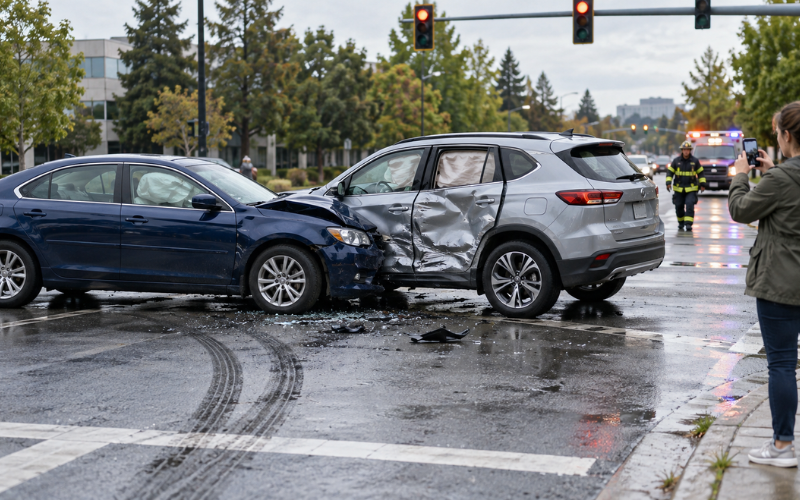
Being T boned means another vehicle has crashed into the side of your vehicle, usually at or near a right angle. The damage often creates a “T” shape, which gives this type of collision its name. It is also known as a side-impact or broadside accident.
A T-bone crash can be especially serious because a vehicle’s doors and side panels provide less space between the impact and the people inside than the front or rear of the car. If you have been T-boned, knowing what to do can help protect your health, document the accident, and make the insurance process easier.
What Does T-Boned Mean?
A vehicle is T-boned when the front of one vehicle strikes the side of another. One vehicle forms the top of the letter “T,” while the other forms its stem.
These accidents commonly happen at intersections, parking-lot exits, driveways, and road junctions. A typical example involves one driver entering an intersection while another driver fails to stop or yield. The National Highway Traffic Safety Administration uses a similar intersection collision in its official side-impact safety test scenario.
How T-Bone Accidents Commonly Happen
Many T-bone accidents involve a mistake about who has the right of way. A driver may run a red light, pass through a stop sign, or enter an intersection before it is clear. Someone making a left turn may also cross the path of an approaching vehicle.
Distraction is another common factor. A driver looking at a phone, navigation screen, passenger, or roadside object may fail to notice a traffic signal. Speed can make the situation worse by reducing the time available to stop and increasing the force of the impact.
Alcohol, drugs, tiredness, poor visibility, and unsafe turns may also contribute. Rain, fog, ice, damaged signs, or a broken traffic light can make an intersection harder to judge. However, poor conditions do not remove a driver’s duty to travel carefully.
Why Side-Impact Crashes Can Be Dangerous
The front and rear of a vehicle contain larger areas designed to absorb crash energy. On the side, only a door, window, pillar, and some safety equipment separate an occupant from the striking vehicle.
A direct hit to the driver’s door can place the driver close to the point of impact. A passenger-side collision may put front or rear passengers at greater risk. The outcome depends on many factors, including speed, vehicle size, impact angle, seat position, seat-belt use, and whether side airbags deploy.
A large SUV or truck may strike higher on a smaller car’s body. A hard side impact can also push the vehicle into another object or cause it to spin, leave the road, or roll over.
Common Injuries After Being T-Boned
A T-bone collision can affect several parts of the body. Head and brain injuries may occur when an occupant hits a window, door, pillar, airbag, or another object. Neck and back injuries can result from the body moving sharply sideways.
Other possible injuries include broken ribs, shoulder injuries, pelvic or hip damage, leg injuries, cuts, bruises, and internal injuries. The person sitting closest to the impact may face the greatest force, but anyone in the vehicle can be hurt.
Some symptoms do not appear immediately. Adrenaline and shock may hide pain during the first hours after a crash. Headache, dizziness, nausea, confusion, unusual tiredness, or trouble concentrating can be signs of a concussion.
Seek emergency help for severe bleeding, breathing difficulty, loss of consciousness, worsening pain, repeated vomiting, seizures, slurred speech, weakness, numbness, or increasing confusion. The CDC’s concussion guidance advises prompt medical attention for these warning signs. A healthcare professional should evaluate concerning or persistent symptoms.
What to Do Immediately After a T-Bone Accident
Safety comes first after being T-boned. Try to remain calm and take the following steps when you can do so safely:
- Check yourself and your passengers for injuries. Do not move a seriously injured person unless there is an immediate danger, such as fire.
- Call the local emergency number. Request medical help when anyone may be injured and ask for police assistance when required.
- Move to a safer position if the vehicle can be driven and local rules allow it. Turn on the hazard lights and stay away from moving traffic.
- Exchange names, contact details, vehicle registration information, driver’s licence details, and insurance information with the other driver.
- Describe events honestly, but do not argue, guess, or accept blame at the scene. A full investigation may reveal facts that were not immediately visible.
Follow any instructions given by emergency workers or police officers. If you receive medical advice, keep copies of your discharge papers and follow-up instructions.
Evidence to Collect at the Accident Scene
Good records can help explain how the collision happened. If your condition allows, photograph the damage to every vehicle, their positions, licence plates, traffic signals, road signs, lane markings, skid marks, debris, and nearby obstructions. Wide photographs can show the entire intersection, while close images can capture specific damage.
Record the date, time, exact location, weather, and road conditions. Ask witnesses for their names and contact details, but do not pressure them to take sides. If police attend, note the officer’s name, badge number, report number, and instructions for obtaining the report.
Preserve dashcam footage quickly because some devices automatically overwrite old recordings. Afterward, save repair estimates, towing bills, medical records, receipts, wage information, and all communication with insurers.
How Fault Is Determined in a T-Bone Collision
The position of the damage alone does not decide fault. Investigators and insurers may examine traffic signals, stop signs, right-of-way rules, vehicle locations, damage patterns, witness accounts, and statements from both drivers.
Video from traffic cameras, security systems, or dashcams may show which vehicle entered the intersection first or whether someone ignored a signal. A police report can contain useful observations and citations, although its role in an insurance claim or court case depends on local law.
Sometimes the evidence points clearly to one driver. In other cases, responsibility may be shared. For example, one driver may have made an unsafe turn while the other was travelling too fast.
Fault rules differ by country, state, and province. In the United States, comparative-negligence rules can reduce compensation according to each person’s share of responsibility, while some places follow different systems. Cornell Law School’s overview explains that the exact approach varies between states.
Insurance Claims After a T-Bone Accident
Report the crash to your insurer promptly, even if you believe the other driver caused it. Provide accurate facts, photographs, contact information, and the police report number when available. Review your policy so you understand its coverage, exclusions, limits, and deductible.
An adjuster may inspect the vehicles, interview those involved, review medical and repair records, and consider the available evidence before deciding what the policy covers. Depending on the circumstances, a claim may include vehicle repairs, towing, a rental vehicle, medical costs, lost income, or other covered losses.
Keep notes of every conversation and ask for important decisions in writing. Read any release or settlement offer carefully before accepting it. The National Association of Insurance Commissioners recommends filing promptly and keeping track of communications with the adjuster in its consumer guide to auto claims.
When Legal Guidance May Be Helpful
Legal advice may be useful when a T-bone accident causes a serious injury, death, long-term health problem, large financial loss, or disagreement about fault. It may also help when the other driver has no insurance, several vehicles are involved, or the crash concerns a commercial truck, rideshare vehicle, or government-owned vehicle.
Deadlines for insurance notices and legal claims differ by jurisdiction. Some can be shorter when a public agency is involved. If you speak with a qualified local lawyer, bring the police report, photographs, medical documents, insurance letters, repair records, receipts, and a timeline of events.
Vehicle Damage and Safety After the Crash
A T-boned vehicle may have crushed doors, broken windows, damaged pillars, bent wheels, or deployed airbags. Damage can also extend beneath the visible surface to the frame, suspension, wiring, sensors, battery system, or seat-belt parts.
Do not assume the vehicle is safe because it still starts. Have it inspected by a qualified repair professional. If the structure cannot be repaired safely, or the repair cost is too high compared with the vehicle’s value, the insurer may declare it a total loss. The exact decision depends on the damage, vehicle value, insurance policy, and local rules.
Reducing the Risk of Being T-Boned
Approach intersections at a safe speed and look in both directions, even when you have a green light or the right of way. Pause long enough to notice a vehicle that may not stop. Avoid rushing through yellow lights or turning across traffic when the available gap is uncertain.
Keep windows, mirrors, lights, brakes, and tyres in good condition. Put phones and other distractions away before driving. Everyone should wear the correct seat belt, and children should use an age- and size-appropriate child restraint.
When choosing a vehicle, compare official side-crash ratings as well as overall ratings. Side airbags and other safety systems can help, but no feature makes careless driving safe.
Conclusion
Being T-boned can leave you dealing with injuries, vehicle damage, insurance questions, and uncertainty about fault. Focus first on safety and medical needs, then document the scene and report the crash promptly. Avoid making assumptions before the evidence has been reviewed.
FAQs
1. Is a T-bone accident always the other driver’s fault?
No. Either driver may be fully or partly responsible. Fault depends on right-of-way rules and evidence such as signals, witness accounts, video, vehicle damage, and driver behaviour. The fact that one vehicle was hit on its side does not settle the issue by itself.
2. Should I seek medical care if I do not feel pain immediately?
Consider a medical evaluation after a forceful collision, particularly if your head was struck or you develop pain, dizziness, nausea, confusion, weakness, or unusual tiredness. Some symptoms can appear later. Seek emergency assistance for severe or worsening symptoms.
3. Can dashcam footage help establish what happened?
Yes. Dashcam footage may show the traffic signal, vehicle speed, direction of travel, timing, or actions taken before impact. Save the original file as soon as possible, keep an unedited copy, and provide it to the insurer or appropriate authority when requested.
4. What happens if both drivers dispute the traffic signal?
Investigators may review witness statements, camera footage, vehicle damage, road evidence, electronic data, and each driver’s account. If the evidence remains unclear, the insurer or court may assign shared fault according to the law that applies in that location.
5. How long does a T-bone accident claim take?
There is no standard timeline. A simple property-damage claim may move faster than one involving serious injuries, unclear fault, several insurers, or ongoing medical treatment. Prompt reporting and complete records can reduce avoidable delays, but they cannot guarantee a particular completion date.