
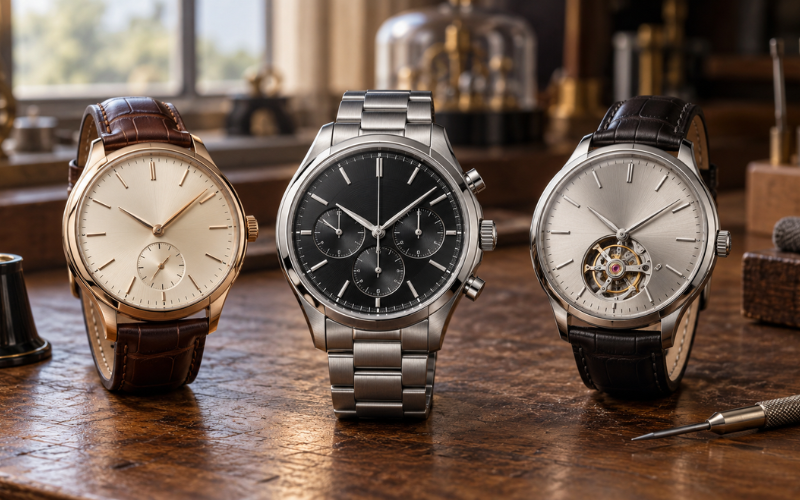
Raymond Weil is an independent Swiss watch company known for combining traditional watchmaking with designs inspired by music and the arts. The brand shares its name with its founder, Raymond Weil, who established the business in Geneva in 1976.
Today, the company remains under family leadership. Its watches range from simple quartz dress models to automatic chronographs, skeleton watches, and limited editions. This article explores Raymond Weil’s history, musical identity, main collections, movements, quality, prices, and the practical details buyers should consider.
Raymond Weil at a Glance
Raymond Weil is a Geneva-based Swiss watchmaker founded by Raymond Weil in 1976. It is currently led by Elie Bernheim, the founder’s grandson, making it one of the remaining family-owned independent names in the Swiss watch industry.
The company produces men’s and women’s watches in a broad selection of styles. These include quartz dress watches, everyday automatic models, chronographs, moon-phase watches, GMT models, diving watches, and open-worked designs.
Raymond Weil generally sits in the accessible or entry-level luxury part of the market. Its watches are more expensive than ordinary fashion watches but usually cost less than models from many prestigious high-luxury manufacturers.
The Story Behind the Raymond Weil Name
Raymond Weil had spent more than 20 years working in the watch industry before creating his own business. He started the company when he was 50, during a difficult period for traditional Swiss watchmaking. Electronic and quartz watches were rapidly changing the global market.
Raymond Weil and his wife, Éliane, presented their first creations at the Basel watch fair in 1976. The early business was initially connected with the name Dinita, formed from the names of their daughters, Diane and Anita.
The founder traveled widely to establish relationships with distributors. These efforts helped the company build a presence in markets such as the United States, the United Kingdom, and the Middle East. Its history reflects a balance of commercial ambition, approachable pricing, and traditional Swiss design. Raymond Weil’s official history provides a detailed timeline of this development.
A Family-Owned Swiss Watchmaker
The second generation joined the business in 1982 when Raymond Weil invited his son-in-law, Olivier Bernheim, into the company. They worked together for 14 years before Olivier took greater control of its leadership.
Olivier helped expand the international distribution network and develop the company’s technical abilities. His sons, Elie and Pierre Bernheim, later became involved, bringing a third generation into the watchmaker.
Elie Bernheim now leads Raymond Weil as chief executive. This family continuity allows the company to make decisions without answering to a large luxury group. Independence can provide greater creative freedom, although a smaller company may not have the manufacturing resources or marketing reach of a multinational watch business.
Why Music Plays Such a Major Role
Music has been part of Raymond Weil’s identity for decades. The founder loved music and the arts, and this interest gradually influenced product names, advertising, partnerships, and limited editions.
Historical collections used names such as Amadeus, Parsifal, Nabucco, and Don Giovanni. These references came from composers, operas, and musical works. The Amadeus collection, released in 1983, became an important early step in strengthening the company’s international profile.
More recent partnerships have involved Frank Sinatra, The Beatles, AC/DC, David Bowie, Jimi Hendrix, Gibson, and Marshall Amplification. These collaborations usually influence dial details, colors, engravings, and packaging. The musical theme is mainly visual and cultural; it does not normally change how the watch measures time.
Raymond Weil’s Main Watch Collections
The company’s main collections in 2026 include Freelancer, Millésime, A.R.T., and Toccata. Limited editions and special anniversary watches also appear alongside these lines.
Freelancer represents the more modern and technical side of Raymond Weil. Millésime focuses on restrained, vintage-inspired mechanical watches. A.R.T. offers contemporary cases with integrated bracelets, while Toccata concentrates largely on elegant quartz and hand-wound dress watches.
The catalog includes round, square, rectangular, and shaped cases in different sizes. Some models are clearly marketed toward men or women, while others have proportions that can suit a wide range of wearers. Collections, colors, sizes, and availability can change, so buyers should always check the current catalog.
Freelancer and Raymond Weil’s Modern Character
Introduced in 2007, Freelancer was the first collection developed under Elie Bernheim’s influence. Unlike many earlier Raymond Weil lines, its name did not come directly from music. It instead represented independence and a more modern direction.
Freelancer watches can include simple date displays, chronographs, GMT functions, diving features, complete calendars, and exposed mechanical parts. Case designs are generally stronger and sportier than those found in the brand’s traditional dress collections.
The collection is also home to the RW1212 movement. Some versions place the balance wheel at six o’clock, allowing the wearer to see part of the mechanism through the dial.
Millésime and the Return to Vintage-Inspired Design
The Millésime collection takes inspiration from watches of the past without simply reproducing one historical model. Many versions use sector-style dials, raised hour tracks, small-seconds displays, glassbox sapphire crystals, and carefully balanced case proportions.
Case sizes are often more restrained than those of large modern sports watches. This can make Millésime appealing to people who want a mechanical watch with a classical appearance and a less imposing fit.
The line includes central-seconds, small-seconds, moon-phase, and chronograph models. In 2023, a Millésime Small Seconds model received the Challenge Watch Prize at the Grand Prix d’Horlogerie de Genève, giving the collection wider attention among watch enthusiasts.
Maestro, Toccata, Tango, and Other Notable Lines
Maestro is known for traditional mechanical dress watches, often featuring Roman numerals, moon phases, open-heart displays, or other classical details. Tango has generally offered a firmer, sportier look, while Toccata focuses on clean and accessible dress designs.
Older buyers and collectors may also encounter names such as Parsifal, Noemia, Jasmine, Shine, Tradition, and Nabucco. Some of these collections are discontinued, while others may still appear through dealers in particular regions.
As of 2026, the global Raymond Weil website places its main attention on Freelancer, Millésime, A.R.T., and Toccata. Anyone considering an older model should confirm its reference number, original specifications, age, and availability of replacement parts.
Movements Used in Raymond Weil Watches
Raymond Weil uses both quartz and mechanical movements. Quartz watches run on batteries and are usually more accurate, affordable, and convenient. Automatic watches use wrist movement to wind a mechanical spring, although they may stop after being left unworn for a period.
Many Raymond Weil mechanical watches use reliable Swiss movement platforms produced by specialist suppliers. The company may modify their appearance, components, or functions before assigning an RW caliber number.
The RW1212 requires a more careful explanation. Raymond Weil describes it as its first in-house movement, but the caliber was developed through close cooperation with Swiss movement producer Sellita. It is therefore more accurate to describe it as an exclusive, proprietary development rather than suggesting every component is manufactured inside Raymond Weil’s own facilities. Current RW1212 versions offer specifications that can vary, so buyers should check the exact reference.
Design, Materials, and Build Quality
Most Raymond Weil watches use stainless-steel cases, although certain models include gold-colored coatings, diamonds, titanium-colored finishes, or other decorative treatments. Sapphire crystal is common and provides better scratch resistance than ordinary mineral glass.
Strap choices include leather, rubber, fabric, and stainless-steel bracelets. Finishing often combines polished and brushed surfaces to give the case more visual depth.
Water resistance differs greatly across the catalog. A dress watch rated to 30 or 50 meters is not intended for the same conditions as a Freelancer diver rated to 300 meters. The crown, case back, crystal, movement, and bracelet can also vary between references. Buyers should judge the exact model rather than assuming every Raymond Weil watch has identical quality or durability.
Is Raymond Weil a Luxury Watch Brand?
Raymond Weil describes itself as a Swiss luxury watchmaker, and its materials, pricing, mechanical options, and distribution support that position. However, luxury is not a precisely defined category.
The company is commonly placed in the accessible-luxury or entry-level Swiss luxury segment. It offers genuine Swiss-made watches and established brand history without generally reaching the prices associated with high watchmaking.
Its technical reputation is respectable, but Raymond Weil is not primarily known for producing every movement component itself or for creating highly complex handmade watches. Its appeal rests more on design, Swiss construction, family ownership, musical character, and relatively approachable pricing.
Raymond Weil Prices and What Buyers Receive
Prices depend on the movement, materials, complications, and collection. As of September 2026, many watches in the official Swiss catalog are listed from roughly CHF 1,095 to CHF 3,950. Special limited editions and anniversary pieces can cost considerably more. Prices vary by country and may change over time.
Quartz Toccata models tend to occupy the lower end of the range. Automatic Millésime and Freelancer watches generally cost more, while chronographs, complete calendars, diamonds, special materials, and limited production can increase the price.
Buyers are paying for Swiss-made construction, established styling, sapphire crystals on many models, dealer support, and a recognized name. Discounts may be available from some retailers, but unusually low prices deserve careful investigation.
How Raymond Weil Compares With Similar Swiss Brands
People considering Raymond Weil may also look at watches from Tissot, Hamilton, Mido, Frederique Constant, Oris, or Longines. The best comparison depends on the exact models rather than the names alone.
Tissot and Hamilton often offer lower starting prices and a very broad selection. Frederique Constant competes closely in classical styling, while Oris focuses strongly on mechanical watches. Longines generally has greater historical recognition and often occupies a somewhat higher market position.
Raymond Weil stands apart through its independent family ownership and strong relationship with music. However, buyers should compare movement specifications, dimensions, water resistance, warranty, finishing, and actual selling prices before deciding.
Choosing the Right Raymond Weil Watch
Begin with how and where the watch will be worn. Toccata may suit formal settings, while a Freelancer diver or chronograph may be more practical for casual or active use. Millésime is a natural choice for someone attracted to vintage-inspired mechanical design.
Movement preference also matters. Quartz is convenient and requires little attention beyond battery changes. An automatic watch offers visible mechanical character but may need resetting after its power reserve runs out.
Check the case diameter, thickness, lug-to-lug length, bracelet fit, and weight. Photographs can make a watch appear smaller or larger than it is. If possible, try it on before buying and confirm every specification using the complete reference number.
Buying New, Pre-Owned, or Vintage
Buying new from Raymond Weil or an authorized retailer normally provides the clearest warranty protection and lowest authenticity risk. A return policy may also help if the watch does not fit as expected.
Pre-owned watches can offer better prices, but their condition and service history matter. Scratches, bracelet stretch, replacement parts, moisture damage, and overdue mechanical servicing can reduce their value.
Vintage or discontinued models require the most research. Ask for clear photographs, the full reference number, movement details, service records, and information about replaced components. Boxes and papers are helpful, but their absence does not automatically make a watch fake—and their presence does not guarantee authenticity.
How to Identify an Authentic Raymond Weil
Authentication requires more than checking the logo. Inspect the dial printing, hands, date window, case finishing, crown, case-back markings, bracelet, clasp, and movement. These details should match reliable images and specifications for the exact reference.
A serial number can be useful, but counterfeit watches may copy real numbers. Poor engraving, uneven printing, incorrect spacing, loose components, and a price far below the normal market level are warning signs.
Choose a seller with a clear identity, strong return terms, and a history of handling watches. For a valuable or uncertain piece, request an examination from an authorized service center or an experienced independent watchmaker. Raymond Weil also offers an official authenticity process for qualifying watches through its after-sales service.
Warranty, Servicing, and Everyday Care
New Raymond Weil watches carry a standard two-year international guarantee against covered manufacturing defects. Registering an eligible watch with the Raymond Weil Club can add one more year. Batteries, straps, crystals, normal wear, accidents, misuse, and unauthorized repairs are generally excluded, so owners should read the actual warranty terms. The official warranty page explains the exclusions.
Keep the watch away from strong impacts, chemicals, extreme temperatures, and powerful magnetic fields. Do not operate pushers or adjust the crown underwater unless the manual specifically allows it.
Raymond Weil recommends a full service every three to five years and battery replacement every two to three years for quartz watches. Actual needs depend on use and conditions. Water resistance should also be tested periodically, especially before swimming. Raymond Weil’s after-sales guidance provides further details.
Resale Value and Collecting Potential
Resale value varies according to the model, condition, age, rarity, demand, and completeness of the original set. A well-kept limited edition may attract more interest than a widely available quartz model.
Music-themed watches can appeal to collectors who follow a particular artist or band. Early models and discontinued mechanical references may also have a small specialist audience. However, rarity alone does not guarantee high value.
Many Raymond Weil watches sell pre-owned for less than their original retail price. That can benefit secondhand buyers, but it means owners should not assume their purchase will increase in value. A watch is better treated as something to wear and enjoy than as a guaranteed investment.
Who Raymond Weil Watches May Suit
Raymond Weil may appeal to someone who wants a recognized Swiss watch without entering the highest luxury price levels. It is also well suited to buyers who value independent family ownership, classical styling, and the brand’s connection with music.
The quartz collections can work for people who prioritize convenience. Millésime may attract fans of restrained vintage design, while Freelancer offers more modern and technical choices.
Another brand may be more suitable for buyers seeking the lowest possible price, extremely high water resistance, a fully manufacture-made movement, or especially strong resale performance. Personal fit and model specifications remain more important than the name printed on the dial.
Common Questions About Raymond Weil
Where are Raymond Weil watches made?
Raymond Weil is based in Geneva and produces watches carrying the Swiss Made label. The company works with a network of Swiss specialists and has assembly operations in Grand-Lancy.
Are Raymond Weil watches considered good quality?
They are generally regarded as well-made watches within their market segment. Quality still varies by model, so buyers should compare the movement, crystal, bracelet, water resistance, and finishing.
Does Raymond Weil make its own movements?
Many models use Swiss supplier-based movements. The RW1212 is an exclusive caliber developed by Raymond Weil in cooperation with Sellita.
How long can a Raymond Weil watch last?
A properly maintained watch can remain usable for many years or even decades. Longevity depends on care, servicing, water exposure, damage, and the availability of parts.
Are Raymond Weil watches worth their price?
They can offer good value for buyers who appreciate their design and identity. Value is less convincing if the watch fits poorly or if another model provides more useful specifications at the same price.
How can owners find the reference number?
It may appear on the case back, warranty card, receipt, or original packaging. Owners can use that number when contacting an authorized retailer or service center.
Conclusion
Raymond Weil has built a clear identity through Swiss watchmaking, family leadership, and a lasting relationship with music. Its catalog covers convenient quartz watches, traditional mechanical designs, modern sports-inspired models, and artist-linked limited editions.
The brand occupies a useful space between ordinary fashion watches and much more expensive luxury names. Its strongest qualities are approachable Swiss design, variety, independence, and cultural character. Still, no buyer should choose a watch on brand reputation alone. Comparing the exact reference, fit, movement, condition, price, warranty, and future service needs is the most reliable way to decide whether a Raymond Weil watch is the right choice.