
A mattress can feel comfortable for a few minutes in a showroom yet feel different after a full night. When comparing memory foam and hybrid mattresses, the goal is to understand how each design fits the way you sleep.
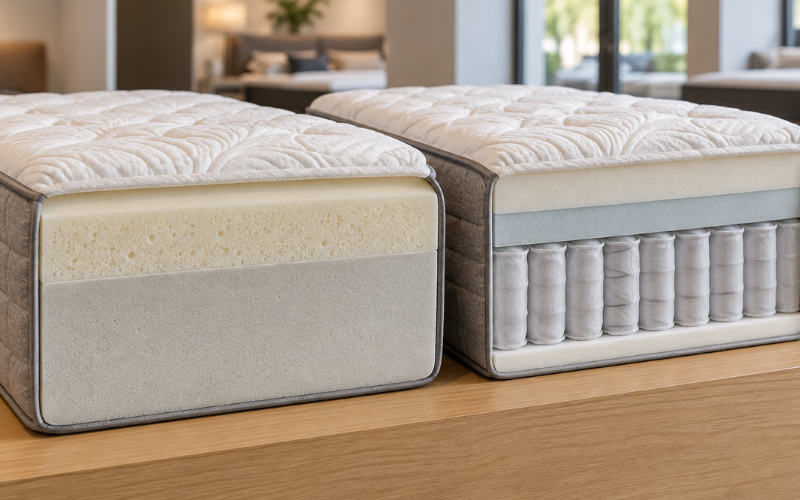
The main difference sits beneath the surface. A memory foam mattress usually has cushioning foam layers over a firm foam base. A hybrid combines comfort layers with a coil support system. Many hybrids also contain memory foam, so the choice is often between two different foundations supporting similar cushioning materials.
If you want to make a table comparing memory foam vs hybrid mattresses, construction alone is not enough. You also need to compare feel, support, cooling, movement, durability, and cost.
Memory Foam vs Hybrid Mattresses: Comparison Table
The table below summarizes common differences. Treat these as starting points, because material quality and the design of each mattress can change its performance.
| Comparison Factor | Memory Foam | Hybrid |
| Construction | Memory foam comfort layers over a firmer foam support core | Foam, latex, or other comfort materials over a coil support core |
| Firmness and overall feel | Usually offers a close, body-hugging feel; available in different firmness levels | Often combines cushioning with springiness; available in different firmness levels |
| Pressure relief | Can cushion shoulders and hips through close contouring | Can provide similar cushioning when comfort layers suit the sleeper |
| Support and spinal alignment | Depends on the foam base, comfort layers, and how deeply you sink | Depends on the coils, comfort layers, and how they support your weight |
| Motion isolation | Often absorbs a partner’s movements well | Varies; pocketed coils and cushioning layers can limit movement transfer |
| Bounce and ease of movement | Usually less bouncy; deep contouring may make turning harder | Usually more responsive, although thick memory foam can reduce that feeling |
| Temperature regulation | Some models retain warmth around the body | Coil layers allow airflow, but surface materials still affect warmth |
| Edge support | Edges may compress noticeably unless reinforced | Reinforced perimeter coils or foam can create a more stable edge |
| Durability | Depends on foam quality, use, and foundation | Depends on both comfort-layer quality and coil construction |
| Mattress weight and handling | Often lighter, although thick, dense models can be heavy | Often heavier because of coils and additional materials |
| Typical price range | Approximately US800–2,500 for a queen in one published comparison | Approximately US1,200–2,000 for a queen in the same comparison |
The price figures are broad reference ranges from Sleep Foundation, rather than live offers or market limits. Budget options and premium models fall outside them, and prices vary by country, size, and retailer.
Use the table to identify your priorities before comparing specific products. A mattress that performs well in a category you barely notice may offer less value than one that solves your main comfort problem.
How Construction Changes the Way Each Mattress Feels
A memory foam mattress is usually made from several foam layers with different jobs. The upper layers provide cushioning, while the firmer base supports the structure. A transition layer may sit between them to make the change from soft cushioning to firm support less noticeable.
A hybrid replaces that foam support core with coils. Above the coils, it may use memory foam, other cushioning foams, latex, or a mixture of materials. Many models use individually wrapped coils, which can respond separately to pressure.
These differences influence how the mattress reacts when you lie down or move. Memory foam generally molds around your body and returns to shape more slowly. You may enjoy that settled feeling, particularly if you prefer a surface that holds you gently in place.
A hybrid often pushes back more quickly when you turn. However, a thick memory foam layer can still create a pronounced hugging sensation above the springs. The word “hybrid” does not automatically mean a buoyant or lightly cushioned bed.
Firmness is a separate consideration. Both categories include soft, medium, and firm models. When testing either type, notice your first impression and what happens after you settle: does the surface remain comfortable, or do you sink farther than you expected?
Comparing Pressure Relief and Support by Sleeping Position
Pressure relief and support work together, but they describe different things. Pressure relief means cushioning areas that carry concentrated weight. Support means keeping your body comfortably balanced without allowing excessive sinking.
Side sleepers generally need enough cushioning for their shoulders and hips. Back sleepers often need a balance of surface comfort and support beneath the pelvis. Stomach sleepers usually benefit from a surface that limits sinking around the middle. Body weight also changes how deeply a person compresses the same mattress.
For a side sleeper comparing two models, a useful question is whether the shoulder feels squeezed against the surface. More softness might help, but excessive softness can introduce a different problem if the hips sink much farther than the rest of the body.
Back and stomach sleepers can compare how evenly their weight feels supported. A soft top is not necessarily unsuitable, provided the layers below prevent uncomfortable dipping. Likewise, a firm surface is not automatically supportive simply because it resists pressure.
Combination sleepers should test every position they regularly use. Spend time on your side, roll onto your back, and notice the effort involved. This practical comparison is more useful than choosing solely from a label such as “best for side sleepers.”
Cooling and Airflow During the Night
Temperature is an important part of the memory foam vs hybrid mattress comparison, especially if you regularly wake feeling too warm.
Memory foam can surround the body closely, and some designs retain noticeable heat. Hybrid coil systems leave space for airflow inside the mattress, giving them a potential advantage. However, that airflow does not guarantee a cool sleeping surface when thick cushioning sits above it.
Testing by RTINGS shows that cooling performance varies between individual foam mattresses. Its comparisons also show why the overall design matters more than assuming every mattress within a category behaves alike.
Look beyond a cooling-related product name. Check what the cover is made from, how thick the comfort layers are, and whether there are meaningful performance details available. Foam density is useful information, but it cannot tell you the complete temperature story on its own.
Your bedding also belongs in the comparison. A heavy duvet or thick protector may affect your experience enough to obscure differences between mattresses. When testing a new bed at home, use bedding similar to what you normally sleep with.
A cool sensation when you first touch a cover is only one observation. The more useful question is whether the complete bed remains comfortable several hours into the night.
Motion Isolation, Bounce, and Edge Support for Couples
Sharing a mattress introduces a trade-off: a surface that absorbs movement may feel less lively when you want to turn over.
Memory foam often limits the movement that travels across the bed. Hybrids tend to offer more bounce, although pocketed coils and cushioning layers can reduce disturbance. Edge support also varies, with reinforced hybrid designs often providing a more stable perimeter.
Rather than judging motion isolation by pressing a hand into the mattress, test it together if possible. One person can lie in a normal sleeping position while the other turns or gets out of bed. Notice whether the movement feels distracting, rather than expecting the surface to remain completely still.
Check the edges separately. Sitting on the side to put on socks places weight differently from lying near the perimeter. A mattress may feel soft when seated yet remain comfortable when sleeping close to its edge.
Different sleep preferences can make the decision harder. One partner may value a deep hug, while the other wants easy movement. Identify the needs that affect sleep most before compromising on less important details.
A middle firmness rating is not automatically a solution. Both people should assess the actual model, because the same surface can feel quite different to partners of different weights.
Price, Durability, and Everyday Ownership
Memory foam mattresses often offer a lower starting cost, but there is substantial price overlap. Premium foam models can cost more than simpler hybrids. Compare similar sizes and quality levels before deciding which construction offers better value.
Calculate the full purchase cost, including delivery, old-mattress removal, and any required foundation. A lower advertised price may become less attractive once those extras are included. Sleep Foundation’s pricing guide identifies materials, size, and additional purchase costs as factors that can change the total expense.
Durability is harder to judge from a product page. For foam mattresses, ask for information about the individual layers rather than relying on total thickness. For hybrids, examine the cushioning as carefully as the springs: a strong coil unit does not prevent the material above it from changing with use.
Avoid treating a long warranty as a promised comfort lifespan. Read what counts as a covered defect, whether visible impressions must reach a specified depth, and whether normal softening is excluded. These details explain more than the number of years printed in a headline.
Handling also deserves attention. Compare the listed mattress weights if you live upstairs or expect to move. Check the manufacturer’s instructions for rotation, and do not assume the mattress should be flipped.
Finally, verify bed-base compatibility and return terms. Confirm slat-spacing requirements, any mandatory trial period, collection arrangements, and possible fees before ordering.
Choosing Between Memory Foam and a Hybrid Mattress
Start with your current mattress experience. What would you most like to change? Being disturbed by a partner, struggling to turn over, and feeling uncomfortable pressure are different problems. Naming the main issue helps you compare useful features.
Memory foam deserves consideration if you enjoy close cushioning and a quieter, less bouncy surface. A hybrid deserves consideration if you prefer a more responsive feel or want to investigate models with reinforced edges and airflow through the support system.
Treat these as directions for your search rather than final answers. You may find that a firmer foam model is easier to move on than a deeply cushioned hybrid. An individual design can matter more than its category.
To keep your comparison manageable, use this short checklist:
- Does it feel comfortable in your usual sleeping positions?
- Can you turn over and get out of bed easily?
- Are movement transfer and edge stability acceptable?
- Does it work with your existing bed base?
- Are the total price and return conditions clear?
If two models remain close, compare the compromises. Someone who rarely sleeps near an edge may reasonably prioritize cushioning over perimeter strength. Someone who changes position often may place greater value on easy movement.
Use a home trial as an opportunity to observe your normal sleep experience. Keep brief notes about comfort, warmth, movement, and waking disturbances so the decision rests on more than your first night.
Conclusion
A useful memory foam vs hybrid mattress comparison connects construction with everyday comfort. Memory foam often appeals to people who enjoy close cushioning and limited bounce. Hybrids offer a different balance through coil support and varied comfort layers.
When you make a table comparing memory foam vs hybrid mattresses, use it to narrow the search, then examine individual models. Firmness, material quality, price, and return terms deserve as much attention as the mattress label.
The better choice is the one that fits your sleeping habits and feels comfortable within your budget. There is no need to choose the most expensive design or the longest feature list when a simpler option meets your needs.
FAQs
1. Can a hybrid mattress contain memory foam?
Yes. A hybrid can have memory foam above its coil support system. “Memory foam” describes a material, while “hybrid” describes a construction that combines a substantial comfort system with coils. In this comparison, “memory foam mattress” refers to an all-foam model. Reading the layer description helps you understand what you are actually buying.
2. Is a hybrid mattress always firmer than memory foam?
No. Both types are available in several firmness levels. A hybrid with thick, soft comfort layers may feel softer than a firm all-foam mattress. Springs alone do not determine the surface feel. Compare the specific firmness option, the amount of cushioning, and your own experience rather than assuming one mattress category is consistently harder.
3. Which mattress type is better for side sleepers?
Either can work if it provides comfortable cushioning without excessive sinking. Instead of selecting by category alone, assess how your shoulder and hip feel once you settle into your normal position. Consider your pillow during the trial as well, and avoid judging the mattress only while sitting on it or briefly lying on your back.
4. Does a hybrid mattress last longer than a memory foam mattress?
Not necessarily. Both include materials that can change through use, and construction quality matters more than a simple category ranking. Compare layer information, care requirements, and warranty exclusions. A hybrid’s springs do not guarantee that its upper cushioning will remain comfortable longer. Your decision should account for the whole mattress, including its required foundation.
5. How can I compare two mattresses with the same firmness rating?
Treat the rating as a starting point because brands may use different scales. Compare how far you sink, how easily you turn, and whether pressure builds in your usual sleeping position. If testing in person, spend comparable time on each model. If buying online, examine trial and return conditions so you can assess the mattress at home.