
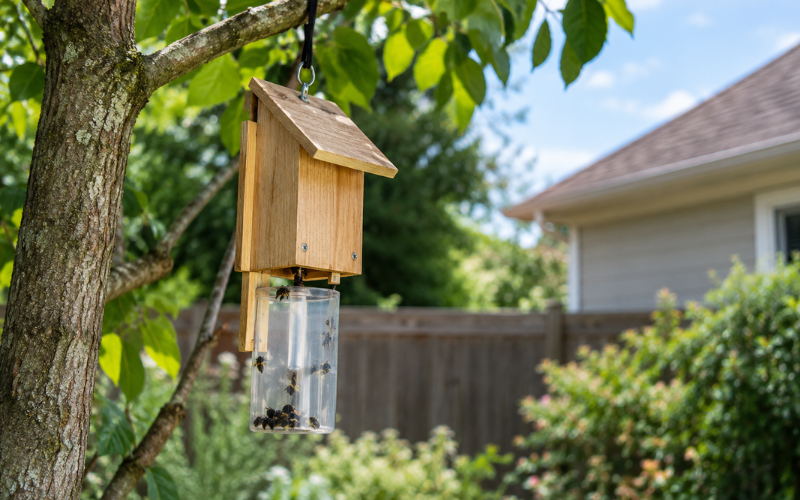
A carpenter bee trap is designed to catch adult carpenter bees investigating holes in wood. Many models combine a wooden block or box with a clear collection container underneath. Homeowners often consider one after noticing bees repeatedly visiting a deck, fence, porch roof, or exposed timber.
If you searched for “bee trap carpenter,” the product you are looking for is usually called a carpenter bee trap. Before choosing one, it helps to establish whether these bees are actually nesting in your home’s wood and what you expect trapping to achieve.
A useful approach starts with identification, then considers trap design, placement, and maintenance. It also includes checking existing damage. A trap may catch visiting adults, but it does not repair a board or automatically solve an established nesting problem.
Confirm Carpenter Bee Activity Before Choosing a Trap
Watch where the insects go before making a purchase. A bee visiting flowers or briefly hovering beside a fence is not enough to confirm that it is drilling into your property.
Look for round entrance holes and fresh, coarse sawdust below them. Repeated visits to the same opening provide another clue. Large carpenter bees commonly found in North America often have a shiny, mostly hairless abdomen, while bumblebees generally look hairy across the abdomen. Appearance varies between species, so use nesting behavior alongside visual identification.
Observe from a comfortable distance during suitable flying weather. Taking a photograph of the insect and the hole can help a local extension service or pest professional identify the problem.
Old holes need careful interpretation. A weathered opening may be unused, occupied again, or sheltering insects you have not seen. Photograph the area and compare it over several observations. Avoid assuming that a quiet afternoon means a tunnel is empty, and do not plug a hole simply to test whether something emerges elsewhere.
How a Carpenter Bee Trap Works
The basic idea is to offer an opening that resembles a potential nesting site. A bee enters the wooden section through a drilled hole and moves through an internal passage toward a collection chamber.
Cornell describes traps in which bees attempting to leave enter a transparent glass or plastic container. Once inside, they have difficulty finding the route out. The arrangement of the entrance, passage, and container matters more than the trap’s decorative appearance.
Most common collection traps are lethal devices, rather than bee houses or reliable live-relocation containers. Read the product description carefully if that distinction affects your decision.
A trap acts on adults that enter it. It does not reach developing bees inside existing wood tunnels, and it cannot show how much damage is hidden behind an entrance.
Results also require realistic interpretation. Several captured bees demonstrate that a trap caught bees; they do not establish that nearby wood is protected. Keep watching for fresh holes and sawdust. Those observations help you judge whether the underlying problem continues.
Features to Compare When Choosing a Carpenter Bee Trap
Start with construction quality. Check whether the wooden body has sound joints, whether the roof or cover sheds rain, and whether the collection container attaches securely. A product intended to remain outdoors should come with clear installation and care instructions.
Examine how the entrance connects to the container. Product photographs should make the basic layout understandable. If a seller provides little beyond claims about catching large numbers of bees, look for more detailed information before buying.
A transparent chamber makes inspection easier. Consider whether you can see its contents from your intended viewing position and remove it without struggling with a tight fitting. Check whether replacement containers or attachments are available.
Mounting hardware deserves equal attention. The fixing must support the assembled trap, and you should be able to reach the collection chamber without leaning over a railing.
Consider unintended captures, too. Prefer a design intended specifically for carpenter bees, but do not assume that any trap is completely selective. Ask what supports claims about protecting other insects. Avoid adding exposed sticky surfaces or improvised attractants that change how the product works.
Buying a Ready-Made Trap or Building Your Own
A ready-made trap offers convenience, particularly if you do not have woodworking tools. However, compare the complete package. Mounting hardware, collection containers, and replacement parts may affect the overall cost and usefulness.
Building your own may suit someone who already has suitable materials and is comfortable drilling accurately. The important challenge is creating the intended internal route, rather than simply making a wooden box with holes.
Use a detailed plan from a reliable source and follow its measurements consistently. Different designs may use different entrance arrangements. Combining measurements from several plans can leave passages that fail to connect or a container opening that does not fit.
Before installation, inspect for split wood, protruding fasteners, loose lids, and poorly attached containers. Check that you can remove the collection section while the body remains securely mounted.
Count your time and any tools you would need to buy. A homemade trap is not automatically cheaper, and a higher-priced commercial model is not automatically more effective. Choose the option you can construct or install correctly, inspect easily, and maintain throughout its intended use.
Where and When to Place a Carpenter Bee Trap
Base placement on confirmed activity. A trap near the affected structure is more relevant than one placed across the garden simply because it is convenient to hang. University of Georgia guidance identifies areas around porches, decks, sheds, and similar structures with carpenter bee activity as possible trapping locations.
Follow the instructions for the particular model. Avoid inventing a universal hanging height or spacing rule, since designs and mounting arrangements differ.
Timing should reflect local conditions. In many temperate North American locations, spring is when overwintered adults become active and investigate nesting sites. University of Kentucky guidance recommends setting traps out in early spring. Warmer and cooler regions will not share an identical calendar.
Choose a position you can inspect safely. Keep the device away from doorways, outdoor seating, children’s play areas, and places where someone could knock the container.
Check the supporting surface before attaching it. Thin trim, loose boards, and damaged fittings may be unsuitable. Consider wind and rain exposure as well as access. A location that seems ideal for bee activity is not practical if routine maintenance requires an awkward climb.
Why a Carpenter Bee Trap May Stay Empty
An empty trap has several possible explanations. The first is identification: the insects you noticed may not be carpenter bees, or they may only be passing through.
Placement and timing are also worth reviewing. Look again at the actual entrance holes and flight activity. A trap installed after the main nesting search may face different conditions from one installed near the start of the season.
Established nesting sites can complicate expectations. An adult visiting an existing tunnel is not necessarily looking for a new opening. Moving a trap closer does not guarantee that it will abandon its current nest.
Inspect the device itself. Confirm that passages are open, the collection chamber is attached correctly, and the trap has not shifted or suffered damage. Compare the installation with the instructions before purchasing additional equipment.
Treat bait claims carefully. Instructions to add sugar water, fruit, scents, or dead bees should not be accepted as universal rules. Ask whether the advice applies to your model and whether independent evidence supports it.
Change one factor at a time and record what happens. Repeatedly moving the trap and changing its contents makes it difficult to understand the result.
Checking and Maintaining Your Trap
Choose an inspection routine you can keep. During active use, look regularly at the collection chamber, entrances, and mounting points. Follow the manufacturer’s recommended schedule, and check the mounting after strong wind or heavy rain.
Initially, frequent visual checks can help you notice unintended captures or installation problems. Viewing the chamber does not mean opening it every time. Keep your hands away from entrances and avoid handling live insects.
For emptying and cleaning, follow the model’s instructions. Do not assume that motionless insects are dead or that removing a lid is risk-free. If the instructions do not explain how to manage live captures, ask the manufacturer before opening the chamber.
Check what is being caught. If you repeatedly find other insects, pause use and reconsider the trap or its placement. Carpenter bees themselves are pollinators, so the aim should be a targeted response to confirmed property damage, not removing bees generally.
Replace cracked containers and damaged fittings. At the end of the intended trapping period, clean and dry the parts as directed. Store them where the container will not break and the mounting hardware will remain together.
Addressing Nesting Damage Alongside Trapping
Inspect the wood as well as the trap. Look for new openings, fresh sawdust, staining, splitting, or repeated activity around the same board. Photographs taken from the same angle can help you track changes without relying on memory.
A visible hole does not reveal the full length of the tunnel behind it. Repeated nesting deserves closer attention, particularly in a railing, support, or other component whose strength matters. Cosmetic filler is not a substitute for assessing a weakened board.
Plan repairs around the condition and occupancy of the nest. Simply sealing an occupied tunnel can cause trapped bees to bore another opening. Ask a local extension service or qualified pest professional how to establish when repair is appropriate. Do not use a fixed date as proof that all bees have left.
Once the nesting issue has been addressed, repair suitable boards and restore their protective finish. University of Kentucky guidance considers paint more reliable than stains or preservatives for discouraging carpenter bee drilling, although no coating should be treated as an absolute guarantee.
Seek professional help when activity is widespread, holes are difficult to reach, or the condition of important woodwork is uncertain. If treatment is proposed, ask how it addresses occupied tunnels and how repairs will follow. Any pesticide use must follow the applicable product label and local requirements.
Conclusion
Choosing a carpenter bee trap starts with confirming that carpenter bees are nesting in wood you need to protect. From there, compare practical features: a sound body, a clear collection chamber, secure mounting, and straightforward maintenance.
Place the trap according to observed activity and the product’s instructions, then monitor the wood as carefully as the catch. An empty container does not explain the whole situation, and a full one does not prove the damage has stopped.
FAQs
1. How long does a carpenter bee trap take to work?
There is no dependable countdown that applies to every trap and property. Local activity, season, placement, and design all influence whether bees enter. Avoid treating a seller’s fastest reported result as a promise. Monitor both the trap and the affected wood. If fresh damage continues, reassess the approach instead of waiting indefinitely for the container to fill.
2. Does a carpenter bee trap need bait?
Do not assume that it does. Many wooden designs are intended to attract bees investigating potential nesting openings. Follow the instructions for your specific model before adding anything. Homemade sweet mixtures are not a standard requirement for these traps. If a special lure is recommended, check what evidence supports its use and whether it could attract insects you are not trying to catch.
3. How many carpenter bee traps should I hang?
There is no universal number for a porch, deck, or garden. Map the confirmed activity first and consider the model’s installation guidance. Avoid choosing a quantity based only on total yard size or an unsupported coverage claim. Additional traps should have a clear purpose and remain easy to inspect. A larger catch does not, by itself, show that the wood is suffering less damage.
4. Are carpenter bee traps safe around children and pets?
Installation and handling matter. Keep traps out of reach and away from busy routes, seating, and play spaces. Secure the mounting and inspect containers for damage. Do not let children or pets investigate captured bees. Male carpenter bees cannot sting, but females can, particularly when handled or disturbed. Treat a collection chamber containing live bees as something to leave alone until it can be managed correctly.
5. Will a carpenter bee trap stop bees from returning next year?
A trap cannot guarantee that result. It does not remove old tunnels or change the condition of exposed wood. Future prevention depends on assessing nesting sites, making appropriate repairs, and maintaining vulnerable surfaces. Check the same areas when activity resumes the following season. If the problem returns despite those steps, get a local assessment before adding more traps or repeating an unsuccessful approach.