
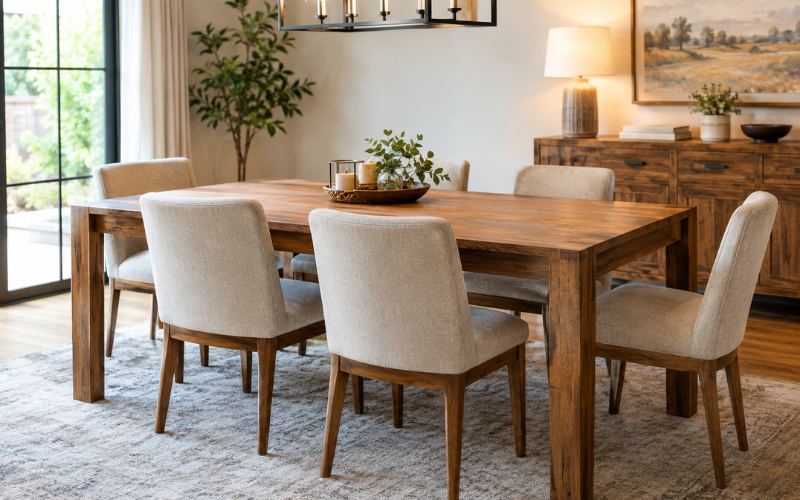
A dining table set brings a table and coordinated chairs together, sometimes with a bench replacing some of the seats. Buying these pieces as a set can make furnishing a dining area simpler, but a matching appearance does not guarantee a comfortable fit.
The table needs to suit your room, the chairs should feel comfortable, and the materials should handle your household’s routine. Shape matters too. A table that looks compact in a photograph may leave little walking space once everyone sits down.
Choosing well starts with understanding how you will use the furniture. This guide explains how to compare dimensions, seating, materials, construction, and purchase details so your dining table set works as well during an ordinary weekday meal as it does when guests visit.
Start With How You Use Your Dining Table
Think about what happens at your table during a normal week. It may be used mainly for meals, or it might also serve as a homework station, a place for crafts, or somewhere to work from home. These activities affect how much surface space you need and how comfortable the seating should be.
Start with the number of people who eat together regularly. A household of four may need four comfortable places every day, with extra seating only occasionally. Buying a much larger table for infrequent gatherings can make the room harder to use throughout the year.
A fixed-size table keeps things straightforward. There are no extension parts to operate or store, and its footprint stays predictable. An extendable table offers flexibility when guest numbers change. However, it only helps if the room can accommodate it when open.
Consider extra chairs as well. If an extending table seats eight but comes with six chairs, you will need two additional seats and somewhere to keep them between visits.
Measure the Room Before Choosing the Set
Measure the usable dining area, taking account of furniture that will remain in place. Room dimensions alone can be misleading when a sideboard, radiator, doorway, or kitchen counter reduces the available space.
Mark the proposed table outline on the floor with removable tape. Then position a chair beside it to understand how far seating extends beyond the tabletop. Pull the chair out as you would when sitting down, and walk around it.
As a general planning guide, allow roughly 36 inches between the table edge and a wall or other obstruction. Around 42 to 48 inches can make circulation easier, particularly where people regularly pass behind occupied chairs. These are starting points; chair size, room layout, and individual mobility needs may call for more space.
Check whether cupboard doors and drawers can open without hitting the seating. Keep the route between the dining area and kitchen usable during meals.
For an extendable dining table set, repeat the layout check using the table’s full length. A comfortable everyday arrangement can become crowded when extensions and extra chairs are added.
Choose a Table Shape That Suits the Space
Round tables often work well for smaller groups because everyone faces toward the center. Their curved edges can make movement around the table feel easier, although they still require enough space for chairs and circulation.
A round shape does not automatically save space. A large round table can occupy considerable floor area, and reaching shared dishes in the center becomes less convenient as its diameter increases.
Rectangular tables often suit long rooms and larger households. They provide a clear arrangement of seats along each side, with additional places at the ends when the dimensions allow. Their shape can also work naturally alongside a long wall or kitchen island.
Square tables can feel balanced in square rooms and offer a comfortable arrangement for a small group. Larger versions need careful consideration because the center may become difficult to reach.
Oval tables combine a longer surface with curved ends. They may soften movement around corners, but check how much usable space the narrower ends provide.
Look beneath every shape. Pedestal bases can offer flexible chair placement, while corner legs may limit where people sit. A broad pedestal or low support bar can still interfere with feet.
Understand Seating Capacity and Set Sizes
Piece count and seating capacity describe different things. A five-piece dining table set usually contains one table and four chairs. A seven-piece set commonly includes a table and six chairs. Sets with benches can be counted differently, so read the item description carefully.
Two-seat sets can suit compact dining corners or households that rarely need additional places. Four-seat sets provide room for a small household, while six-seat versions allow more flexibility for shared meals and guests. Eight-seat arrangements need enough space for both the furniture and comfortable movement around it.
Treat the stated seating capacity as a claim to check against the dimensions. Two tables described as six-seaters can offer different amounts of elbow room.
Around 24 inches of table edge per diner is a useful initial estimate, though wider chairs and larger place settings may need more. Table legs, curved ends, and armrests can reduce usable seating space.
A bench can offer flexible seating, but its capacity depends on its length and the people using it. Backless benches also provide less support, and someone seated in the middle may find getting out inconvenient.
Compare Materials by Care and Everyday Wear
Solid wood offers natural variation and can develop character with use. Some solid wood surfaces can be repaired or refinished, depending on their construction and finish. However, wood still needs protection from standing water, excessive heat, and unsuitable cleaners.
Veneer consists of a thin layer of real wood over another material. It can provide a wood appearance at different price points and should not automatically be treated as poor quality. The underlying board, edge treatment, and overall construction matter. Deep damage can be harder to repair because the wood layer is thin.
Laminate surfaces are often practical where easy cleaning is a priority. Their resistance to scratches, heat, and moisture varies, so check the product’s care instructions. Pay attention to edges and seams where damage may allow moisture underneath.
Glass can make a dining area feel visually lighter, although fingerprints and smudges may show clearly. Confirm the type of glass used and inspect how the tabletop attaches to its base.
Natural stone can be heavy and may require sealing or particular cleaning products. Ceramic tabletops can offer a hard-wearing surface, but their performance depends on the product, and edges may still chip.
Consider the frame and chair materials alongside the tabletop. Upholstered seats need different care from finished wood or molded seating. For frequent spills, look for clear cleaning instructions and removable covers where available, rather than relying only on descriptions such as “family-friendly.”
Check Chair Comfort and Table Height Together
A dining chair can look comfortable and still feel awkward after a meal. Seat depth, back support, cushion firmness, and the position of your feet all affect comfort.
If possible, sit in the chair at the actual table for several minutes. Your feet should feel supported, and you should be able to sit close enough to eat without leaning forward unnecessarily. A seat that is too deep may press behind your knees or leave your back unsupported.
Many standard dining tables stand around 28 to 30 inches high. A gap of roughly 10 to 12 inches between the seat and tabletop is a common starting point, but the underside of the table matters too. A deep supporting panel beneath the top can reduce thigh clearance.
Counter-height sets create a different seating position and usually require higher chairs with suitable footrests. Consider who will use them regularly. A higher seat may be less convenient for someone who finds climbing onto or stepping down from seating difficult.
Find a Style That Works With Your Room
Look at the finishes already present in your flooring, cabinets, and nearby furniture. Your dining set does not need to match every surface, but it should feel connected to the room.
For example, a warm wood table can sit comfortably alongside other warm-toned finishes without being exactly the same color. Contrast can also work well, particularly when another element, such as the chair fabric or frame color, connects the set to its surroundings.
Consider how visually substantial the furniture appears. A thick tabletop with broad legs and large upholstered chairs can feel imposing in a small room. Slimmer chairs or a more open base may help the space feel less crowded.
Choose upholstery with everyday use in mind. Texture, color, and pattern affect how noticeable marks become, but none replaces suitable cleaning and care.
A coordinated dining table set simplifies the selection process. Buying pieces separately offers more freedom, though it requires closer checks of seat height, chair width, arm clearance, and overall proportions.
Look Closely at Construction and Value
Appearance gives only part of the picture. A useful dining set should feel stable when people sit, stand, lean on the table normally, or move their chairs.
When examining furniture in person, check for loose joints, uneven chair legs, rough edges, and movement that seems excessive. A wobble may come from the floor rather than the furniture, so check the cause before drawing a conclusion.
For an extending table, ask to see the mechanism in use. It should operate as intended without parts being forced. Check how the extension is supported, whether the sections sit level, and whether one person can reasonably manage the process.
Find out where the leaves are stored. Some tables hold them internally; others require a separate dry, protected space. A large leaf can be awkward to handle even when storage is available.
Compare the complete cost of each option. Delivery, assembly, additional chairs, and care products may change the total considerably. Better value comes from furniture that meets your needs over time, rather than decorative features that add cost without improving daily use.
Confirm the Details Before Ordering
Read the full specifications instead of relying on photographs or the product name. Confirm table dimensions, chair measurements, seat height, and the exact number of included items. Lifestyle images may show additional chairs or furniture that are sold separately.
Check how the pieces will reach the dining area. Measure entrances, narrow hallways, stair turns, and lifts where relevant. Ask whether the tabletop and base arrive separately and whether the packaged dimensions differ substantially from the assembled measurements.
Understand the delivery service as well. Some services bring furniture only to the building entrance, while others place it in the room. Assembly and packaging removal may carry separate charges or be unavailable.
Review return conditions before purchasing. Check time limits, collection costs, packaging requirements, and how assembly affects returns. Read what the warranty covers rather than assuming it applies to every form of damage.
Finally, ask whether replacement chairs or individual parts are available. This can be useful if one item becomes damaged or your seating needs change, although future stock cannot always be guaranteed.
Conclusion
The right dining table set should fit your room, support comfortable meals, and suit the amount of care you are willing to give it. Shape and finish matter, but so do chair clearance, usable seating space, stable construction, and straightforward maintenance.
Start with your everyday needs, then measure the full arrangement with the chairs in use. Compare materials and comfort before checking the delivery and purchase terms. When those practical details work together, it becomes easier to choose a set that looks at home and remains useful through ordinary meals, busy afternoons, and occasional gatherings.
FAQs
1. What is included in a dining table set?
A dining table set typically includes a table and a specified number of coordinated chairs. Some sets replace chairs with one or two benches. A five-piece set often means one table and four chairs, but configurations vary. Check the included-item list, since photographs may show furniture or accessories that are not part of the purchase.
2. Is a round or rectangular dining table better for a small room?
The better choice depends on the room’s proportions and walking routes. A round table can work well in a compact, roughly square area, while a narrow rectangular table may suit a longer space. Compare the complete seating arrangement, including pulled-out chairs, rather than judging only the tabletop’s shape or dimensions.
3. Should I choose dining chairs or a bench?
Chairs usually provide separate places and allow each person to move independently. A bench can create a flexible arrangement and may tuck beneath the table if its dimensions allow. However, backless benches offer less support, and shared seating can make getting in and out harder. Consider comfort, access, and who uses the table most often.
4. Is an extendable dining table worth buying?
An extendable table can be useful when your everyday household is smaller than the groups you occasionally host. It works best when the room has enough space for the open table and additional chairs. Before buying, check the extension mechanism, leaf storage, and extra seating arrangements. If the table will always remain extended, a fixed-size model may be simpler.
5. Can I replace the chairs in a dining table set later?
Yes, provided the new chairs work with the table’s dimensions. Check seat height, width, armrest clearance, and the space between the table legs. Try one chair at the table before ordering several where possible. Replacement chairs do not need to match exactly, but repeating a color, material, or design detail can help the arrangement feel connected.