
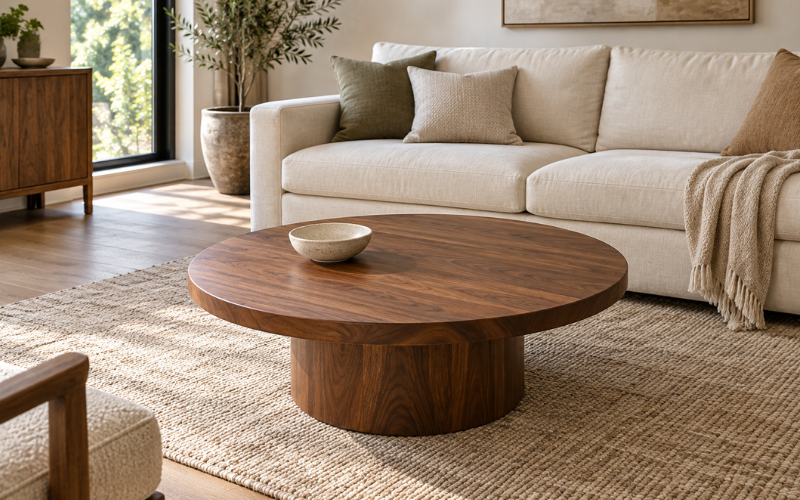
A round coffee table gives drinks, books, and everyday essentials a place at the center of your living room. Its curved outline can soften a space filled with straight furniture edges and make certain seating arrangements easier to move around. But a table that looks perfectly balanced in a showroom may feel too large, too low, or surprisingly difficult to reach at home.
The right choice depends on how your seating area works. You need enough surface space for daily use, a comfortable height beside the sofa, and room to walk without turning sideways. The material, base, and storage features also affect how convenient the table feels over time.
Before choosing a finish or style, picture an ordinary evening in your living room. Think about where people sit, what they keep nearby, and how they move through the space. Those details provide a useful starting point for finding a table that fits.
When a Round Coffee Table Works Best
A round coffee table often suits seating areas where furniture gathers around a shared center. A sofa facing two armchairs, for example, can work well with a circular surface between them. The curved edge gives the arrangement a natural focal point without adding another long, straight line.
It can also help where people approach the seating from several directions. There are no projecting tabletop corners to navigate, although the table still needs enough clearance around its widest points. A circular shape does not automatically make an oversized table suitable for a small room.
Reach matters just as much as movement. With a long sofa, people sitting at either end may struggle to reach a small central table. Increasing the diameter could solve that problem but take up too much space in front of the seats.
Consider what happens on the tabletop, too. Drinks and a book need relatively little room. Board games, shared snacks, and several people using the surface at once require more. A circle provides less surface area than a square with the same overall width, so check whether the usable space matches your habits.
Choosing the Right Diameter and Height
Diameter is the distance across the tabletop through its center. This measurement tells you how much space a round table occupies in both directions. Unlike a narrow rectangular table, a circular design becomes deeper whenever it becomes wider.
Start with the open area between your seats rather than relying only on sofa length. A table should look connected to the furniture, but visual proportion is only part of the decision. It also needs to fit without pushing chairs backward or blocking the route through the room.
For height, a useful starting point is a tabletop level with the sofa cushions or slightly below them. Furniture buying guides commonly use seat height and sofa dimensions to help establish suitable table proportions. Treat these as starting points, then check your own comfort.
A very low table may suit a low sofa but require an uncomfortable stretch from a taller armchair. Measure the seats you use most often, including how much the cushions sink when occupied.
Before buying, mark the proposed circle on the floor using a paper template or carefully placed removable tape. Leave it in place while you use the room. This simple check can reveal a cramped arrangement more clearly than measurements alone.
Leaving Enough Space Around the Table
The gap between the sofa and table needs to support two activities: reaching forward and getting up. Too much distance makes setting down a cup awkward. Too little leaves knees crowded and makes entering the seating area difficult.
Around 16–18 inches, or roughly 40–45 centimeters, can be a useful starting point between the sofa and tabletop. This is a planning guide rather than a fixed requirement; seat depth, body size, and movement needs can change what feels comfortable.
Do not treat that reaching gap as the main walkway through the room. A frequently used route needs more generous space, especially where people carry laundry, shopping bags, or serving trays. Test the route while someone is sitting down, since their feet also occupy floor space.
With a sectional, check the distance from both sides of the seating. A round table may fit neatly inside the open corner while remaining too far from the outer seats. Small side tables can provide additional surfaces without forcing an oversized coffee table into the middle.
For a chaise sofa, pay particular attention to the narrowest gap beside the chaise. Armchairs also need enough room to turn, recline, or move slightly without hitting the table.
Materials That Suit Your Everyday Routine
The tabletop material affects appearance, cleaning, weight, and how comfortably you can live with everyday wear. Choose with your routines in mind rather than assuming one material is always the most practical.
Wood brings warmth and visible texture to a living room. Smooth, pale finishes can feel quiet and light, while darker wood creates a stronger focal point. Solid wood and wood veneer are different forms of construction, but neither label alone tells you everything about quality. The finish, joints, and overall build matter too.
Glass allows more of the rug and floor to remain visible, which can make the table appear less bulky. However, fingerprints, dust, and marks may be noticeable. Check the glass specification, edge finish, and how the top attaches to its base. A transparent surface still needs the same physical clearance as an opaque one.
Stone offers natural variation and a substantial appearance. It can also make the table difficult to move. Care requirements differ between stone types and finishes, so read the instructions for the exact product. Do not assume that every marble or stone surface tolerates the same cleaners or spills.
Metal can suit both simple and decorative designs. Its coating influences how it handles marks and cleaning. Engineered surfaces, including laminates and coated boards, offer a range of prices and finishes, but their resistance to moisture, heat, and scratches varies.
Whatever you choose, check whether the recommended care fits your habits. Coasters and prompt spill cleanup are easier to maintain when they become part of your normal routine.
How the Base Changes Comfort and Stability
The base deserves as much attention as the tabletop. Two tables with the same diameter can feel very different beside a sofa because of what sits underneath them.
A central pedestal can leave the outer edge free of individual legs, giving people more flexibility when placing their feet. However, a wide pedestal may still reduce foot space. Check its position and size rather than assuming every pedestal design feels open.
Separate legs can create a lighter appearance, but their placement matters. Legs that angle outward may extend beyond the tabletop and enter the walking area. Crossbars can also get in the way when you stretch your feet forward.
Look at how the top connects to the base and whether the table sits evenly. Weight alone does not prove stability or quality. A heavy top needs suitable support, while a lighter table should still feel secure during normal use.
If you expect to move the table regularly, consider how easily it can be lifted and whether its feet suit your flooring. Follow assembly instructions carefully, including any guidance about checking fasteners after use.
Storage, Shelves, and Nesting Options
Storage can make a round coffee table more useful, especially when the living room lacks nearby cupboards. The best option depends on what you actually need to keep close.
A lower shelf works well for books, a small basket, or items used frequently. Because the shelf remains visible, everything stored there becomes part of the room’s appearance. Check that you can reach it easily and that it leaves enough space for your feet.
Hidden compartments can keep remotes, chargers, and other small objects out of sight. Before choosing one, consider how it opens. A removable lid may require clearing the tabletop each time, while a drawer needs enough room to extend toward the seating.
Nesting tables provide an extra surface when needed and tuck together afterward. They can be useful for occasional guests, but the smaller table needs somewhere practical to stand when pulled out. Check the dimensions of the full arrangement, not just the larger piece.
Matching a Round Coffee Table to Your Living Room
A coffee table does not need to match every other piece of furniture. It should, however, feel connected to the room through its color, material, shape, or level of detail.
Start with the finishes already present. A wood tabletop might share a warm tone with shelving without matching it exactly. A metal base could repeat a finish found in lamps or cabinet handles. One clear connection is often enough to make the choice feel considered.
Then assess visual weight: how solid or noticeable the table appears. A thick top on a broad base will usually feel more substantial than a thin top on slender legs, even if both have the same diameter.
A large, deep sofa may sit comfortably beside a more substantial table. In a compact seating area, an open base can help preserve a sense of space. Neither approach replaces measuring, but it affects how crowded the room looks.
Use style labels as a starting point rather than a strict rule. The table’s actual proportions and details matter more than whether it is described as modern, traditional, or rustic.
Styling the Surface Without Losing Usable Space
A well-styled round coffee table should still be easy to use. If you must move several objects before setting down a drink, the arrangement is probably doing too much.
Begin with the items you regularly need. That might be a remote, a book, and space for two mugs. Add decoration around those needs rather than filling the surface first and hoping daily life fits afterward.
A small tray can gather loose items and make them easier to move together. It does not need to cover most of the tabletop. A rectangular tray can also provide a pleasing contrast against the curved edge.
For a simple focal point, try a low bowl, a small vase, or one decorative object. Modest changes in height can add interest, but tall arrangements may interrupt conversation or block the television from certain seats.
Leave clear space close to the seats people use most. The table should work from those positions, not just look balanced in a photograph. Review the arrangement after a few days and remove anything that repeatedly gets in the way.
What to Check Before You Buy
Read the full product description rather than relying on photographs. Confirm the tabletop diameter, overall height, base dimensions, and whether any legs extend beyond the top. If the table has storage, check the usable internal measurements.
Look closely at material descriptions. “Wood finish” does not necessarily mean solid wood, and a stone appearance does not identify the underlying construction. Ask for clarification when the listing leaves important details unclear.
Check the stated weight capacity and intended use. A coffee table should not be treated as seating unless the manufacturer specifically designs it for that purpose. For moving tops or nesting pieces, read any instructions about how they should be supported and operated.
Consider delivery and assembly before ordering. Measure doorways and tight turns, particularly if the table arrives fully assembled. A heavy top may require two people to handle it, and some delivery services leave furniture at the entrance.
Finally, compare the complete cost, including delivery, assembly, and possible return charges. Read the return terms before purchase, especially for large furniture or made-to-order finishes. Keep the packaging until you have inspected the table and confirmed that it fits.
Conclusion
The right round coffee table supports the way you use your living room. It keeps everyday items within reach, leaves comfortable space around the seating, and offers a surface you can maintain without unnecessary effort.
Start with the available floor space and seat height, then consider materials, base design, and storage. Style becomes easier to judge once those practical needs are clear. A table that looks attractive and works comfortably during an ordinary evening is more likely to remain a useful part of your home.
FAQs
1. Is a round coffee table good for a small living room?
It can be, provided its diameter leaves enough room around the seating. The curved edge may help people move past it, and an open base can make it appear less bulky. However, a circle occupies equal width and depth, so it can be too deep for a narrow room. Measure the available space before choosing the shape.
2. Can you use a round coffee table with a sectional sofa?
Yes, particularly when the sectional creates an open central seating area. Position the table where the most-used seats can reach it comfortably, then check clearance beside the chaise or corner section. A long sectional may still need side tables at its outer ends. Avoid making the central table so large that it crowds the inner seats.
3. Should a round coffee table be lower than the sofa?
A tabletop level with the seat cushions or slightly lower is a useful starting point. The most comfortable height depends on your seating and how you use the table. Deep, soft cushions can change your seated position considerably. Check the height while sitting normally rather than comparing the table only with the sofa’s listed overall dimensions.
4. What type of rug works under a round coffee table?
Both rectangular and round rugs can work. Choose the rug around the whole seating arrangement rather than matching the tabletop shape automatically. A rectangular rug often connects a sofa and chairs effectively, while a round rug may suit a more compact grouping. The rug should feel proportionate to the furniture, with enough visible area around the table to avoid looking cramped.
5. How do you keep a round coffee table from looking cluttered?
Give the surface a limited number of jobs. Keep frequently used items together, choose one modest decorative feature, and preserve clear space for drinks. Move spare cables, magazines, and occasional items into nearby storage. If clutter returns quickly, consider whether the room needs a better storage location rather than another tray or decorative container.