
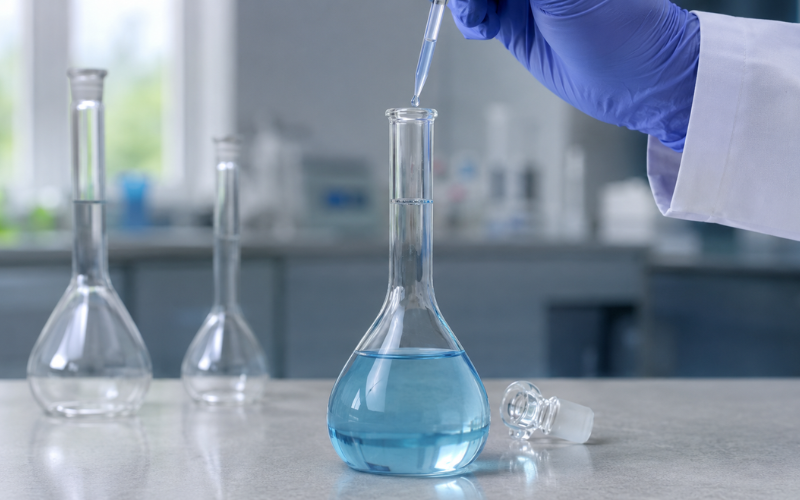
A volumetric flask is a laboratory container designed to hold one exact volume of liquid. It is commonly used in chemistry, medicine, education, quality testing, and research whenever accurate liquid measurement is important.
Unlike a beaker or measuring cup, a volumetric flask has a rounded body, a long narrow neck, and a single calibration line. When the liquid reaches this line correctly, the flask contains the volume printed on its label.
The Design Features That Make a Volumetric Flask Precise
The body of a volumetric flask is usually pear-shaped, giving it enough space to hold and mix a solution. Its flat base allows it to stand safely on a laboratory bench.
The long, narrow neck is an important accuracy feature. Because the neck is thin, even a small change in liquid volume causes a visible change in the liquid level. This makes it easier to align the liquid with the single calibration line.
Most flasks also have a stopper to prevent spills during mixing. Their labels normally show the capacity, accuracy class, calibration temperature, and whether the flask is calibrated to contain a stated volume.
How a Volumetric Flask Measures an Exact Volume
Most standard volumetric flasks are marked TC, meaning “to contain,” or IN, which has the same basic meaning. When filled correctly, the flask contains the printed volume. It is not necessarily designed to deliver that entire volume because a small amount of liquid may remain on its inner surface. NIST calibration procedures identify volumetric flasks as containers commonly calibrated “to contain.”
Temperature also matters because liquids and containers expand or contract as temperature changes. Many laboratory flasks are calibrated at 20°C, although users should always check the temperature printed on the flask.
For a clear liquid, read the bottom of its curved surface, called the meniscus. Keep your eyes level with the calibration mark to avoid an inaccurate reading.
Common Volumetric Flask Sizes and Accuracy Classes
Volumetric flasks are available in many capacities. Common sizes include 10, 25, 50, 100, 250, 500, and 1,000 millilitres. The right capacity depends on the amount of solution being prepared.
A Class A volumetric flask has a smaller permitted measurement error and is normally chosen for precise analytical work. A Class B flask has a wider tolerance and may be suitable for teaching, routine preparation, or work where the highest accuracy is unnecessary.
Glass and Plastic Volumetric Flasks
Many high-quality volumetric flasks are made from borosilicate glass. This glass provides good chemical resistance, remains clear, and handles normal laboratory temperature changes better than ordinary glass.
Plastic flasks are lighter and less likely to break. They can be useful in classrooms, fieldwork, or laboratories where broken glass presents a serious risk. However, some plastics may react with certain chemicals or change shape when exposed to heat.
Glass generally provides better visibility and long-term stability, while plastic offers easier handling and greater break resistance. Chemical compatibility should always be checked before use.
Proper Steps for Using a Volumetric Flask
Begin by checking that the flask is clean and free from cracks, chips, residue, or damaged markings. If preparing a solution from a solid, place the measured substance inside the flask using a clean funnel. Add enough solvent to cover and dissolve the substance, but do not immediately fill to the line.
Swirl the flask gently until the material has completely dissolved. If the solution becomes warm, allow it to return to the required temperature. Then add more solvent until the liquid is close to the calibration mark.
Use a dropper or wash bottle for the final amount. Bring the bottom of the meniscus exactly onto the line while viewing it at eye level. Insert the stopper and slowly invert the flask several times to create a uniform solution.
Preparing Standard Solutions and Dilutions
A volumetric flask is widely used to prepare a standard solution, which contains a carefully known amount of a substance in a specific final volume. The measured substance must be fully transferred into the flask. Any beaker, funnel, or transfer tool used should be rinsed so remaining material enters the flask.
For a dilution, an exact portion of a concentrated stock solution is normally transferred with a suitable pipette. Solvent is then added to the volumetric flask until the final level reaches the calibration line.
Mistakes That Can Affect Measurement Accuracy
Filling above or below the calibration line changes the final volume and therefore changes the solution’s concentration. If too much liquid is added, simply removing some liquid may not correct the solution because some dissolved substance will also be removed.
Another common mistake is reading the meniscus from above or below eye level. This creates a viewing error and can make the liquid appear aligned when it is not.
Accuracy may also be affected by using a hot or very cold solution, filling the flask before the substance has dissolved, leaving air bubbles inside, or working with dirty or damaged glassware. Even a small crack can make the flask unsafe and unreliable.
Volumetric Flask Compared With Other Laboratory Glassware
A graduated cylinder measures several different volumes but is usually less precise than a volumetric flask at its stated capacity. A volumetric flask is designed for one exact final volume.
An Erlenmeyer flask has a wide base and narrow opening that make it useful for swirling, reactions, and temporary storage. However, its printed volume marks are generally approximate.
A beaker is useful for holding, heating, and mixing liquids, but it should not be selected when an exact volume is required.
A volumetric pipette accurately transfers one fixed amount of liquid. The pipette delivers a measured portion, while the volumetric flask establishes the exact final volume of a prepared solution.
Cleaning, Drying, and Storing a Volumetric Flask
Clean a volumetric flask with an appropriate laboratory detergent and rinse it thoroughly with purified water. Avoid rough tools that could scratch its inner surface or damage the calibration mark.
Allow the flask to drain or air-dry when drying is required. Do not place it under strong heat unless the manufacturer confirms that the material and markings can tolerate it.
Store the flask upright in a secure location. Keep its stopper loose or stored separately so it does not become stuck. Never use a flask with a chipped neck, unclear calibration line, or permanent contamination.
Calibration, Tolerance, and Quality Checks
Tolerance is the small difference permitted between the flask’s stated volume and its actual volume. A lower tolerance indicates greater measurement accuracy.
Calibration may be checked by weighing a known amount of purified water under controlled conditions. Professional calibration also considers water temperature, air conditions, equipment accuracy, and the flask’s reference temperature.
A flask should be replaced or professionally checked if it is damaged, has been exposed to unsuitable heat, or produces results that repeatedly fail quality checks.
Choosing the Right Volumetric Flask for Laboratory Work
Select a flask that matches the final volume you need instead of estimating between markings. Choose Class A when high accuracy or certified work is required and Class B when a wider tolerance is acceptable.
Also consider chemical compatibility, working temperature, glass or plastic construction, stopper material, and applicable laboratory standards. A certificate or individual identification number may be useful when measurements must be traceable.
Safe and Reliable Volumetric Flask Use
Handle glass flasks with dry hands and keep them away from the edge of the bench. Wear suitable protective equipment when working with harmful, corrosive, or irritating chemicals.
A volumetric flask is not intended for direct heating. If a preparation releases heat, allow it to cool before making the final volume adjustment.
Clearly label every prepared solution with its name, concentration, preparation date, and any necessary hazard information. Never rely on memory or the appearance of the liquid.
Conclusion
A volumetric flask is a simple but highly accurate tool for preparing solutions at a fixed volume. Its narrow neck, single calibration line, and controlled design help users achieve dependable results. Correct meniscus reading, suitable temperature, proper mixing, and careful cleaning are all necessary for maintaining that accuracy.
FAQS
1. What is a volumetric flask mainly used for?
It is mainly used to prepare solutions with an exact final volume, including standard solutions and laboratory dilutions.
2. Is a volumetric flask more accurate than a graduated cylinder?
Yes. A volumetric flask is generally more accurate at its stated capacity because it is calibrated for one specific volume.
3. Can a volumetric flask be heated?
It should not be heated directly. Heat changes liquid volume and may damage the flask, stopper, or calibration accuracy.
4. Why does a volumetric flask have a narrow neck?
The narrow neck makes small changes in liquid level easier to see, allowing more accurate alignment with the calibration mark.
5. Why should a filled volumetric flask be inverted?
Gentle inversion mixes the contents throughout the flask, helping create a solution with the same concentration from top to bottom.