
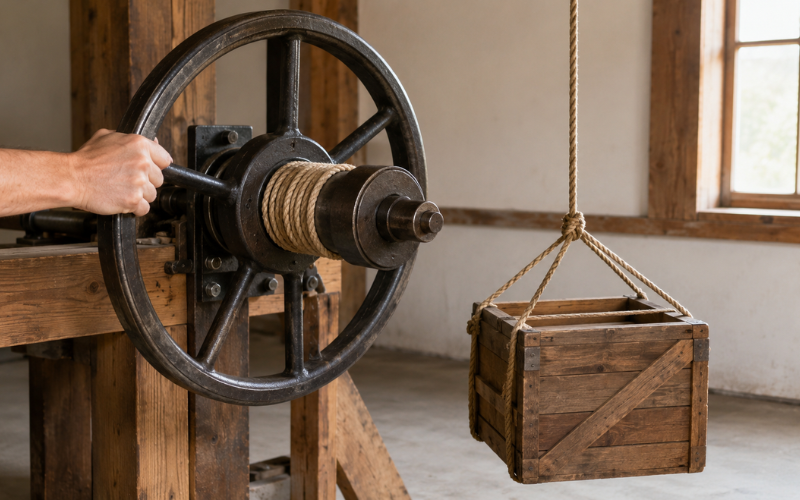
The wheel and axle is a simple machine that helps people move, lift, turn, or control objects with less effort. It consists of a large circular part called the wheel and a smaller central rod called the axle. When one part turns, it causes the other part to turn as well.
It is classified as a simple machine because it changes the size, direction, or effect of an applied force. It does not create energy. Instead, it allows a person to use available energy more effectively.
You probably use wheel and axle systems every day without noticing them. Door knobs, steering wheels, screwdrivers, bicycle wheels, faucets, fishing reels, and many machine controls use the same basic principle. The difference in size between the wheel and the axle can reduce the effort needed to complete a task or increase the speed of movement.
Understanding the Wheel and Axle
Simple definition
A wheel and axle is a simple machine made from two connected circular parts of different sizes. The larger part is the wheel, while the smaller part is the axle. Both are arranged around the same central line, known as an axis.
Force can be applied to either part. When force is applied to the wheel, the axle turns with greater force. When force is applied to the axle, the wheel can move faster or cover a greater distance.
The relationship between the wheel and the axle
The wheel and axle work as a connected system. Because the wheel has a larger radius, its outer edge travels farther during one complete rotation. The axle travels a shorter distance during that same rotation.
This difference allows the system to exchange distance for force. Turning the larger wheel through a longer distance can produce a stronger turning effect at the smaller axle.
How both parts rotate together
In the classic form of this simple machine, the wheel is firmly attached to the axle. When the wheel completes one rotation, the axle also completes one rotation. Their outer edges travel different distances, but their turning speed in rotations per minute is the same.
Some modern systems use bearings that allow a wheel to rotate around a fixed axle. These designs still use the broader wheel-and-axle principle, although the two parts may not always turn as one solid unit.
Main Parts of a Wheel and Axle System
The wheel
The wheel is the larger circular part of the system. A person may push or pull its outer edge to turn the machine. Its larger size gives the user more leverage, which can reduce the force required.
A wheel does not need to look like a vehicle wheel. A round door knob, screwdriver handle, steering wheel, and faucet handle can all act as wheels.
The axle
The axle is the smaller rod or cylinder at the center of the wheel. It supports rotation and transfers the turning force to another object or part of a machine. For example, the spindle inside a door knob acts as an axle and moves the latch when the knob is turned.
The point where force is applied
The place where the user applies effort affects the result. Applying force near the outside edge of the wheel usually makes turning easier because the force acts farther from the center.
If force is applied to the axle instead, the larger wheel can produce faster movement at its outer edge. However, the available output force will usually be lower.
The load or resistance
The load is the object or resistance the system must move. It could be a door latch, a bucket attached to a windlass, a vehicle, or part of a machine. The wheel and axle must provide enough turning force to overcome this resistance.
How a Wheel and Axle Works
Applying force to the wheel
When a person applies force to the wheel, that force acts over a larger distance from the center. This creates a stronger turning effect, or torque, at the axle.
A door knob is a clear example. Turning the narrow spindle directly would be difficult, but the larger knob gives the hand a wider surface to grip. As a result, the spindle can be turned with less effort.
Applying force to the axle
The system behaves differently when force is applied to the axle. The axle turns the larger wheel, whose outer edge travels a greater distance during every rotation. This arrangement can increase movement or speed rather than force.
Vehicle drive systems provide a practical example. The engine and transmission turn an axle, and the attached wheels move the vehicle over a greater distance.
How rotational motion transfers force
The wheel and axle transfer force through rotational motion, which means movement around a central point. The applied force creates a turning effect that passes from one part to the other.
This process may help a user overcome a heavy load, control movement more accurately, or make an object travel farther.
The role of wheel and axle size
The size difference between the two parts is extremely important. A larger wheel combined with a smaller axle provides a greater increase in force when effort is applied to the wheel.
If the wheel and axle are nearly the same size, the system offers less mechanical advantage. However, it may still be useful for control, balance, or smooth movement.
Mechanical Advantage of a Wheel and Axle
Mechanical advantage explained simply
Mechanical advantage describes how much a machine increases an applied force. A mechanical advantage of 5 means that, under ideal conditions, the machine can produce an output force five times greater than the input force.
This does not mean the machine creates free energy. The user applies a smaller force over a longer distance, while the load moves through a shorter distance with greater force.
Wheel and axle formula
When effort is applied to the wheel, the ideal mechanical advantage can be calculated with this formula:
Mechanical advantage = Radius of the wheel ÷ Radius of the axle
The diameter of each part can also be used:
Mechanical advantage = Diameter of the wheel ÷ Diameter of the axle
Both measurements must use the same unit, such as centimeters or inches.
Step-by-step calculation example
Imagine that a wheel has a radius of 20 centimeters and its axle has a radius of 4 centimeters. Divide the wheel’s radius by the axle’s radius:
20 ÷ 4 = 5
The ideal mechanical advantage is 5. In a perfect system, an input force of 10 newtons could produce an output force of 50 newtons at the axle. A real machine would produce slightly less because some energy is lost through friction and other forms of resistance.
Factors that affect efficiency
Real wheel and axle systems are not completely efficient. Friction between moving surfaces, poor alignment, weak materials, and worn parts can reduce performance. The weight of the components may also affect how easily the machine turns.
Bearings, lubrication, correct alignment, and suitable materials help reduce energy loss and improve efficiency.
Types of Wheel and Axle Arrangements
Force applied to the wheel
In this arrangement, effort is applied to the larger wheel and the load acts on the smaller axle. Door knobs, steering wheels, screwdrivers, and windlasses operate mainly in this way. The purpose is usually to increase turning force or improve control.
Force applied to the axle
When effort enters through the axle, the wheel provides the output movement. This arrangement is common in powered vehicles and machines. It can increase speed and distance at the wheel’s outer edge, although it does not multiply output force in the same way.
Fixed and rotating axle systems
In some systems, the wheel and axle are firmly joined and rotate together. In others, the axle remains fixed while the wheel turns around it using a bearing. Some vehicle systems use a rotating axle that turns the wheels.
Each arrangement serves a different purpose, but all use circular motion to improve movement, control, or force transfer.
Everyday Examples of the Wheel and Axle
Door knobs
A door knob acts as the wheel, while the central spindle acts as the axle. The wide knob makes it easier to rotate the narrow spindle and pull back the latch.
Steering wheels
A steering wheel allows a driver to control the steering system with less effort and greater accuracy. Its large diameter creates more turning effect than a small central shaft would provide.
Bicycles and vehicle wheels
Wheels reduce the resistance involved in moving a load across a surface. In many vehicles, power reaches the wheel through an axle. Bearings help the parts rotate smoothly while supporting the vehicle’s weight.
Screwdrivers
The wide handle of a screwdriver acts as the wheel, and the metal shaft acts as the axle. The handle makes it easier to produce enough turning force to tighten or loosen a screw.
Faucets and handles
Many round faucet handles use the wheel and axle principle. Turning the larger handle rotates a smaller stem that controls the flow of water.
Windlasses and fishing reels
A windlass uses a wheel or crank to rotate a drum that winds a rope. Fishing reels use a similar arrangement to pull in line with controlled effort.
Uses of the Wheel and Axle in Different Fields
Transportation
Cars, bicycles, trains, carts, wheelchairs, and many other forms of transportation depend on wheels and axles. These systems support loads, enable smooth movement, and transfer power.
Household tools and appliances
Door handles, rolling pins, can openers, pizza cutters, screwdriver handles, and appliance controls use wheel-and-axle features. These designs make ordinary tasks easier and more comfortable.
Construction and manufacturing
Construction equipment uses wheels, axles, rollers, winches, and hand controls to move materials and operate heavy machinery. Factory machines also use rotating shafts and wheels to transfer power between components.
Agriculture
Tractors, carts, irrigation controls, harvesting equipment, and manual well systems rely on wheel and axle arrangements. They help workers transport loads and operate equipment more efficiently.
Engineering and machinery
Engineers use the wheel and axle principle in motors, turbines, gear systems, conveyor rollers, and control mechanisms. Although modern machines can be complex, many still depend on this basic simple machine.
Wheel and Axle Compared with Other Simple Machines
Wheel and axle vs. lever
A lever is a rigid bar that moves around a fixed point called a fulcrum. A wheel and axle rotates around a central axis. Both can increase force by allowing effort to act farther from the center or turning point.
Wheel and axle vs. pulley
A pulley is a grooved wheel that guides a rope, belt, or cable. It may change the direction of force or help lift a load. A wheel and axle transfers force directly between two connected circular parts.
Wheel and axle vs. gear
A gear is a toothed wheel designed to connect with another gear. Gears can change speed, force, or direction. A basic wheel and axle does not require teeth or a second wheel, although it can be combined with gears in a larger machine.
Benefits and Limitations of the Wheel and Axle
The main benefit of a wheel and axle is reduced effort. When force is applied to a large wheel, the system can produce a stronger turning effect at the axle. It also offers better control because the user can make smooth and accurate movements.
Depending on where force is applied, the machine may increase force, speed, or travel distance. This flexibility makes it useful in both hand-operated tools and powered equipment.
However, every system has limitations. Friction causes energy loss, while repeated use can wear down axles, bearings, and connecting parts. A badly aligned or poorly maintained system may become difficult to turn. Increasing force also requires the user to move the wheel through a greater distance, so the machine does not eliminate work.
A Simple Wheel and Axle Experiment
Materials required
For a basic experiment, use a round cardboard disc, a pencil, some string, tape, and a small lightweight object such as a toy block. Adult supervision may be helpful when making a hole in the cardboard.
Assembly steps
Make a small hole in the center of the cardboard disc and push the pencil through it. Secure the disc to the pencil so that they rotate together. Tie one end of the string to the pencil and attach the small object to the other end.
Turn the cardboard wheel slowly. As the pencil rotates, the string will wrap around it and lift the object.
What to observe
Notice that the outside edge of the cardboard travels a long distance during each turn, while the string wraps around the smaller pencil over a shorter distance. The larger cardboard wheel makes it easier to turn the pencil and lift the load.
How to explain the results
The cardboard acts as the wheel, the pencil acts as the axle, and the toy is the load. Effort applied to the larger wheel creates a stronger turning effect at the smaller axle. This demonstrates mechanical advantage in a simple and visible way.
Common Misconceptions About the Wheel and Axle
Not every wheel is a simple machine
A wheel by itself does not always provide mechanical advantage. It must be part of a working arrangement that transfers force, supports motion, or changes the effect of effort.
The axle does more than hold the wheel
An axle can support a wheel, but it can also transfer force and rotational motion. In powered machines, the axle may carry energy from a motor to the wheel.
Mechanical advantage does not create extra energy
A wheel and axle can increase output force, but it cannot create energy. A smaller input force must act through a greater distance. Friction also means that some input energy is converted into heat and sound.
Key Facts About the Wheel and Axle
The wheel and axle is a simple machine made from two circular parts of different sizes that share a central axis. Force may be applied to either part to increase turning force, movement, speed, or control. When effort is applied to the wheel, its ideal mechanical advantage equals the wheel radius divided by the axle radius.
Common examples include door knobs, steering wheels, screwdriver handles, bicycles, faucets, windlasses, and fishing reels. Its actual efficiency depends on friction, alignment, materials, bearings, and maintenance.
Conclusion
The wheel and axle is one of the simplest and most useful machines in everyday life. By connecting a large wheel to a smaller axle, it can increase turning force, improve control, or create faster movement. Its operation depends mainly on rotational motion and the difference between the sizes of its two parts.
From opening a door and driving a car to operating farm equipment and factory machinery, the wheel and axle continues to make work and movement easier. Learning its basic principle also helps explain how many familiar tools and complex machines operate.
FAQs
1. Who invented the wheel and axle?
No single inventor is known. Early wheels appeared thousands of years ago, and people gradually adapted them for transport, pottery, lifting devices, and other tools.
2. Is a bicycle an example of a wheel and axle?
Yes. A bicycle uses wheels, axles, and bearings to support movement. Its complete drive system also includes other parts, such as pedals, cranks, chains, and gears.
3. Does a larger wheel provide more mechanical advantage?
A larger wheel provides more mechanical advantage when effort is applied to the wheel and the axle size stays the same. A smaller axle can also increase the mechanical advantage.
4. Can the wheel and axle increase speed?
Yes. When force is applied through the axle, the outer edge of the larger wheel travels farther and can move faster. The trade-off is a reduction in available output force.
5. Why is a wheel and axle useful?
It can reduce the effort needed to turn or move a load, improve control, transfer power, and increase movement. These benefits make it valuable in transportation, household tools, agriculture, and machinery.