
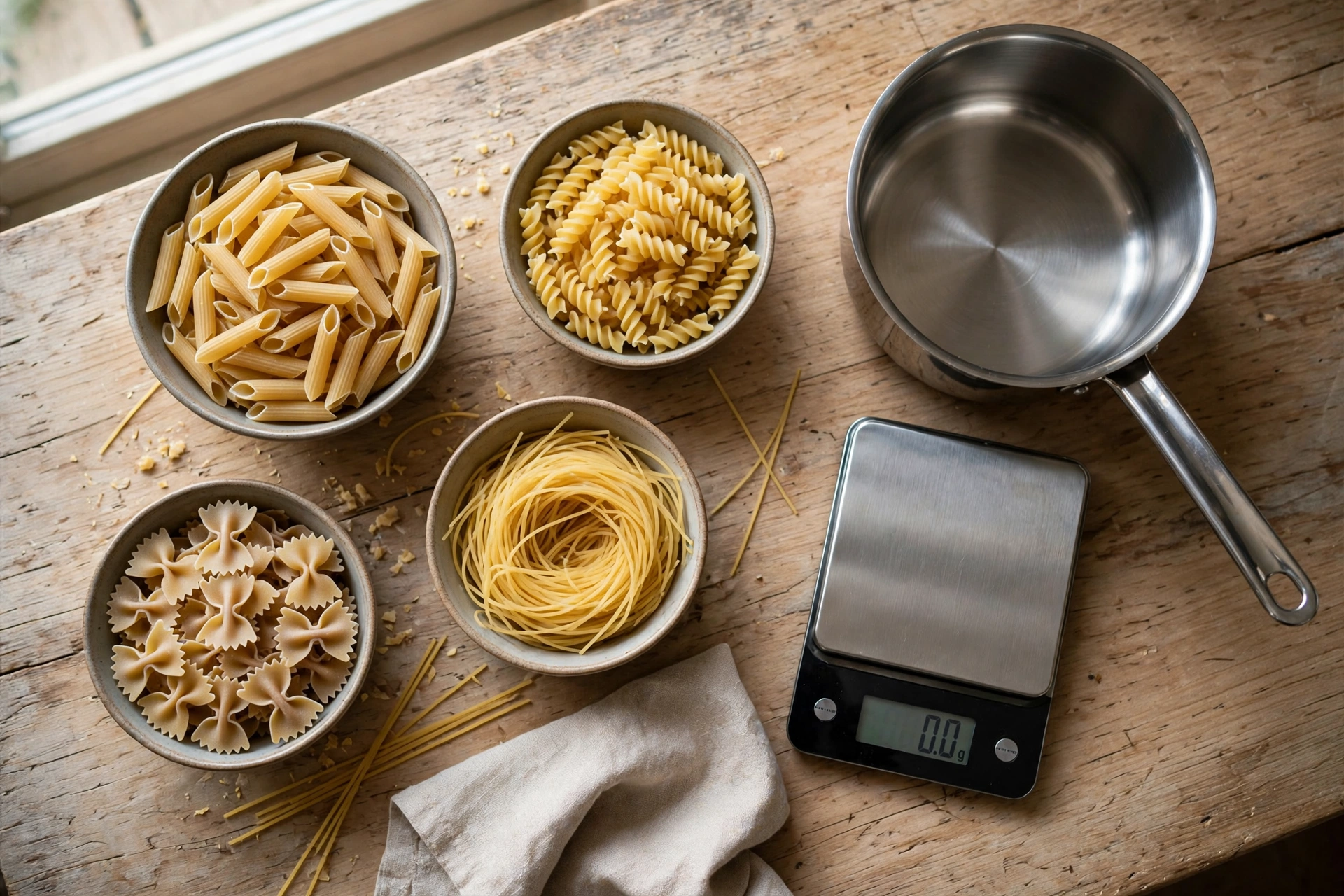
Pasta is easy to get wrong in the simplest way. Tip a little extra into the pot just in case, and you end up with leftovers no one wants. Cook too little, and someone leaves the table still hungry. The question of how much pasta per person to cook is really about balance: enough pasta to feel satisfied, enough sauce and vegetables to complete the meal, and no large pot of extras.
This guide gives you a clear starting point and shows how to adjust it. You will find the usual dry and fresh pasta weights for an adult main dish, why fresh pasta needs a larger weight, how shape changes what a portion looks like, and how appetite, sauce, and the rest of the meal change the amount. It also covers children, groups, measuring without a scale, and leftovers. The figures reflect widely published general guidance, not a personal eating plan.
The Short Answer on How Much Pasta Per Person
For most adults, a good starting point for a main dish is 75 to 100 grams of dry pasta per person. That range appears in much published cookery guidance, including the Good Food guide to cooking pasta, which gives 80 to 100 grams of dry pasta per person. About 50 to 60 grams works well as a side dish or first course, and 100 to 125 grams suits a very hungry eater or a meal where pasta is the only substantial dish.
Those numbers are for dry pasta weighed before cooking. Dry pasta takes in water as it cooks and roughly doubles in weight, so 100 grams dry becomes about 200 grams cooked. Weighing dry pasta is therefore the most reliable way to plan. Cooked pasta is harder to judge, because its weight depends on cooking time, water absorbed, and whether sauce was added before weighing. Move within the range according to the meal.
Dry Pasta Versus Fresh Pasta: Why the Weights Are Different
Dry and fresh pasta are not interchangeable by weight. Dry pasta has had most of its water removed, while fresh pasta still holds moisture, so the same weight of fresh pasta contains less actual pasta and more water. You therefore need a larger weight of fresh pasta for a similar amount of food. Widely published guidance puts fresh pasta at about 115 to 150 grams per person for a main dish, roughly one-third to one-half more by weight than the dry pasta range.
Filled fresh pasta, such as ravioli or tortellini, needs more again, because part of the weight is filling. Published guidance often puts filled pasta at about 175 to 200 grams per person for a main dish, and package guidance is worth reading because fillings and sizes vary a great deal. Fresh pasta also cooks much faster, often in just a few minutes, so taste a piece early. Dry pasta keeps well in a cupboard, while fresh pasta must be used soon or frozen, so plan the portion before you shop.
How Pasta Shape Changes the Portion You See
The weight per person stays broadly the same across shapes, but the look of the portion changes a lot, and that can fool the eye. A mound of spaghetti looks very different from a scoop of penne, even when both started at 100 grams dry. Long shapes tangle and trap air, so they look larger in the bowl. Short shapes pack together more tightly, so the same weight can look smaller. Small shapes such as orzo look smaller still and are easy to over-serve. A scale is more reliable than a cup: cups of dry penne, fusilli, and farfalle do not weigh the same.
Shape also affects how sauce behaves, and that affects how much pasta feels right. Tube shapes and twists hold chunky sauces well, because sauce catches in the hollows and folds. Long, smooth strands suit lighter sauces that coat rather than fill, and flat ribbons work well with creamy sauces that cling. A shape that holds sauce well can feel satisfying with a slightly smaller portion. For soups, use less pasta, because broth and vegetables fill the bowl. For baked pasta, start at the top of the range, because moisture is lost in the oven.
How Appetite, Sauce, and the Rest of the Meal Change the Amount
Appetite is the largest variable in any portion guide. Age, activity, time of day, and what else has been eaten all matter. Active people and those who skipped lunch usually want more; people eating late or after a large lunch usually want less. Start in the middle of the range, watch what gets eaten, and adjust next time. Sauce changes the portion too: a light sauce of oil, garlic, and herbs leaves pasta as the main substance, while a hearty sauce with meat, beans, or plenty of vegetables adds bulk of its own, so a smaller amount of pasta can still satisfy.
The rest of the meal matters too. Pasta with a large salad and bread needs a smaller portion than pasta served alone. The Eatwell Guide presents starchy foods such as pasta as just over a third of what we eat overall, with balance reached over a day or a week rather than at every meal. That supports the advice here: pasta works best as part of a varied plate, with vegetables and protein alongside it. Ideas such as the healthy dinner ideas on this site show how that balance can look on an ordinary weeknight. If you have a health condition or a special dietary need, general guidance is not a substitute for advice from your own clinician or a registered dietitian.
How Much Pasta for Children
Children need less pasta than adults, and the amount depends far more on age and appetite than on any single rule. As a general starting point, widely published guidance suggests about 50 to 60 grams of dry pasta for a child, roughly half to two-thirds of the usual adult main-dish portion. Younger children need less, older children and teenagers need more, and a hungry teenager may eat close to an adult portion. The best guide is the child, the time of day, and what else is on the plate. Serve a modest portion first and offer more if needed. That reduces waste and keeps vegetables and protein alongside the pasta.
Fresh and filled pasta need the same adjustment for children as for adults: a child portion of fresh pasta weighs more than a child portion of dry pasta, and filled pasta weighs more again because of the filling. If you cook one pot for adults and children together, weigh the total for the group and serve the children first, so their portions are set aside before adult servings are taken. The Eatwell Guide does not apply to children under two, who have different needs. If you have questions about a child’s eating, ask a health professional who knows the child.
Cooking for a Group: A Simple Way to Scale Up
Scaling up is simple arithmetic, but it is easy to overdo because hosts worry about running out. Start with the per-person weight you have chosen, multiply by the number of people, and add only a small margin if you expect seconds. A modest margin of about one extra adult portion for every six to eight people is usually enough. For four adults, 75 to 100 grams each means 300 to 400 grams, less than a standard 500 gram pack. For six, 450 to 600 grams; for eight, 600 to 800 grams; for ten, 750 grams to 1 kilogram; for twelve, 900 grams to 1.2 kilograms. For a side dish, use 50 to 60 grams per person. Count each child as roughly half an adult portion.
Large amounts need a large pot and plenty of water. Published cookery guidance suggests about 500 milliliters to 1 liter of water for every 100 grams of dry pasta, so a pot that is comfortable for two people will be crowded for eight. If you do not have a pot large enough, cook in two batches rather than cramming pasta into one small pot, where it will stick and cook unevenly. Stir at first, keep the water boiling, and taste before the package time suggests. Drain well, keep a little cooking water aside, and toss with sauce promptly. For a buffet, use the top of the range, but do not leave pasta at room temperature for long; cook a second batch later if needed.
Measuring Without a Scale
A kitchen scale is the easiest and most reliable tool for pasta portions. Weigh the dry pasta in a bowl, note the weight, and pour it into the pot. After a few weeks, you will recognize the right amount by sight. Without a scale, a bundle of spaghetti held between thumb and forefinger is a common guide: a snug bundle about the width of a small coin is often described as roughly one adult portion. A pasta measure or the hole in a spaghetti spoon is more consistent.
Cups and handfuls are rough guides only. Package sizes can help: many packs weigh 500 grams, which serves about five to six adults as a main dish. One pack for four leaves a little in reserve; eight will need two packs. Fresh pasta packs vary more, so read the pack weight and divide by the fresh pasta range.
Cooking, Serving, and Using Leftovers Well
Fill a large pot with plenty of water, add salt if you wish, and bring it to a full boil before adding the pasta. Stir at the start so pieces do not stick, and taste near the end of the suggested time. Pasta that is tender but still firm holds sauce better than pasta that has gone soft. Drain promptly, do not rinse unless a recipe calls for it, and toss with sauce before serving so every piece is coated.
Store pasta and sauce separately. Plain cooked pasta tossed with a little oil, cooled quickly, and kept covered in the fridge can be reheated and combined with fresh sauce the next day. Reheat until hot throughout, and throw it away if unsure whether it is still fresh. Deliberate leftovers can help: cook a little extra plain pasta for a busy tomorrow and build the next meal around it.
Common Portion Mistakes
The most common mistake is cooking by habit. Many cooks tip pasta from the pack and discover too late that it has doubled in size. Weighing dry pasta, even for a few weeks, replaces guesswork with a number you can trust. The second mistake is using the same weight for every role: a main dish, side dish, first course, and soup need different amounts. A third is forgetting sauce and sides: a plate where pasta, vegetables, and protein share the space feels more balanced than one that is mostly pasta.
That idea links to wider healthy eating guidance. Fiber foods such as whole grains, beans, lentils, fruit, and vegetables add bulk and variety to the plate, and the NHS Health Check information on this site sets out how routine checks look at overall health patterns rather than single meals. A single pasta dinner does not define a diet, and the pattern across the week matters more than any one plate. A final mistake is treating the guide weight as a rule to obey exactly. If everyone is still hungry, cook a little more next time. If food is regularly left over, cook a little less. Note what worked, adjust by a small amount, and let the guide become your own.
General information note: This article is general information only. It is not medical advice, it does not diagnose or treat any health condition, and it is not a personal eating plan. If you have a health condition, a food allergy, or a special dietary need, speak to your GP or a registered dietitian before making a major change to what you eat.
Frequently Asked Questions
How much pasta per person should I cook for a main dish?
Start with 75 to 100 grams of dry pasta per adult for a main dish. Use about 50 to 60 grams if pasta is a side dish or a first course, and move toward 100 to 125 grams for a very hungry eater. Weigh it dry, because it roughly doubles as it cooks.
How much fresh pasta per person do I need?
Allow about 115 to 150 grams of fresh pasta per person for a main dish. Fresh pasta holds moisture, so it needs a larger weight. Filled pasta such as ravioli needs more again, often 175 to 200 grams, because part of the weight is filling.
Does the shape of pasta change how much I should cook?
The weight per person stays broadly the same across shapes, but the look of the portion changes. Long shapes look larger, short shapes pack more tightly, and small shapes look modest even at the same weight. Measure by weight, because a cup of one shape does not weigh the same as a cup of another.
How much pasta per person should I cook for children?
Allow about 50 to 60 grams of dry pasta for a child as a starting point, roughly half to two-thirds of an adult main-dish portion. Younger children need less and older children need more. Serve a modest portion first, offer more if needed, and keep vegetables and protein on the plate too.
How do I scale pasta portions for a large group?
Multiply your chosen per-person weight by the number of people, count each child as roughly half an adult portion, and add only a small margin of about one extra adult portion for every six to eight people if you expect seconds. Use a large pot, or cook in two batches.
Conclusion
How much pasta per person comes down to a simple starting point and a few sensible adjustments. Begin with 75 to 100 grams of dry pasta per adult for a main dish, use 115 to 150 grams for fresh pasta, and adjust for appetite, sauce, and the rest of the meal. Give children a smaller portion, scale up for a group by multiplying rather than guessing, and weigh the pasta dry so the result is predictable. Serve pasta as part of a balanced plate, store leftovers separately, and let what gets eaten guide you next time. Cooked this way, pasta stops being a guessing game and becomes what it should be: a satisfying meal in the right amount, with little waste and no one left hungry.