
Introduction
An arc detector breaker is a safety device designed to recognize dangerous electrical arcing and disconnect power before the intense heat can start a fire. Its standard name is an arc-fault circuit interrupter, commonly shortened to AFCI.
An ordinary circuit breaker mainly responds to an overload or short circuit. An AFCI provides another layer of protection by monitoring the circuit for unusual electrical patterns linked to damaged wires, loose connections, and deteriorated insulation. The U.S. Consumer Product Safety Commission explains that common breakers may not respond to early arcing and sparking, while AFCIs are specifically designed to address these hazards. U.S. Consumer Product Safety Commission
Arc Faults and the Electrical Dangers They Create
An arc fault happens when electricity moves across an unintended gap or damaged connection. The resulting spark may produce enough heat to ignite wood, insulation, carpeting, or other nearby material.
Arc faults can develop because of loose terminals, aging insulation, bent power cords, nails driven through wiring, or furniture pressing against cables. Unlike a complete short circuit, an arc may draw too little current to trip a standard breaker. It can therefore remain active while creating dangerous heat.
How an Arc Detector Breaker Identifies Unsafe Current Patterns
An AFCI continuously watches the flow of electricity through a circuit. Its internal electronics look for irregular patterns associated with hazardous arcing.
Normal devices can also create harmless electrical noise. Vacuum cleaners, switches, dimmers, and tools with motors are common examples. A modern arc detector breaker is designed to distinguish normal activity from patterns that suggest a dangerous fault. When it identifies a serious arc, it quickly opens the circuit and stops the power.
Series Arcs, Parallel Arcs, and Ground Arcs Explained
A series arc forms along a single conductor, often at a loose terminal or broken section of wire. Because the load limits the current, a normal breaker may not recognize it as an overload.
A parallel arc occurs between two conductors, such as a hot wire and neutral wire. A ground arc develops between an energized conductor and a grounding path. These faults may create more current than series arcs, but they can still be intermittent or difficult for an ordinary breaker to detect.
Main Types of Arc Detector Breakers
Branch/Feeder AFCI Breakers
Branch/feeder AFCIs were an earlier form of arc-fault protection. They mainly protected permanent branch-circuit wiring against certain parallel arc faults. They are less comprehensive than the combination AFCI breakers normally used in newer installations.
Combination AFCI Breakers
A combination AFCI detects both series and parallel arc faults. The word “combination” refers to its combination of arc-detection abilities; it does not mean that the breaker automatically includes GFCI protection.
Dual-Function AFCI/GFCI Breakers
A dual-function breaker combines AFCI and GFCI protection in one device. It helps reduce both electrical fire risks and shock hazards caused by current leaking to ground. It may be used where both forms of protection are required.
Arc Detector Breaker vs Standard Breaker vs GFCI
A standard breaker protects wiring from excessive current caused by overloads and short circuits. An AFCI focuses on dangerous arcing that could start a fire. A ground-fault circuit interrupter, or GFCI, primarily protects people from electrical shock by detecting current flowing along an unintended path.
One device does not always replace another. A circuit may require both AFCI and GFCI protection, which can be provided through separate devices or a compatible dual-function breaker.
Where Arc Detector Breakers Are Commonly Installed
Arc detector breakers are commonly found on circuits serving bedrooms, living rooms, dining rooms, family rooms, hallways, closets, kitchens, laundry areas, recreation rooms, and similar residential spaces.
Their exact placement depends on the electrical code adopted by the local authority, the age of the property, and the work being completed. Older homes may not have AFCIs unless their electrical systems have been upgraded.
Electrical Code Requirements for AFCI Protection
The National Electrical Code (NEC) contains broad AFCI requirements for many residential branch circuits. However, the NEC is a model standard, and states or local authorities may adopt different editions or make amendments.
A new circuit, extension, renovation, or breaker replacement may trigger requirements that did not apply when the home was originally built. A licensed electrician or local building department can identify the rules that apply to a particular property.
Benefits and Limitations of Arc Detector Breakers
The main benefit of an AFCI is its ability to detect some fire-producing faults that standard breakers can miss. This makes it especially useful where wiring is concealed inside walls and ceilings.
However, AFCIs cannot prevent every electrical fire. They do not repair damaged wiring, replace smoke alarms, or make unsafe appliances acceptable to use. The CPSC notes that AFCIs can reduce the effects of arc faults but cannot eliminate every possible risk.
Common Reasons an Arc Detector Breaker Trips
A trip may be caused by a damaged cord, loose outlet connection, faulty appliance, pinched cable, or wiring problem. An overloaded or shorted circuit can also trip the breaker because most AFCIs still provide ordinary overcurrent protection.
Some trips involve wiring mistakes, including shared or incorrectly connected neutral wires. A trip should not automatically be dismissed as a defective breaker, particularly when it happens repeatedly.
Safe Troubleshooting for Repeated or Unexplained Tripping
Start by turning off or unplugging everything on the affected circuit. Reset the breaker according to its instructions, then reconnect appliances one at a time. If the breaker trips after a particular item is connected, stop using that item until it has been checked.
If the breaker trips with all loads disconnected, will not reset, or produces a diagnostic light, contact a qualified electrician. Never bypass an AFCI or replace it with a standard breaker simply to stop the tripping.
Signs an Arc Detector Breaker May Be Faulty
A breaker may require professional inspection if its test button does not work, it will not reset with the circuit loads disconnected, or it shows physical damage. Discoloration, a burning smell, crackling, or unusual heat near the electrical panel requires prompt attention.
Testing and Maintaining an AFCI Breaker
Most AFCI breakers have a clearly marked TEST button. The Electrical Safety Foundation International recommends testing AFCIs after installation and once each month, while also following the manufacturer’s instructions. If the device does not trip during the test, it should be evaluated and replaced if necessary.
Choosing a Compatible Arc Detector Breaker
A replacement must match the electrical panel, circuit amperage, voltage, number of poles, and required protection type. Physical fit alone does not prove compatibility.
Check the panel label and manufacturer documentation for approved breaker models. Avoid selecting a higher amperage merely to prevent trips because this could leave the circuit wiring without proper overcurrent protection.
Installation and Replacement Safety Considerations
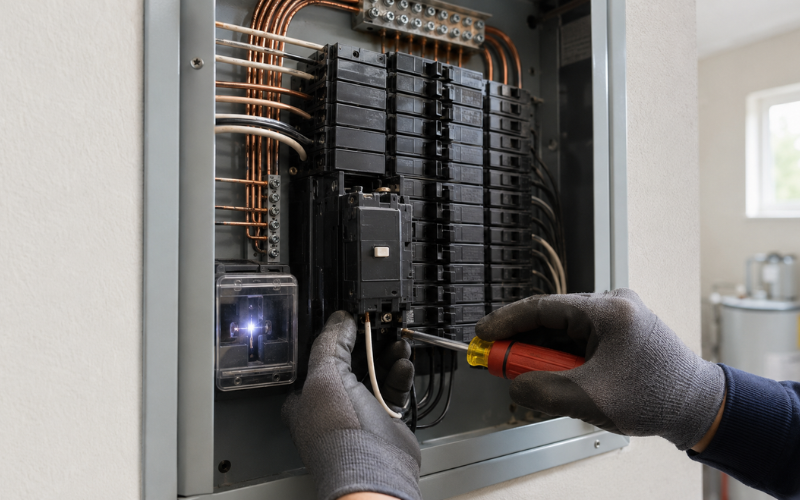
Breaker installation should be handled by a licensed electrician. Removing a panel cover can expose energized parts, and some components may remain live even when the main disconnect is switched off.
An electrician can confirm compatibility, inspect the neutral and grounding connections, test the circuit, and determine whether a trip is coming from the breaker, connected equipment, or permanent wiring.
Arc Detector Breaker Costs and Expected Service Life
The breaker alone often costs more than a standard model. Current U.S. retail examples commonly place single-pole AFCI and dual-function breakers at approximately $50 to $80, although brand, panel type, amperage, and location affect pricing.
Professional installation and troubleshooting add to the total cost. There is no universal replacement age for every AFCI. A properly installed device may work for many years, but it should be replaced if it fails testing, becomes damaged, is recalled, or no longer operates reliably.
Conclusion
An arc detector breaker adds important protection by identifying electrical patterns that an ordinary breaker may overlook. It can respond to hidden problems such as damaged cables, loose connections, and deteriorating insulation before they develop into a larger hazard.
Regular testing, correct breaker selection, and professional troubleshooting are essential. When an AFCI trips repeatedly, the safest response is to investigate the underlying cause rather than remove the protection.
FAQs
1. Can an arc detector breaker prevent electrical fires?
It can significantly reduce the risk of fires caused by certain arc faults by shutting down the circuit. However, it cannot prevent every fire or compensate for damaged wiring, unsafe appliances, or poor electrical maintenance.
2. Why does an AFCI trip when an appliance is connected?
The appliance may have a damaged cord, internal fault, loose plug, or motor problem that creates an unsafe electrical pattern. If the same appliance repeatedly causes trips, stop using it and have it inspected.
3. Can an arc detector breaker replace a GFCI?
A standard AFCI cannot replace a GFCI because the two devices address different hazards. Where both protections are required, use properly coordinated devices or a listed dual-function AFCI/GFCI breaker.
4. How often should an AFCI breaker be tested?
General safety guidance recommends testing it once a month, although the manufacturer’s instructions should always be followed. If pressing the test button does not trip the breaker, arrange for professional evaluation.
5. Can a homeowner replace an arc detector breaker?
Breaker replacement involves serious shock, fire, and compatibility risks. Even with the main breaker turned off, parts of the panel can remain energized. A licensed electrician should normally perform the replacement.