
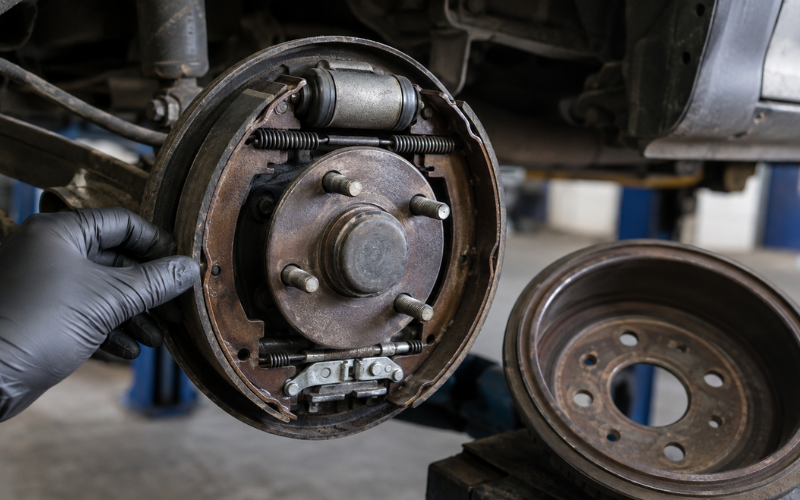
Drum brakes are a type of braking system that slows a vehicle by pressing curved brake shoes against the inside of a rotating metal drum. The friction created between these parts reduces wheel speed and brings the vehicle to a stop.
Although many modern vehicles use disc brakes at the front, drum brakes are still commonly found on rear wheels. They are also used for parking-brake systems and on some trucks, trailers, and commercial vehicles.
Understanding how drum brakes work can help drivers notice problems before they become serious. This guide explains their main parts, benefits, limitations, warning signs, maintenance needs, and replacement considerations in simple language.
Drum Brakes at a Glance
Drum brakes are most often installed on the rear axle because the front brakes usually handle more of the stopping force. When a vehicle slows down, its weight shifts toward the front. This is why many vehicles combine front disc brakes with rear drum brakes.
Rear drum brakes may perform two jobs. They operate as regular service brakes when the driver presses the brake pedal, and their internal shoes can also hold the vehicle still when the parking brake is applied.
How Drum Brakes Work
When the driver presses the brake pedal, the master cylinder sends pressurized brake fluid through the brake lines. The fluid enters a wheel cylinder inside each drum brake assembly.
Small pistons in the wheel cylinder move outward and push the brake shoes against the inside surface of the rotating drum. The resulting friction slows the drum, wheel, and vehicle. This basic hydraulic action is also described in technical brake-system guidance hosted by the National Highway Traffic Safety Administration.
When the driver releases the pedal, return springs pull the shoes away from the drum. A small gap remains between the surfaces, allowing the wheel to rotate freely.
Parts Inside a Drum Brake Assembly
A wheel cylinder sits near the top of the assembly and pushes the shoes outward. Return springs pull them back after braking, while hold-down springs keep the shoes correctly positioned against the backing plate.
The adjuster mechanism maintains the proper gap between the shoes and drum as the friction material wears. The backing plate supports the entire assembly and provides contact points for shoe movement.
A mechanical lever and cable are normally connected to one of the shoes for the parking brake. Pulling the parking-brake lever or pressing the parking-brake pedal spreads the shoes without relying on normal hydraulic pressure.
Leading, Trailing, and Self-Energizing Brake Shoes
Brake-shoe operation depends on the design of the assembly. In a leading-and-trailing system, drum rotation helps pull one shoe more firmly against the braking surface. The other shoe provides a different amount of braking force based on its position and the direction of rotation.
Many systems use a self-energizing or duo-servo design. Friction causes one shoe to transfer force to the other, increasing the pressure against the drum. This produces strong braking without requiring extremely high hydraulic pressure.
The primary and secondary shoes may have different lining lengths or positions. Installing them on the wrong sides can affect braking performance, so the vehicle’s service instructions must always be followed.
Drum Brakes vs. Disc Brakes
Drum and disc brakes use friction to slow a vehicle, but they manage heat differently. Disc brakes squeeze pads against both sides of an exposed rotor. Their open design allows heat to escape quickly, making them suitable for the front axle and repeated heavy braking.
Drum brakes hold their working parts inside an enclosed drum. They can provide strong braking force and often last a long time during normal rear-brake use. However, heat cannot escape as easily. Heavy or repeated braking may therefore cause brake fade, which is a temporary reduction in stopping power.
Disc brakes are usually easier to inspect and service because fewer parts must be removed. Drum brakes contain more springs, clips, and adjustment hardware. However, they are often less expensive to manufacture, and their design makes it easy to include a mechanical parking brake.
Advantages and Limitations of Drum Brakes
One major advantage of drum brakes is their self-energizing action. Drum rotation helps press the shoes against the braking surface, allowing the system to create useful stopping force with moderate hydraulic pressure.
The large friction surfaces can also provide good service life. Because the assembly is enclosed, its parts receive some protection from road debris. The system can also hold a parked vehicle effectively through a simple cable-operated mechanism.
The enclosed design has disadvantages as well. Heat, dust, and moisture can remain trapped inside the drum. Excessive heat may reduce braking performance, while moisture may cause temporary grabbing, noise, or corrosion. Drum brakes also require correct adjustment and careful installation of their internal hardware.
Common Signs of Worn or Failing Drum Brakes
Reduced braking response is one of the most important warning signs. The brake pedal may feel low, soft, or inconsistent if the shoes are badly adjusted, the hydraulic system contains air, or a wheel cylinder is leaking.
Grinding or scraping may indicate worn friction material or metal-to-metal contact. Squealing can come from glazed shoes, dust, worn hardware, or vibration. A pulsing pedal may point to a drum that is distorted or no longer perfectly round.
A vehicle that pulls to one side during braking may have uneven shoe wear, contamination, a seized adjuster, or a faulty wheel cylinder. Weak parking-brake performance can also indicate worn shoes or an incorrectly adjusted cable.
What Causes Drum Brake Problems
Brake shoes naturally become thinner as their friction material wears. Oil, grease, or brake fluid can also contaminate the lining and greatly reduce its ability to create friction.
The drum itself may develop deep grooves, heat spots, cracks, glazing, or an uneven shape. Wheel cylinders can leak or seize, preventing the shoes from moving correctly. Return springs may weaken, break, or corrode with age.
Automatic adjusters can become stuck because of rust, dirt, incorrect assembly, or a lack of approved lubrication. Poor installation may leave the shoes too close to the drum or too far away. Regular exposure to water, road salt, heavy loads, and high temperatures can make these problems develop faster.
Drum Brake Inspection and Wear Limits
A safe inspection begins with the vehicle parked on a firm, level surface. The wheels must be secured, and the vehicle must be raised only at approved lifting points and supported by correctly rated jack stands.
After removing the wheel and drum, a technician examines the shoe linings for wear, cracking, glazing, or contamination. The drum should be checked for scoring, cracks, heat damage, and distortion. Its inside diameter must be measured and compared with the maximum limit provided by the vehicle or drum manufacturer.
The wheel-cylinder boots and surrounding areas should be dry. Wetness may indicate a brake-fluid leak. Springs, clips, adjusters, the backing plate, and parking-brake parts also need inspection.
There is no single wear limit or inspection schedule for every vehicle. Manufacturer schedules differ, so drivers should follow their owner’s manual. For example, Ford’s official maintenance guidance lists inspections of brake shoes, drums, linings, hoses, and the parking brake at specified intervals for the model covered by that manual—not as a universal interval for all vehicles.
Drum Brake Cleaning and Routine Maintenance
Brake assemblies must be cleaned carefully because old brake dust may contain harmful material. The EPA advises against using compressed air, a dry brush, or a dry rag because these methods can send fine particles into the air. It recommends approved dust-control methods and notes that uncertain components may be safer to service professionally.
Only an approved brake-cleaning method should be used. Lubricant belongs on specific metal contact points and adjuster threads, not on the drum or shoe linings. Any friction surface contaminated by grease or brake fluid may require replacement.
Adjusting Drum Brakes Correctly
Correct adjustment keeps the shoes close enough to the drum for quick braking without causing constant contact. If the gap is too large, the pedal may travel farther before the brakes engage. If it is too small, the brakes may drag, overheat, and wear quickly.
Many modern drum brakes have automatic adjusters, but these mechanisms can seize or be installed incorrectly. A properly adjusted drum may have a slight, even drag when rotated, although the correct procedure varies by vehicle.
Replacing Brake Shoes, Drums, and Hardware
Brake shoes require replacement when the lining reaches its service limit, becomes contaminated, cracks, separates, or wears unevenly. Shoes should normally be replaced on both wheels of the same axle to maintain balanced braking.
A drum may be resurfaced only if it remains within its permitted diameter and meets the manufacturer’s requirements. Cracked, badly damaged, overheated, or oversized drums must be replaced.
New springs and related hardware are often sensible during a brake-shoe replacement because old parts can weaken through repeated heating and movement. Leaking or seized wheel cylinders also require attention. Opening the hydraulic system may make brake bleeding necessary.
After installation, the shoes must be adjusted, the service and parking brakes tested, and any bedding procedure provided by the manufacturer followed.
Drum Brake Service Life and Replacement Costs
There is no guaranteed lifespan for drum brake shoes. Their wear depends on vehicle design, driving style, road conditions, load, adjustment, and maintenance. Rear shoes may last longer than front disc pads because rear brakes usually handle less stopping force, but they still need regular inspection.
Replacement cost depends on labor rates and whether the job requires only shoes or also needs drums, hardware, adjusters, or wheel cylinders. Delaying repairs can increase the cost because worn shoes may damage otherwise reusable drums.
How to Make Drum Brakes Last Longer
Smooth, early braking reduces heat and wear. Drivers should avoid unnecessary overloading and should use lower gears where appropriate on long descents instead of relying continuously on the brakes.
A parking brake that feels unusually loose or tight should be inspected. Fluid leaks, grinding sounds, pulling, or changes in pedal feel should also be addressed early. Following the vehicle’s maintenance schedule is more reliable than waiting for a fixed mileage estimate.
Drum Brake Safety Mistakes to Avoid
Reusing stretched, damaged, or badly corroded hardware can lead to poor shoe control. Mixing up primary and secondary shoes may also change braking performance.
Grease, oil, and brake fluid must never reach the friction linings. Servicing only one side of an axle can create uneven braking, while ignoring drum measurements may allow an unsafe component to remain in use.
The most serious mistake is continuing to drive after noticing a fluid leak, grinding noise, warning light, or major loss of braking response. These symptoms require prompt inspection.
Conclusion
Drum brakes remain a practical and reliable part of many vehicle braking systems. Their strong braking action, durable friction surfaces, and simple parking-brake function make them useful, especially on rear wheels.
They still require correct adjustment, safe cleaning, and regular inspection. Recognizing unusual noises, fluid leaks, weak braking, and pedal changes early can prevent further damage and help keep the vehicle safe.
FAQs
1. Are drum brakes still used in modern vehicles?
Yes. Many modern cars use drum brakes on the rear wheels, especially smaller and lower-cost models. They are also used on some trucks, trailers, and parking-brake systems because they provide strong holding force and can be economical to manufacture.
2. How often should drum brakes be inspected?
Follow the schedule in the vehicle’s owner’s manual. Inspection may also be needed sooner if the driver notices noise, pulling, pedal changes, weak parking-brake performance, or a brake warning light. Severe driving conditions may require more frequent checks.
3. How long do drum brake shoes usually last?
There is no universal replacement mileage. Brake-shoe life depends on driving habits, vehicle weight, road conditions, adjustment, and the amount of braking handled by the rear axle. Physical inspection is more dependable than mileage alone.
4. Is it safe to drive with noisy drum brakes?
Not until the cause is known. A minor squeak does not always mean immediate failure, but grinding, scraping, frequent squealing, or noise combined with poor braking may indicate serious wear or damage. Arrange an inspection as soon as possible.