
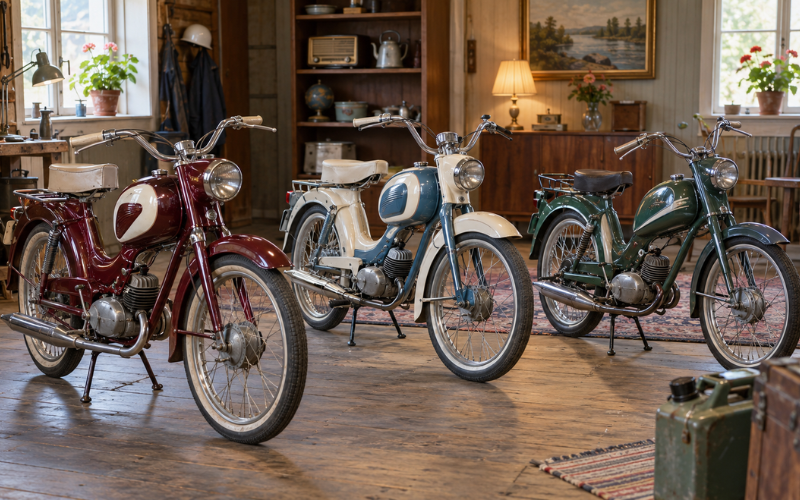
Mopedum was a Swedish nostalgia museum where classic mopeds shared space with objects from everyday life. Located in Nynäshamn, south of Stockholm, it invited visitors to step back into the 1950s, 1960s, and 1970s.
The museum was not only for people interested in engines or vintage vehicles. Its displays also included familiar products, games, music, household objects, and other reminders of earlier decades. Together, these items created a picture of how people traveled, relaxed, dressed, and spent time with friends and family.
Mopedum permanently closed in December 2022 and is no longer an active visitor attraction. Some travel pages and old social media posts remain online, which can make its current status unclear. However, the archived visitor information confirms that the museum planned to close for good at the end of 2022.
Although its doors are closed, Mopedum continues to attract interest from moped enthusiasts, collectors, local residents, and people researching unusual Swedish museums. Its story shows how an ordinary vehicle can become part of a much larger cultural memory.
Mopedum at a Glance
Mopedum was also known as the Swedish Nostalgia Museum, or Svenska Nostalgimuséet. Its main purpose was to preserve and present classic mopeds alongside objects connected with Swedish life in earlier decades.
The museum’s name appears to combine the ideas of “moped” and “museum,” which clearly reflected its central theme. However, Mopedum offered more than rows of old two-wheeled vehicles. It used clothing, furniture, entertainment items, signs, products, and period details to place those mopeds within their original social setting.
This wider approach helped visitors understand why mopeds mattered. For many people, a moped was not simply a machine. It represented independence, mobility, work, friendships, and the excitement of traveling without relying on parents or public transport.
The museum appealed to collectors and vehicle enthusiasts, but it also welcomed families and casual visitors. Older guests could recognize items from their younger years, while younger visitors could discover a version of daily life that existed before smartphones, online shopping, and modern digital entertainment.
How Mopedum Became a Home for Swedish Nostalgia
Mopedum was built around a simple but effective idea: use familiar objects to bring the past back to life. Rather than presenting mopeds as isolated machines, the museum connected them with the places, products, and experiences that surrounded their use.
Public information about the museum focused more heavily on the visitor experience than on a detailed history of its founders. Reliable online records about its opening date, ownership, and early development are limited. For that reason, claims about the people behind Mopedum should be treated carefully unless supported by original records or direct statements.
What can be confirmed is that Mopedum developed a clear identity as a local nostalgia attraction. It combined interest in historic mopeds with memories of Swedish popular culture. This gave the museum a warmer and more personal character than a traditional technical collection.
Over time, Mopedum also became connected with local gatherings and community activity. Archived social media material shows that the venue hosted or promoted events, performances, and moped-related outings. These activities suggest that it functioned as more than a quiet display space. It also offered a meeting point for people with shared interests.
Vintage Mopeds at the Heart of Mopedum
Classic mopeds formed the center of the Mopedum experience. These compact motorized vehicles were once a common sight on Swedish streets and country roads. They provided practical transport while being easier and less expensive to use than a car or full-size motorcycle.
The collection helped visitors notice how moped design changed over time. Older models often had simple frames, visible mechanical parts, narrow tires, and practical shapes. Other examples reflected changing tastes through brighter colors, new body styles, improved seating, and more decorative details.
For former riders, these vehicles could bring back highly personal memories. A particular model might remind someone of a first job, a daily trip to school, a summer journey, or evenings spent with friends. Collectors could also appreciate the craftsmanship, original parts, paintwork, and mechanical differences between models.
Mopedum therefore presented the moped from two angles. It was a piece of transport history, but it was also an object connected with growing up and gaining independence. That emotional connection helped the collection appeal to people who did not consider themselves vehicle experts.
A Journey Through the 1950s, 1960s, and 1970s
Mopedum focused strongly on three decades that brought major changes to Swedish society. The 1950s, 1960s, and 1970s saw shifting fashions, expanding consumer choice, new forms of entertainment, and changing ideas about youth and personal freedom.
The museum recreated the atmosphere of these years through colors, products, furniture, music, and leisure items. Visitors could see how everyday design changed and how objects that once seemed ordinary later became symbols of their time.
Placing mopeds beside these items gave the vehicles useful context. A moped from the 1960s could be understood as part of a wider world that included popular music, social gatherings, changing hairstyles, and recognizable household products. This made the display feel more like a journey through daily life than a technical review of old machines.
Historical objects can also encourage conversation. A parent or grandparent may recognize an item and explain how it was used, what it cost, or why it mattered. In this way, Mopedum helped turn private memories into shared stories.
More Than Mopeds: The Museum’s Everyday Treasures
The word “Mopedum” naturally suggests a museum filled only with mopeds, but its scope was wider. Archived descriptions mention nostalgic attractions such as table football, Carmen Curlers, and draft beer displays. These details reflected the museum’s interest in the broader habits and products of earlier decades.
Household goods, personal-care products, games, signs, and entertainment objects helped complete the setting. Each item offered a small clue about how people once lived. Packaging revealed older design styles, while games showed how leisure time was spent before digital devices became common.
These supporting displays were important because they prevented the mopeds from feeling disconnected from real life. A vehicle gains more meaning when visitors can picture the shops, homes, clothing, and music that existed around it.
Sometimes a very ordinary object can create a stronger reaction than a rare machine. A familiar product box, kitchen item, or childhood game may instantly unlock a memory. Mopedum used this emotional power to make history feel personal and approachable.
What Visiting Mopedum Felt Like
Descriptions of Mopedum presented it as an informal and welcoming place rather than a large, formal institution. The displays encouraged visitors to look closely, recognize familiar objects, and talk about their own experiences.
For moped enthusiasts, the main attraction was the chance to see older vehicles together in one place. The collection offered opportunities to compare designs and remember models that had disappeared from everyday roads.
Families could experience the museum differently. Grandparents and parents might explain the objects they recognized, while children could ask how the vehicles and household items worked. This exchange between generations was part of Mopedum’s appeal.
The atmosphere was designed around discovery and memory. Visitors did not need specialist knowledge to enjoy it. Someone could arrive with little interest in engines and still connect with the colors, games, music, or everyday products displayed around the museum.
Mopedum’s Place in Nynäshamn
Mopedum was located on Vikingavägen in Nynäshamn, a coastal town in Stockholm County. Nynäshamn is known for its harbor and its connection with the southern Stockholm archipelago.
Within this setting, the museum offered something different from the area’s natural and maritime attractions. It gave residents and visitors an indoor cultural experience centered on Swedish transport and everyday history.
Smaller museums can play an important role in local identity. They often preserve subjects that larger national institutions may not explore in the same personal detail. Mopedum focused on vehicles and objects that many ordinary people had used, owned, or encountered.
Its local presence also created a reason for moped groups and nostalgia enthusiasts to visit Nynäshamn. Even after the museum’s closure, online references and tribute events show that the Mopedum name remains connected with the area.
Why Mopedum Appealed Across Generations
Nostalgia museums often work because visitors bring their own experiences to the displays. At Mopedum, the same object could mean something different to each generation.
For an older visitor, a moped might recall the first taste of independence. A household product could bring back memories of a family home, while a song or game could recall friendships and social events.
Younger visitors did not share those memories, but they could still learn from them. The displays offered a simple way to understand how transport, entertainment, and consumer life had changed. They could compare the past with their own technology-filled routines.
Mopeds provided a particularly effective link between generations. Their basic purpose was easy to understand, yet their designs carried the character of the period in which they were made. This combination of function and memory helped Mopedum turn a vehicle collection into a shared cultural experience.
The Closure of Mopedum
Mopedum closed permanently in December 2022. The closure means that opening hours, admission prices, directions, and visitor recommendations found on older websites should no longer be treated as current information.
This distinction matters because historical attraction pages often remain visible long after a business or museum has closed. Search engines may continue to display old listings, photographs, reviews, and social media accounts without clearly showing their age.
Anyone researching Mopedum should check when a page was published or last updated. A positive visitor review can still describe what the museum was like, but it does not prove that the attraction remains open.
The archived listing from Explore Archipelago provides the clearest public statement about the closure. It describes Mopedum’s nostalgic focus while also stating that the museum would close for good in December 2022.
What Happened to the Mopedum Collection?
Public information about the full collection after the closure is limited. This makes it difficult to confirm where every moped, sign, household object, or display item eventually went.
A public Facebook post from May 2023 referred to an auction and flea market as part of the final stage of Mopedum. This suggests that at least some objects connected with the former museum were offered for sale. However, the available notice does not provide a complete inventory or explain the final destination of each item.
It is therefore reasonable to say that parts of the collection may have been distributed, but it would be unsafe to claim that all items were sold or that the entire collection moved to another museum.
Unless more detailed records become available, questions about individual vehicles should be answered cautiously. Clear evidence should always be separated from assumptions based on incomplete social media posts.
Mopedum’s Lasting Cultural Value
Mopedum preserved a part of Swedish history that can easily be overlooked. Mopeds were practical machines, but they were also connected with independence, work, youth culture, and everyday movement.
The museum also showed why ordinary objects deserve attention. History is not made only from famous events or valuable works of art. Product packaging, games, furniture, tools, and personal items can reveal how people lived and what they valued.
Although Mopedum no longer operates, its memory continues through photographs, reviews, archived listings, and community interest. A tribute ride announced for 2026 in Mopedum’s honor is one sign that the museum left a lasting impression on local moped culture.
Its legacy rests not only in the vehicles it displayed but also in the conversations it encouraged. By bringing generations together around familiar objects, Mopedum helped preserve stories that might otherwise have faded.
Common Questions About Mopedum
What was Mopedum?
Mopedum was a Swedish nostalgia museum centered on classic mopeds and everyday objects from the 1950s, 1960s, and 1970s. It combined transport history with displays about popular culture and ordinary life.
Where was Mopedum located?
The museum was located on Vikingavägen in Nynäshamn, Sweden. The coastal town lies south of Stockholm and serves as an important gateway to the southern Stockholm archipelago.
Was Mopedum only about mopeds?
No. Mopeds were its central attraction, but the museum also displayed games, household products, personal-care items, signs, and other objects associated with earlier decades.
Is Mopedum still open?
No. Mopedum permanently closed in December 2022. Older listings and reviews may still appear online, but they describe the museum when it was operating.
Can the former Mopedum collection still be viewed?
There is no clear public record showing that the complete collection remains available at another location. Some items appear to have been connected with post-closure sales, but the location of every object has not been publicly documented.
Conclusion
Mopedum was more than a collection of old mopeds. It was a Swedish time capsule that connected classic vehicles with the music, products, games, styles, and personal memories of the 1950s, 1960s, and 1970s.
Its displays helped older visitors reconnect with their past while giving younger generations a simple and engaging look at earlier Swedish life. By placing mopeds within their social setting, the museum showed how everyday transport can become part of personal and cultural identity.
Mopedum is no longer open, but its influence has not completely disappeared. Online memories, archived information, community interest, and tribute activities continue to keep its name alive. Its story remains a valuable reminder that even familiar machines and ordinary household objects can preserve the character of an era.