
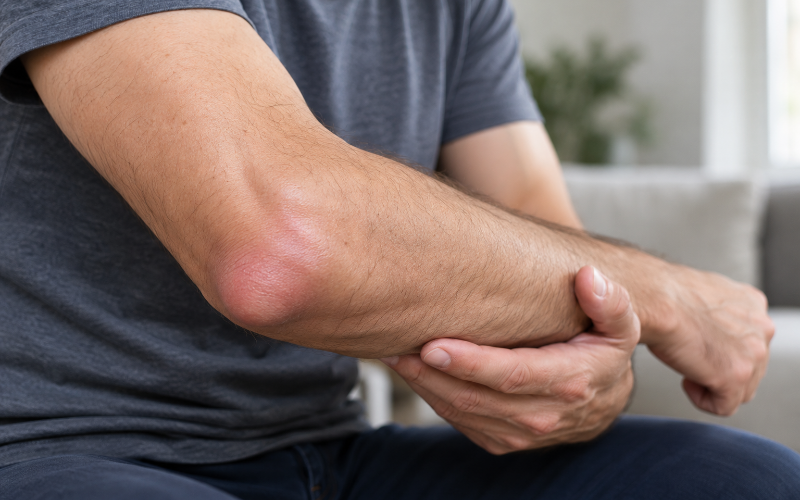
The olecranon is the bony point at the back of your elbow. You can usually feel it easily, especially when your arm is bent. Although it may seem like a simple bump, it forms part of the elbow joint and provides an attachment point for the muscle that straightens your arm.
Several structures work together around this small area. The bone helps guide movement, the triceps tendon transfers muscle force, and a thin protective sac allows the skin to slide over the elbow’s tip. A problem in any of these tissues can cause discomfort, but each may need a different approach.
Understanding the olecranon helps explain why leaning on your elbow can irritate it, why swelling does not always mean a broken bone, and why some injuries need prompt assessment. This guide covers its location and function, common causes of pain, and how healthcare professionals assess and treat problems around it.
Where the Olecranon Is Located
The olecranon sits at the upper end of the ulna, one of the two bones in your forearm. The ulna runs along the little-finger side of the forearm. Its upper end meets the humerus, or upper-arm bone, at the elbow.
Rather than being a separate bone, the olecranon is a curved projection of the ulna. It forms the prominent point you notice behind the elbow. Only a thin layer of tissue covers its outer surface, which makes it easy to feel and leaves it exposed to pressure and knocks.
To locate it, gently bend an uninjured arm and touch the firm point at the back of the joint. Avoid pressing on an elbow that is painful or swollen after an injury.
The olecranon fossa is a different structure. It is a hollow at the back of the lower humerus that receives the olecranon when you straighten your arm. The olecranon is the projection; the fossa is the space into which it fits. Their relationship helps the elbow reach its straightened position.
How the Olecranon Helps Your Elbow Move
The triceps muscle runs along the back of your upper arm. Its tendon, a strong band of tissue connecting muscle to bone, attaches to the olecranon. When the triceps contracts, it pulls through this attachment to straighten the elbow.
This action supports everyday movements such as pushing a door open, reaching forward, or pressing yourself up from a chair. The olecranon gives the triceps a firm attachment and helps turn its pulling force into movement.
That connection also matters during an injury. If the olecranon breaks, the triceps can pull a broken fragment away from the rest of the ulna. Depending on the fracture, this may interfere with active straightening of the arm.
The olecranon also forms part of the curved upper ulna that fits around the lower humerus. Together, these surfaces create the elbow’s hinge-like movement. Ligaments and surrounding muscles help keep the joint stable as it bends and straightens.
Its shape therefore serves two related purposes: supporting movement and helping maintain the joint’s fit. The visible tip is only the outer part of a structure that contributes to the elbow’s stability beneath the skin.
The Protective Bursa Over the Elbow’s Tip
Between the skin and the olecranon lies the olecranon bursa. A bursa is a small, thin sac containing a little lubricating fluid. At the elbow’s tip, it reduces friction as the skin moves over the underlying bone.
A healthy bursa is usually flat and difficult to notice. When it becomes irritated, its lining can become inflamed and extra fluid may collect inside. This produces swelling over the back of the elbow, a condition called olecranon bursitis.
The distinction between the bone and the bursa is important. A swollen bursa does not automatically mean the olecranon has enlarged or broken. The swelling may be in the soft tissue over a structurally intact bone.
Likewise, the bursa does not provide thick protection against a hard impact. Its main job is to support smooth movement between surfaces. Because it sits close to the skin, it remains vulnerable to repeated pressure, direct injury, and infection.
Common Causes of Pain and Swelling Around the Olecranon
Repeated pressure is a common reason for irritation around the elbow’s tip. Leaning on a hard desk, supporting your weight on your elbows, or resting them against firm surfaces for long periods can irritate the bursa. Symptoms may develop gradually rather than after one memorable event.
A direct knock can also cause the bursa to swell. Olecranon bursitis may create a noticeable lump, sometimes with tenderness when the elbow touches a surface. The amount of swelling and discomfort varies between people.
Infection is another possible cause. Bacteria may enter through a scrape, puncture, or other break in the skin. Occasionally, there is no obvious wound. Gout and rheumatoid arthritis can also contribute to inflammation in the bursa.
An olecranon fracture involves the bone itself. It can happen after a fall directly onto the elbow, a hard blow, or an indirect injury such as landing on an outstretched arm. Pain, bruising, and difficulty moving the elbow may follow.
Nearby tendon problems can cause pain in the same general area. Repeated forceful straightening, including during weight training or manual work, may affect the triceps tendon. A more significant tendon injury can cause weakness as well as pain. The location of discomfort helps guide assessment, but it does not identify the cause by itself.
Olecranon Bursitis and Fractures: Understanding the Difference
Olecranon bursitis affects the fluid-filled sac over the bone. An olecranon fracture is a break in the bone. They involve different structures, even though both can cause swelling at the back of the elbow.
With bursitis, swelling may be the most obvious change. It can develop slowly after repeated pressure or appear more quickly after a knock. Some people retain much of their elbow movement, although bending or pressing on the swollen area may hurt.
A fracture more often follows a clear injury and causes sudden pain. Bruising, tenderness, and painful or difficult movement raise concern, particularly after a fall. However, being able to move the elbow does not safely rule out a fracture.
There is also overlap. The same impact can irritate the bursa and damage the bone. A swelling that looks like bursitis may need investigation when there has been significant trauma.
Symptoms alone cannot reliably separate every possibility. The history of the injury, examination findings, and appropriate tests help establish what is affected. Avoid repeatedly squeezing the swelling or forcing the arm straight to test it yourself.
When Elbow Symptoms Need Prompt Medical Attention
Seek prompt assessment when elbow pain follows a fall or hard impact, especially if movement is difficult. Marked swelling, substantial bruising, or an inability to straighten the arm should not be dismissed as a minor knock.
An obvious change in the elbow’s shape, an open wound over a suspected fracture, or new numbness in the fingers requires urgent attention. A fracture with a wound communicating with the bone carries an increased infection risk and needs immediate treatment.
A hot, increasingly swollen elbow also needs medical advice, particularly if you have fever, chills, or feel unwell. Redness that spreads, drainage from the skin, or rapidly worsening pain may suggest infection. Skin redness can be less visible on darker skin, so warmth and other changes matter too.
Do not wait for fever before seeking advice about a concerning elbow. Arrange assessment if swelling keeps returning, becomes larger, or does not improve. The NHS also recommends urgent advice for severe joint pain, inability to move the joint, or symptoms suggesting infection.
How Olecranon Problems Are Assessed
Assessment usually starts with a conversation about your symptoms. A healthcare professional may ask when the swelling appeared, whether you fell or struck the elbow, and which movements or positions make it worse.
It helps to describe your usual activities and any repeated pressure on the area. Mention skin wounds, previous episodes, gout or other inflammatory conditions, and medicines that affect your immune system.
During the examination, the clinician checks the location of swelling, tenderness, warmth, and changes in movement. After an injury, they may also assess feeling in the hand and blood flow. These findings help determine whether the concern involves the bursa, bone, tendon, or another structure.
X-rays are important when a fracture is suspected. They show the bone and help reveal whether broken pieces have moved out of position. Ultrasound can sometimes help assess fluid or nearby soft tissues. More detailed imaging is reserved for situations where it would clarify the diagnosis or guide treatment.
If infection or gout is suspected, a clinician may take a sample of fluid from the bursa using a sterile needle. Testing can help identify bacteria or crystals. This procedure is called aspiration and is performed for a specific clinical reason; it is not necessary for every swollen elbow.
Treatment and Recovery Depend on the Cause
Treatment works best when it addresses the affected structure. A pressure-related bursa problem, an infected bursa, and a broken olecranon require different plans.
For uncomplicated bursitis without infection, care often begins with reducing pressure and avoiding activities that aggravate the area. An elbow pad may help protect it. A cold pack wrapped in a towel can ease discomfort; avoid placing ice directly against the skin.
A clinician or pharmacist can advise whether pain relief is suitable for you. Anti-inflammatory medicines may help some people, but they are not appropriate for everyone. Existing health conditions and other medicines can influence the choice.
Draining or injecting the bursa is not automatically the next step. These procedures have risks, including introducing infection. Steroid injections are not routinely recommended for every case. Persistent or recurring bursitis may need further assessment, and surgery is considered in selected cases that do not respond to other care.
An infected bursa needs medical treatment, usually involving antibiotics. Fluid testing or drainage may be appropriate, depending on the findings. More severe illness can require hospital care. Reducing pressure alone does not treat a bacterial infection.
For an olecranon fracture, the plan depends on the position of the broken pieces, joint stability, ability to straighten the arm, and the person’s health and activity needs. Some fractures can be managed with a splint and close monitoring. Displaced fractures often need surgery, although selected patients may be treated without it.
Surgery generally brings the bone pieces back into alignment and holds them with suitable hardware, such as plates, screws, or wires. Recovery includes wound care, follow-up appointments, and a planned return to movement.
Rehabilitation balances protection with the need to reduce stiffness. The timing of exercises and lifting varies with the injury and treatment. Follow the prescribed plan rather than assuming that less pain means the bone is ready for full use. Healing and recovery of strength or flexibility can take different amounts of time.
Reducing Pressure and Protecting the Olecranon
Small changes to daily habits can reduce repeated irritation. If you regularly lean on your elbows while working, notice where that pressure occurs. Adjust your chair, desk position, or armrests so the elbow’s tip is not pressed against a hard edge.
For tasks involving contact with firm surfaces, suitable padding can spread pressure and reduce direct rubbing. It should fit comfortably and allow normal circulation. Padding is most useful alongside changes in how long and how often you load the area.
Sports and exercise may also need temporary adjustments. If an activity brings on swelling or pain at the elbow’s tip, reduce the aggravating load and seek advice when symptoms persist. Appropriate protection can help during activities where falls or direct contact are likely.
After a fracture or operation, return to activity according to your treatment plan. Everyday reaching, heavy lifting, and pushing body weight through the arm place different demands on the elbow. Being ready for one does not necessarily mean you are ready for all three.
Recovery may involve gradually restoring movement before rebuilding strength. Keep follow-up appointments so healing and function can be checked. If an exercise causes new pain, increasing swelling, or other unexpected symptoms, ask your treatment team before progressing.
Conclusion
The olecranon forms the familiar point of your elbow and contributes to the joint’s movement and stability. Its connection to the triceps helps you straighten your arm, while the overlying bursa allows the skin to move smoothly across it.
Pain or swelling in this area can arise from pressure, bursitis, a fracture, infection, or nearby tendon problems. Those causes can look similar, which is why the circumstances and examination matter more than the appearance of a lump alone.
Reducing unnecessary pressure is a useful protective habit. When symptoms follow an injury, worsen, or suggest infection, timely assessment helps establish the cause and guide suitable care.
FAQs
1. Is the olecranon a separate bone?
No. The olecranon is the curved projection at the upper end of the ulna, one of the two forearm bones. It forms the point at the back of the elbow and fits into a hollow in the humerus when the arm straightens.
2. Is the olecranon the same as the funny bone?
No. The olecranon is bone. The “funny bone” sensation comes from the nearby ulnar nerve, which passes behind the inner side of the elbow. Irritation of this nerve can produce tingling toward the ring and little fingers.
3. Can olecranon bursitis happen without much pain?
Yes. Some cases, particularly longer-standing bursitis, produce noticeable swelling with little tenderness. A painless lump still deserves assessment if it is new, growing, or persistent. Warmth, drainage, worsening discomfort, or feeling unwell makes medical advice more urgent.
4. Can you move your elbow with an olecranon fracture?
Sometimes. The amount of movement depends on the fracture and surrounding injuries. Being able to bend or partly straighten your arm does not exclude a break. Pain and swelling after a significant impact should be assessed rather than judged through repeated movement tests.
5. How long does olecranon bursitis take to improve?
Many uncomplicated cases improve over several weeks, but recovery varies. Continued pressure, infection, or an underlying inflammatory condition can prolong symptoms. Cleveland Clinic describes a common recovery range of three to six weeks, rather than a guaranteed deadline. Seek reassessment if swelling persists or worsens.