
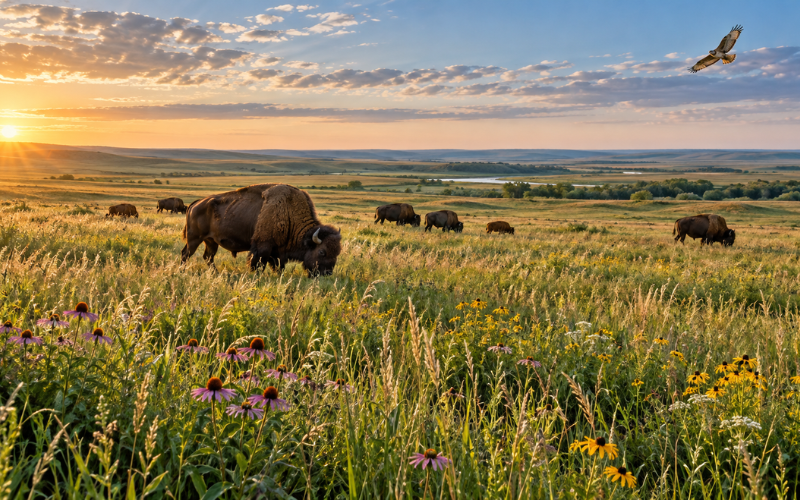
A prairie is a large grassland where grasses and flowering plants dominate the landscape. Trees are usually uncommon except near rivers, lakes, and other protected or wetter areas. Although a prairie may look like a simple field from a distance, it is a complex living system filled with plants, animals, insects, fungi, and microorganisms.
Prairies are shaped by climate, soil, fire, grazing, and seasonal changes. Many prairie plants have deep roots that help them survive drought, cold winters, and periodic fires. Wildlife also plays an important role. Grazing animals influence plant growth, insects pollinate flowers, and predators help keep animal populations balanced.
These grasslands once covered a vast area of central North America. Human settlement and farming later transformed much of the original landscape. Today, surviving prairies provide important wildlife habitat, protect soil, store carbon, and preserve cultural history.
Understanding the prairie means looking beyond the grass. Its types, plants, wildlife, history, and conservation needs reveal one of the continent’s most valuable ecosystems.
What Defines a Prairie
A prairie is an ecosystem dominated by grasses rather than trees. It usually develops in a region where rainfall is high enough to support dense plant growth but too limited or seasonal for large forests to spread across the landscape.
Grasses are especially suited to these conditions. Most grow from points close to or below the ground, allowing them to recover after grazing and fire. Their roots can extend deep into the soil, where they reach water and store energy. Prairie wildflowers, often called forbs, grow alongside the grasses and add color and diversity.
A prairie is different from a meadow, plain, or savanna. A meadow is generally a smaller grassy area and may occur beside a forest, stream, or mountain. A plain is a broad, mostly flat landform that can contain several types of ecosystems. A savanna is another grass-dominated ecosystem, but it normally has more scattered trees and is often associated with warmer climates.
Prairies can be flat, gently rolling, or marked by hills and river valleys. Their identity comes from their plant communities and natural processes, not simply from the shape of the land.
Where Prairies Are Found
The word “prairie” is most closely connected with North America. Historically, a wide belt of prairie stretched through the continent’s central region, from parts of Canada south into the United States.
In Canada, prairie landscapes are strongly associated with Alberta, Saskatchewan, and Manitoba. In the United States, they once extended across much of the Great Plains and parts of the Midwest. States such as Kansas, Nebraska, Iowa, Illinois, North Dakota, South Dakota, Oklahoma, and Texas contain prairie regions or surviving fragments.
Rainfall generally decreases from east to west across this broad area. As a result, taller and denser grasses developed in wetter eastern regions, while shorter grasses became more common in the drier west.
Similar temperate grasslands exist elsewhere, although they have different names. The steppes of Eurasia, the pampas of South America, and the veld of southern Africa share some features with North American prairies. Each has its own climate, wildlife, plants, and cultural history.
The Three Main Types of Prairie
North American prairies are commonly divided into tallgrass, mixed-grass, and shortgrass types. These categories describe the usual height and composition of the vegetation, but boundaries between them are not always sharp.
Tallgrass prairie developed mainly in the wetter eastern portion of the prairie region. It supports grasses that can grow very tall under favorable conditions. Big bluestem, switchgrass, and Indiangrass are well-known examples. A wide range of flowering plants grows among them.
Mixed-grass prairie occupies the central transition zone. It contains both tall and short grasses, with the balance changing according to rainfall, soil, grazing, and local conditions. This variety creates habitat for many different species.
Shortgrass prairie is found mainly in the drier western Great Plains. Its plants remain relatively low and are adapted to limited rainfall, strong winds, and periods of drought. Blue grama and buffalograss are characteristic species.
These prairie types are not defined by grass height alone. Soil depth, elevation, temperature, rainfall, fire, and grazing all influence the plants that can survive in a particular place.
Climate, Soil, and the Formation of Prairies
Prairie regions often experience hot summers, cold winters, strong winds, and changing amounts of rainfall. Drought may occur regularly, while thunderstorms can bring heavy rain during warmer months.
This climate helps limit the growth of trees. Tree seedlings may struggle during drought, and fires can prevent young trees from becoming established. Grasses are better prepared for these conditions because much of their living structure remains protected underground.
Prairie soil developed through the growth and decay of dense roots over long periods. Each year, some roots die and add organic matter to the ground. This process can create dark, fertile soil rich in nutrients.
Wind, grazing, and fire also helped form the landscape. Grazing animals removed older plant growth and returned nutrients through their waste. Fire cleared dead material, reduced some invading woody plants, and allowed sunlight to reach new growth. Together, these forces maintained open grassland over many generations.
Plants That Shape the Prairie Landscape
Prairie vegetation includes far more than grass. A healthy native prairie may contain many grasses, sedges, and flowering plants growing together in a layered community.
Common grasses include big bluestem, little bluestem, switchgrass, sideoats grama, blue grama, and buffalograss. Flowering species may include coneflowers, asters, goldenrods, blazing stars, milkweeds, and prairie clovers. The exact mixture depends on the region and local conditions.
Many prairie plants survive through deep or spreading root systems. These roots help them reach moisture during dry periods and regrow after grazing or fire. They also hold soil in place, reducing erosion caused by wind and water.
The landscape changes with the seasons. Early plants begin growing in spring, while other species bloom during summer or autumn. This extended flowering period supplies food for bees, butterflies, and other pollinators.
Plant diversity makes the prairie more resilient. If drought, disease, or extreme weather harms one species, others may continue growing and help the ecosystem function.
Wildlife of the Prairie
Prairie wildlife ranges from large grazing mammals to insects living beneath leaves and soil. Every species occupies a place within the grassland food web.
Historically, large herds of bison moved across parts of the North American prairie. Their grazing, movement, and wallowing changed plant growth and created small habitats used by other animals. Pronghorn and deer are also associated with grassland regions.
Smaller mammals include prairie dogs, ground squirrels, mice, voles, badgers, and rabbits. Many shelter in underground burrows, which provide protection from predators and severe weather.
Prairie birds include meadowlarks, grasshopper sparrows, greater prairie-chickens, burrowing owls, and several species of hawks. Some require large, unbroken areas of grassland for nesting and feeding. Reptiles, amphibians, bees, beetles, butterflies, and grasshoppers add further diversity.
Predators such as foxes, coyotes, hawks, owls, and snakes help control prey populations. When one part of this food web disappears, the effects can spread throughout the prairie ecosystem.
Fire and Grazing as Natural Forces
Fire is a natural and important part of many prairie environments. Before modern fire control, lightning and planned Indigenous burning regularly affected grassland areas.
Prairie plants are well adapted to periodic fire. Their growth points and much of their stored energy remain below ground, allowing them to recover. Fire removes dead vegetation, returns some nutrients to the soil, and can slow the spread of shrubs and trees.
Grazing produces different but connected effects. Animals eat selected plants, disturb the soil, move seeds, and create areas with varied vegetation heights. This variety can provide feeding and nesting opportunities for different wildlife species.
Bison were especially influential because large herds moved across wide areas rather than grazing every place in the same way. Modern conservation projects sometimes use bison or cattle to recreate parts of this natural pattern.
Too much fire or grazing can damage a prairie, but removing both can also cause problems. Without suitable management, dead vegetation may build up, plant diversity may decline, and woody plants may gradually take over.
Why Prairies Matter
Prairies provide habitat for plants and animals that may not survive in forests, cropland, or developed areas. Some grassland birds, insects, and native flowers depend on specific prairie conditions.
Their deep-rooted plants also support healthy soil. Roots improve soil structure, help water enter the ground, and reduce erosion. Prairie areas near streams and farms may slow runoff and trap some sediment before it reaches waterways.
Prairie soil can store significant amounts of carbon, much of it below ground. Because the carbon is held in roots and soil organic matter, protecting established grasslands can contribute to climate-related conservation efforts.
These ecosystems also support people. Prairie soils have made central North America highly productive for agriculture. Native grasslands can provide grazing land when managed carefully, while restored prairie strips may support pollinators and help protect farmland.
The value of a prairie is therefore ecological, cultural, historical, and practical. It supports life above the ground while quietly maintaining important processes beneath it.
Indigenous Connections to the Prairie
Indigenous peoples have lived with and cared for North American grasslands for thousands of years. Prairie landscapes supported food, medicine, materials, travel, trade, and cultural traditions.
Many communities developed detailed knowledge of local plants, wildlife, weather, and seasonal change. Planned burning was one form of land stewardship. Carefully timed fires could renew plant growth, improve certain habitats, support hunting, and keep parts of the landscape open.
Bison held deep practical and cultural importance for many Plains peoples. The animal provided food and materials, but its significance extended beyond physical use into community life, identity, and spiritual traditions.
Prairie history should not be presented as though the landscape was empty before European settlement. Indigenous nations actively shaped, understood, and maintained these environments. Their knowledge continues to inform conservation and restoration work today.
How Human Activity Changed the Prairie
The fertile soil beneath the prairie made it highly desirable for farming. As settlement expanded, large grassland areas were plowed for crops. Towns, roads, railways, fences, and other forms of development divided the remaining habitat.
This change was especially severe in tallgrass regions, where rainfall and rich soil supported intensive agriculture. In many places, native prairie now survives only in small preserves, along railways, in old cemeteries, or on land that was difficult to plow.
The widespread killing of bison also disrupted grazing patterns and affected Indigenous communities whose lives were closely connected with the herds. Fire suppression allowed shrubs and trees to enter some areas that had historically remained open.
Not every modern grass field is native prairie. Pastures planted with a small number of introduced grasses cannot fully replace the diverse plants, roots, soil life, and wildlife relationships of an ancient prairie.
The Biggest Threats Facing Prairies Today
Habitat loss remains one of the greatest threats. When native grassland is converted into cropland, housing, roads, or industrial sites, its complex biological community can be difficult to restore.
Fragmentation creates another problem. Small prairie remnants may be separated by long distances, making it harder for wildlife to move and plants to spread. Small areas are also more exposed to pollution, nearby development, and invasive species.
Invasive plants can crowd out native vegetation and change the way fire moves through the landscape. Poorly managed grazing, unsuitable fire schedules, and the spread of woody plants may further reduce habitat quality.
Climate change adds uncertainty through shifting rainfall, higher temperatures, stronger droughts, and extreme weather. Prairie species have evolved with natural variation, but rapid changes combined with habitat loss may limit their ability to adjust.
Prairie Conservation and Restoration
Prairie conservation begins with protecting native areas that still remain. An established prairie contains long-developed soil conditions and biological relationships that cannot be recreated quickly.
Restoration can help reconnect habitats and return native vegetation to damaged land. The process may involve removing invasive plants, planting locally appropriate seeds, using controlled burns, and introducing carefully managed grazing.
Successful restoration requires patience. Some plants establish quickly, while others may take years to become visible. Land managers must observe how the site responds and adjust their approach over time.
Conservation groups, Indigenous nations, public agencies, researchers, farmers, ranchers, and private landowners all have roles to play. Their goals may differ, but cooperation can protect larger and better-connected grassland areas.
Creating a Small Prairie at Home
A small native prairie garden can provide food and shelter for pollinators, birds, and other wildlife. It can also introduce people to the seasonal beauty of local grasslands.
The first step is choosing plants native to the local region. A sunny site is usually best because most prairie plants need several hours of direct light. Soil moisture and available space should also guide plant selection.
Site preparation is important. Existing weeds or lawn grass can compete strongly with young native plants. Once planted, the area may need regular weeding while its root systems develop.
A prairie garden does not become maintenance-free. It requires monitoring, occasional cutting or other suitable management, and control of invasive plants. Local rules should always be followed before using fire. In most home settings, safer management methods are more practical.
Visiting a Prairie Responsibly
A prairie can offer a different experience in every season. Spring brings fresh growth, summer often provides the greatest variety of flowers, and autumn highlights warm colors and mature grasses. Winter reveals seed heads, animal tracks, and the shape of the land.
Visitors should remain on marked trails where required. Walking through sensitive areas can crush plants, disturb nesting birds, and spread unwanted seeds. Wildflowers should be left in place so they can reproduce and continue supporting wildlife.
Animals need space, especially large mammals such as bison. Visitors should follow park guidance, avoid feeding wildlife, and use binoculars or cameras for safe observation.
Supporting preserves, joining guided walks, volunteering, and learning about local conservation projects are practical ways to help protect prairie landscapes.
Common Misunderstandings About Prairies
One common misunderstanding is that a prairie is empty land waiting to be used. In reality, it is a biologically rich ecosystem with much of its activity hidden among roots, soil, and low vegetation.
Another mistake is assuming that all grasslands are the same. A native prairie contains many plant species and complex relationships. A lawn, hayfield, or planted pasture may look green and open but usually lacks the same diversity.
People may also believe that every fire is harmful. Uncontrolled wildfire can threaten lives and property, but carefully planned burns conducted by trained professionals can support prairie health.
Finally, a prairie is not only a historic landscape. It remains relevant today because it protects wildlife, supports soil and water, stores carbon, and connects people with the natural and cultural history of the continent.
Conclusion
A prairie is much more than an open field of grass. It is a living system shaped by climate, deep-rooted plants, grazing animals, fire, and thousands of years of human relationships with the land.
Tallgrass, mixed-grass, and shortgrass prairies each support distinct communities. Together, they provide wildlife habitat, build fertile soil, filter water, reduce erosion, and store carbon below ground.
Much of the original prairie has been altered or lost, making the protection of surviving areas especially important. Conservation, careful restoration, Indigenous stewardship, and responsible land management can help these landscapes endure.
FAQs
1. What is a prairie in simple terms?
A prairie is a large, mostly treeless grassland dominated by native grasses and flowering plants. Its ecosystem is shaped by rainfall, soil, fire, grazing, and seasonal temperature changes.
2. What is the difference between a prairie and a plain?
A plain is a broad area of flat or gently rolling land. A prairie is a type of grassland ecosystem. A plain may contain a prairie, but it can also contain farmland, desert, forest, or other environments.
3. Why are there so few trees on a prairie?
Limited or seasonal rainfall, drought, grazing, and periodic fire make it difficult for many trees to become established. Prairie grasses survive because their roots and growth points are protected underground.
4. What animals live in prairie habitats?
Prairie wildlife includes bison, pronghorn, prairie dogs, badgers, rabbits, coyotes, snakes, hawks, owls, grassland birds, bees, butterflies, and many other insects.
5. Can a damaged prairie be restored?
Yes, but restoration takes time. It may require planting native species, controlling invasive plants, managing grazing, and using carefully planned burns. Even a well-restored site may take many years to develop the complexity of an original prairie.