
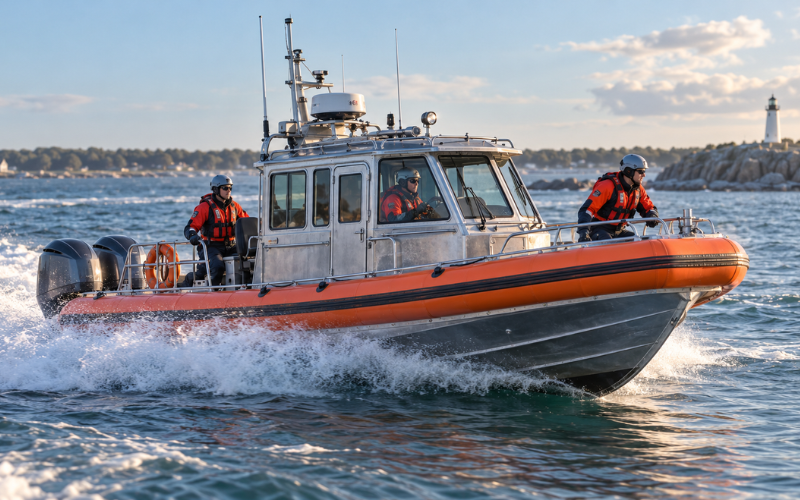
The Response Boat-Small is a fast and highly maneuverable vessel used by the United States Coast Guard. Its official abbreviation is RB-S. Although compact, it can support several important missions, including search and rescue, maritime security, law enforcement, and environmental response.
The boat is especially useful in coastal waters, harbors, ports, bays, and other nearshore areas. Its speed allows crews to reach incidents quickly, while its relatively shallow draft helps it operate in places that larger vessels may struggle to enter.
There have been multiple generations of the Response Boat-Small. The second generation, known as the RB-S II, became one of the Coast Guard’s most widely used small boats. This guide explains its purpose, design, specifications, missions, operating limits, crew features, and planned replacement.
Response Boat-Small at a Glance
The term “Response Boat-Small” can refer to the overall boat family or a specific generation. The RB-S I entered service in 2003, while the larger RB-S II entered service in 2012. Most current references to the boat describe the second-generation model.
| Detail | Response Boat-Small II |
| Operator | United States Coast Guard |
| Vessel type | High-speed, multi-mission response boat |
| Main operating area | Coastal and nearshore waters |
| Length | 28 feet 8 inches |
| Beam | 8 feet 5 inches |
| Draft | 1 foot 8 inches |
| Displacement | 8,300 pounds |
| Maximum speed | More than 40 knots |
| Published cruising range | 150 nautical miles |
| Propulsion | Twin outboard engines |
These figures come from the Coast Guard’s current RB-S II program profile. Other government documents contain slightly different performance figures because they may use rounded measurements, operational limits, or data from different periods.
The Purpose Behind the RB-S
The Coast Guard needs boats that can respond quickly without depending on a large cutter or specialized rescue vessel for every incident. The Response Boat-Small fills that need by combining speed, easy deployment, and the ability to perform several types of work.
Its compact size is useful in busy ports and narrow waterways. Crews can maneuver around docks, recreational boats, commercial traffic, and shoreline structures while maintaining a clear view of the surrounding area.
The RB-S is not intended to replace every other Coast Guard boat. Instead, it works as a flexible nearshore platform. A station can use the same boat for a rescue call, a security patrol, or the delivery of a boarding team.
Design Built for Speed and Control
The Response Boat-Small II has an aluminum hull and a compact cabin. Aluminum provides a strong structure without making the boat unnecessarily heavy. This supports quick acceleration and responsive handling.
Twin outboard engines supply the power. Using two engines improves maneuverability and provides more operating flexibility than a single-engine setup. The boat’s shallow draft also allows it to work close to shore and in relatively shallow waterways.
The deck arrangement gives crew members access to the front and rear areas of the vessel. Large windows and an open view around the boat help the operator watch nearby traffic, people in the water, and approaching hazards. These features make the RB-S II suitable for rapid launches and time-sensitive assignments.
Response Boat-Small Specifications
The Coast Guard lists the RB-S II at 28 feet 8 inches long, although it is commonly described as a 29-foot boat. It is 8 feet 5 inches wide and has a draft of 1 foot 8 inches. Its displacement is approximately 8,300 pounds.
The official program page reports a maximum speed above 40 knots and a range of 150 nautical miles at cruising speed. A 2017 Government Accountability Office report listed a maximum speed of 47 knots, a 175-nautical-mile range, a six-foot maximum sea condition, and a 10-nautical-mile maximum offshore distance. Those figures were based on Coast Guard documentation available in March 2017 and should be treated as a historical operational snapshot rather than universal limits for every situation. GAO’s comparison of Coast Guard rescue boats provides the original context.
A simple passenger limit is not included in the Coast Guard’s public program profile. Actual loading depends on the crew, fuel, equipment, survivors, weather, and mission requirements.
Search-and-Rescue Operations
Search and rescue is one of the Response Boat-Small’s main duties. When a person falls overboard, a recreational boat loses power, or a vessel reports trouble near the coast, an RB-S crew can launch quickly and travel at high speed.
Once on scene, the crew can search the area, recover people from the water, provide immediate assistance, or tow a suitable disabled vessel. The planned RB-S III is expected to retain the ability to tow vessels weighing up to 10 tons.
The RB-S is most effective in its intended nearshore environment. Rough seas, severe weather, long distances, or a large number of survivors may require a Response Boat-Medium, motor lifeboat, cutter, helicopter, or several assets working together.
Maritime Security and Law-Enforcement Missions
The Response Boat-Small is also used for port, waterway, and coastal-security patrols. Its speed and maneuverability help crews observe activity, approach vessels, protect restricted areas, and react to possible threats.
The boat can transport Coast Guard boarding teams that inspect vessels and enforce maritime laws. It also supports drug and migrant-interdiction operations when the location, conditions, and mission plan are suitable.
Other assignments can include environmental-response work, protection of living marine resources, defense readiness, and support for aids to navigation. The boat’s value comes from its flexibility: crews can adjust the equipment and personnel carried according to the task.
Crew Protection and Onboard Equipment
Working at high speed on open water can expose crew members to repeated impacts. The RB-S II therefore includes shock-mitigating seats that help reduce the force transferred to the body. Crew restraints provide additional protection during sudden turns or movement through waves.
The cabin offers 360-degree visibility and includes standardized navigation and communication equipment. Lowering windows can improve airflow and communication with people outside the cabin.
Other official features include two secondary navigation displays, integrated ballistic panels, and mounting points at the front and rear. A forward shock-mitigating gunner’s seat may support security missions. The exact equipment carried can change with the assignment, and mounting points do not mean every boat is armed during every operation.
Response Boat-Small I and II Compared
The first-generation RB-S I was a 25-foot Defender-class boat placed into service in 2003. It was created to replace various non-standard boats used at shore units. Government records describe it as a fast vessel powered by twin gasoline outboard engines.
The second-generation RB-S II is almost 29 feet long. It provides more attention to crew comfort and ergonomics while continuing the original model’s multi-mission role. The first RB-S II entered service in 2012.
Historical Coast Guard data gave the RB-S I a maximum speed of 46 knots and a range of 150 nautical miles. The same government comparison listed the RB-S II at 47 knots and 175 nautical miles. Current public specifications use the broader figures of more than 40 knots and a 150-nautical-mile cruising range.
Where the Response Boat-Small Operates
Response Boat-Small vessels operate from Coast Guard stations covering a wide range of American waters. Deployment areas have included the Atlantic, Pacific, and Gulf coasts, along with the Great Lakes.
The fleet has also served in Hawaii, Guam, and parts of Alaska. These locations present different challenges, from crowded warm-water ports to cold and remote coastal environments.
Local commanders select assets according to distance, weather, water depth, vessel availability, and the nature of the emergency. This means the RB-S may be the main response boat in one case and part of a larger operation involving aircraft or other vessels in another.
RB-S Versus the Response Boat-Medium
The Response Boat-Medium, or RB-M, is a much larger vessel. It is 45 feet long, weighs 36,500 pounds, and has a published range of 250 nautical miles at 30 knots. It uses twin diesel engines with waterjet propulsion and has self-righting capability.
By comparison, the Response Boat-Small is lighter, easier to deploy, and well suited to nearshore work. The RB-M offers more space, greater endurance, a longer operating range, and stronger capability in difficult sea conditions. It also contains a separate survivor compartment.
Both boats can conduct rescue, security, and law-enforcement missions. The choice is not simply about which one is faster. Crews must consider weather, distance, water depth, survivor needs, towing requirements, and the expected length of the operation.
Operational Limits of a Small Response Boat
The qualities that make the RB-S quick and agile also create limits. A small boat has less interior space, fuel capacity, endurance, and payload capacity than a larger vessel. It may also be more affected by high waves and severe weather.
Historical operating data listed a maximum offshore distance of 10 nautical miles and maximum seas of six feet for both the RB-S I and RB-S II. However, crews follow current Coast Guard policies and mission-specific risk assessments rather than relying on a single published figure.
A longer offshore search, heavy-weather rescue, large towing job, or incident involving many survivors may require another asset. Selecting the right boat protects both the public and the responding crew.
Training, Maintenance, and Readiness
Operating an RB-S safely requires more than knowing how to steer a boat. Crew members train for high-speed handling, navigation, emergency response, towing, survivor recovery, communications, and law-enforcement support.
Regular inspections help identify problems with the hull, outboard engines, electrical systems, navigation displays, radios, seats, restraints, and safety gear. Fuel, spare equipment, and protective clothing must also be ready before a launch.
Standardized systems make it easier for qualified personnel to move between units and understand the equipment. Consistent training and maintenance are essential because a response boat must be available when an urgent call arrives.
The Next Generation of Response Boat-Small
The RB-S II fleet is approaching the end of its planned service life, so the Coast Guard has started preparing for a third generation. On April 28, 2026, it accepted four demonstration boats at Coast Guard Base Charleston in South Carolina.
The boats range from approximately 29 to 37 feet and use twin outboard engines producing up to 600 horsepower. Multiple crews are evaluating them to identify useful equipment and design features. Their feedback will help the Coast Guard develop and validate requirements for the future RB-S III. The Coast Guard’s June 2026 update explains that these are test vessels, not finalized production models.
An August 2026 Department of Homeland Security planning forecast says the Coast Guard may acquire up to 400 RB-S III boats, with an option allowing other government agencies to order as many as 100 modified versions. The plan calls for the new generation to maintain core rescue, security, and law-enforcement capabilities.
These numbers, dates, and requirements remain subject to change. A planning forecast is not a final contract or a guarantee that every proposed feature will enter production.
Why the Response Boat-Small Matters
The Response Boat-Small gives Coast Guard stations a practical way to reach coastal incidents quickly. One compact platform can carry rescue personnel, boarding teams, safety equipment, and mission-specific gear.
Its widespread presence also matters. A capable boat based near busy waterways can often respond sooner than a larger vessel traveling from farther away. As the Coast Guard develops the RB-S III, preserving this combination of speed, control, crew protection, and flexibility will be central to the program.
Conclusion
The Response Boat-Small is a compact but important part of the U.S. Coast Guard fleet. Known officially as the RB-S, it supports search and rescue, maritime security, law enforcement, and several other coastal missions.
The RB-S II improved crew comfort while maintaining the speed and maneuverability established by the original model. As the fleet ages, testing for the proposed RB-S III is shaping what comes next. Whatever its final design, the future boat will need to remain a dependable and adaptable tool for nearshore operations.
FAQs
1. What does RB-S mean?
RB-S stands for Response Boat-Small. It is the official abbreviation used for a family of fast, multi-mission boats operated by the U.S. Coast Guard.
2. How fast is the Response Boat-Small?
The Coast Guard’s current RB-S II profile lists a maximum speed of more than 40 knots. Historical government documents have reported speeds as high as 47 knots.
3. What is the Response Boat-Small used for?
It is used for search and rescue, vessel boardings, maritime law enforcement, port security, drug and migrant interdiction, environmental response, and other nearshore duties.
4. How is the RB-S different from the RB-M?
The RB-S is smaller and mainly suited to quick nearshore operations. The 45-foot RB-M provides more range, endurance, interior space, and capability in difficult conditions.
5. Is the Response Boat-Small III already in service?
No production RB-S III fleet has been placed in service. As of September 2026, the Coast Guard is evaluating demonstration boats and developing requirements for the proposed third-generation program.