
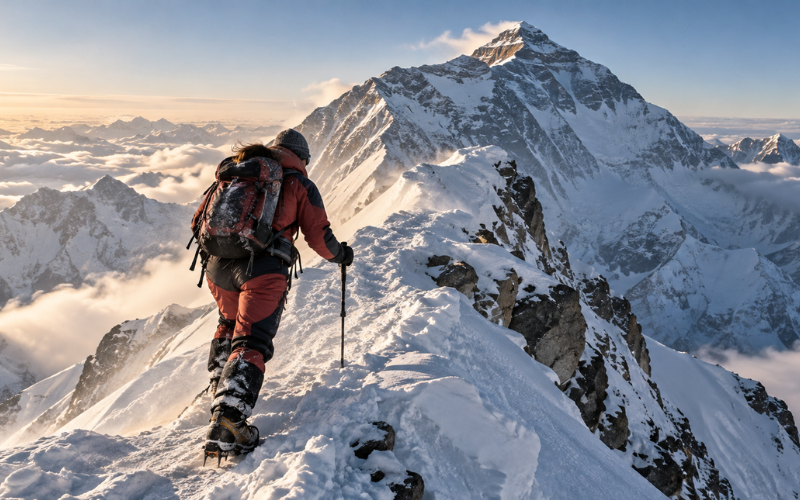
The phrase “sleeping beauty Mount Everest” refers to Francys Arsentiev, an American mountaineer who died while descending Everest in May 1998. After her death, climbers began calling her “Sleeping Beauty” because of the peaceful appearance of her body. It remained visible near the northern climbing route for several years.
However, Francys was far more than a nickname or a landmark. She was an experienced climber, a wife, and a mother who achieved an important place in mountaineering history. On May 22, 1998, she became the first American woman known to reach the summit of Mount Everest without using supplemental oxygen.
Her success was followed by a tragic descent, several rescue attempts, and the death of her husband, Sergei Arsentiev. This article explains her life, final expedition, historical achievement, and lasting legacy while separating supported facts from online myths.
Sleeping Beauty of Mount Everest at a Glance
Francys Arsentiev, born Francys Yarbro, was an American mountaineer from Honolulu, Hawaii. She climbed Everest with her Russian husband, Sergei Arsentiev, using the northern route from Tibet.
| Detail | Information | Evidence status |
| Full name | Francys Yarbro Distefano-Arsentiev | Widely documented |
| Nationality | American | Confirmed |
| Born | January 18, 1958 | Widely documented |
| Everest summit | May 22, 1998 | Confirmed by expedition accounts |
| Route | North Col and Northeast Ridge from Tibet | Widely reported |
| Supplemental oxygen | She did not use it for her climb | Widely documented |
| Death | Usually recorded as May 24, 1998 | Exact final timeline varies |
| Husband | Sergei Arsentiev | Confirmed |
| Body moved | May 23, 2007 | Widely documented |
The central facts are well established, but the exact timing of some events during the descent remains uncertain. Accounts were reconstructed from climbers who saw Francys and Sergei at different points on the mountain.
The Woman Behind the Sleeping Beauty Nickname
Francys Arsentiev was born in Hawaii in 1958. Public biographies report that she was introduced to mountain environments as a child and later studied in Switzerland and the United States. She eventually worked as an accountant in Colorado, where access to the mountains allowed her to develop her climbing skills.
She married experienced Russian climber Sergei Arsentiev in 1992. Francys also had a son from an earlier relationship. Together, the couple climbed several demanding peaks and built experience in cold, high-altitude environments.
Their reported achievements included climbing Denali in Alaska and making the first ascent of a 5,800-meter Russian peak, which they named Peak Goodwill. Francys also climbed both summits of Mount Elbrus and reportedly skied down the mountain. These experiences show that she was not an unprepared tourist. She had already spent years developing the endurance and judgment needed for major expeditions.
Francys Arsentiev’s Everest Ambition
Francys wanted to become the first American woman to reach the summit of Mount Everest without bottled oxygen. It was a demanding goal because the natural oxygen level near the summit is only a small part of what people breathe at sea level.
Supplemental oxygen helps climbers think more clearly, move more effectively, and remain warmer. Without it, exhaustion develops faster, judgment may become poor, and the body has less power to recover. Even experienced mountaineers can suddenly become confused or unable to walk.
Francys and Sergei had made earlier attempts before their successful climb in 1998. They spent time adjusting to the altitude and preparing on Everest’s northern side. Their experience helped them reach the upper mountain, but no amount of preparation could remove the dangers of weather, fatigue, darkness, and limited oxygen.
The 1998 Journey Toward the Summit
Francys and Sergei approached Everest through Tibet and followed the North Col route toward the Northeast Ridge. After previous summit efforts were affected by conditions, they made another attempt on May 22, 1998.
The couple reached the summit very late in the day. Although reported times differ, their arrival appears to have been much later than the normal turnaround time. Late summits are dangerous because climbers must descend difficult ground in fading light while already exhausted.
Francys’s arrival at the top made her the first American woman recorded as summiting Everest without supplemental oxygen. Her achievement is recognized in published accounts of her life and expedition, including her biographical record.
Yet the summit was not the end of the climb. In mountaineering, a successful ascent includes returning safely. For Francys and Sergei, the descent became a struggle for survival.
The Descent That Turned Into a Tragedy
During the descent, Francys and Sergei became separated in the darkness. The exact reason is not fully known. Poor visibility, exhaustion, equipment problems, and the effects of low oxygen may all have contributed.
Sergei reportedly reached a high camp and realized that Francys had not returned. Instead of continuing down, he gathered oxygen and supplies before climbing back toward her. It was a dangerous decision, but he apparently hoped that she was still alive and could be helped.
Other climbers later found Francys extremely weak and unable to descend on her own. Sergei disappeared during his attempt to reach her. Because there was no complete eyewitness account of the couple’s final hours together, some published timelines place events on slightly different dates. Francys’s death is generally recorded as May 24, 1998, although parts of the emergency unfolded across May 23 and 24.
Attempts to Rescue Francys Arsentiev
A group of Uzbek climbers encountered Francys during their climb. Reports indicate that they tried to help her down but could not complete the rescue in the extreme conditions. Assisting a person who cannot walk is extraordinarily difficult at such an altitude.
British climber Ian Woodall and South African climber Cathy O’Dowd later found Francys alive. They gave up their own summit plans and spent more than an hour trying to help her. She was severely affected by exposure and lack of oxygen, and the terrain made it nearly impossible to move her.
Woodall and O’Dowd eventually had to descend to protect their own lives. This decision has sometimes been judged harshly in simplified online versions of the story. In reality, climbers in the death zone have little strength to spare. Attempting to carry an unresponsive adult without a large, equipped rescue team can lead to several deaths instead of one.
What Happened to Sergei Arsentiev?
Sergei was last known to be climbing back toward Francys with oxygen and medicine. He never returned to camp, and his fate was initially unclear.
A body believed to be Sergei’s was discovered lower on the mountain the following year. Evidence suggested that he had suffered a fatal fall while attempting to reach or assist his wife. His ice axe and other items had reportedly been found near the area where Francys was seen.
Because no one witnessed his final moments, it is impossible to reconstruct every movement with certainty. What is clear is that Sergei went back into a highly dangerous part of Everest after learning that Francys was missing.
Why She Became Known as Sleeping Beauty
Francys’s body remained near a well-used section of the northern route. Climbers reportedly thought her position and preserved appearance made her look as though she were sleeping. This led to the nickname “Sleeping Beauty.”
The precise person who first used the name is not clearly documented. Over time, it spread through climbing stories, media reports, documentaries, and online articles. The nickname made the story memorable, but it also reduced a real person to a disturbing attraction.
Referring to her as Francys Arsentiev provides a more respectful way to discuss the tragedy. She had a family, a life away from Everest, and a significant climbing record. Her death should not be treated simply as a frightening detail from the mountain.
Where Is Sleeping Beauty on Mount Everest Now?
Francys’s body originally rested near the main climbing line on Everest’s North Face. Moving it immediately would have required people to place themselves in serious danger, so it remained there for about nine years.
In 2007, Ian Woodall returned as part of an effort called the Tao of Everest expedition. On May 23, he and Phuri Sherpa reached Francys. Woodall performed a brief ceremony, covered her with an American flag, and moved her away from the route to a lower, less visible location.
Therefore, claims that the sleeping beauty Mount Everest body remains clearly visible beside the standard trail are misleading. Her remains are believed to be on the mountain, but they have not been a public landmark since 2007.
Why Everest Bodies Are So Difficult to Recover
The upper part of Everest is often called the death zone. This generally means terrain above 8,000 meters, where the human body cannot adjust to the lack of oxygen for long periods. Thinking becomes slower, movement requires enormous effort, and the risk of frostbite, collapse, or altitude illness rises sharply.
Recovering a body may require a team of skilled high-altitude workers, ropes, oxygen, specialist equipment, and suitable weather. A frozen body can also be extremely heavy and difficult to move safely across steep ground.
Strong winds, falling ice, hidden crevasses, and sudden storms add further danger. Modern recovery missions can still place several people at risk, which is why some families decide not to request them. In certain situations, moving a body out of sight is safer and more respectful than attempting to carry it down.
Myths and Facts About Sleeping Beauty Mount Everest
Several online retellings mix verified details with dramatic language. One common myth is that Francys failed to reach the summit. Available expedition evidence indicates that she did reach it on May 22, 1998. Her tragedy occurred during the descent.
Another misunderstanding concerns oxygen. Francys achieved the summit without relying on supplemental oxygen. Sergei reportedly took oxygen with him when he returned to search for her, but that does not change the nature of her ascent.
Francys is also sometimes confused with the climber known as Green Boots. They were different people who died in different Everest incidents. Even the identity long attached to Green Boots has been questioned in recent reporting, showing why informal labels should not replace careful documentation.
Finally, Francys is no longer visible beside the main route. Ian Woodall moved her remains in 2007. Articles claiming that passing climbers can still see her in the original position are using outdated or inaccurate information.
The Human and Ethical Questions Behind Her Story
The story raises painful questions about rescue responsibilities on high mountains. From a safe distance, it may seem simple to say that climbers should always save someone in trouble. Above 8,000 meters, however, even standing, thinking, and breathing are major tasks.
Helping another person is an important part of mountaineering, but a rescue must also be physically possible. Woodall, O’Dowd, and the Uzbek climbers made efforts to help Francys. Their inability to bring her down does not mean they ignored her suffering.
The way these deaths are presented also matters. Graphic photographs and dramatic nicknames may attract attention, but they can remove dignity from the people involved. Responsible storytelling should explain the risks and decisions without turning human remains into entertainment.
Francys Arsentiev’s Place in Everest History
Francys Arsentiev holds an important place in American mountaineering because of her oxygen-free summit. Reaching the highest point on Earth under those conditions required experience, determination, and exceptional physical effort.
Her death also demonstrates the narrow distance between achievement and disaster at extreme altitude. A summit reached too late can leave too little time, strength, or daylight for a safe return. Clear turnaround rules, reliable communication, close teamwork, and honest self-assessment can be as important as ambition.
Francys’s legacy should not be limited to the name Sleeping Beauty. She should be remembered as an accomplished climber whose final expedition reveals both the attraction of high-altitude mountaineering and its unforgiving limits.
Conclusion
The sleeping beauty Mount Everest story is the story of Francys Arsentiev, not simply a frozen landmark or unsettling nickname. She achieved a historic oxygen-free summit on May 22, 1998, but lost her life during the descent. Her husband, Sergei, also died after returning to search for her.
Her final climb illustrates Everest’s extreme dangers, the limits of rescue in the death zone, and the importance of treating those who die there with dignity. Remembering Francys by her name allows her courage, achievement, family, and humanity to remain at the center of the story.
FAQs
1. Who was Sleeping Beauty on Mount Everest?
Sleeping Beauty was the nickname given to American mountaineer Francys Arsentiev after her death on Everest in 1998. Her body remained visible near the northern climbing route until Ian Woodall moved it out of sight in 2007.
2. Did Francys Arsentiev reach the summit of Everest?
Yes. Francys and Sergei Arsentiev reached the summit on May 22, 1998. Francys became the first American woman recorded as reaching Everest’s summit without supplemental oxygen.
3. How did Francys Arsentiev die?
Francys died during the descent after becoming separated from Sergei. Extreme cold, exhaustion, and the lack of oxygen left her unable to move. Several climbers tried to help, but the altitude and dangerous terrain prevented a successful rescue.
4. Is Sleeping Beauty’s body still visible on Everest?
No. Francys’s remains are believed to be on Everest, but they are no longer visible from the main route. Ian Woodall and Phuri Sherpa moved her to a private location on the mountain in 2007.
5. Are Sleeping Beauty and Green Boots the same person?
No. Sleeping Beauty was Francys Arsentiev, who died in 1998. Green Boots is the informal name attached to a different climber who died during the 1996 Everest disaster. The two are often mentioned together because their bodies were once visible near climbing routes.