
Shopping for bedding can become confusing surprisingly quickly. One product is called a duvet, another is a comforter, and a third looks like a complete bed covering but turns out to be an empty duvet cover. Similar photos and overlapping labels make it difficult to know what you are buying.
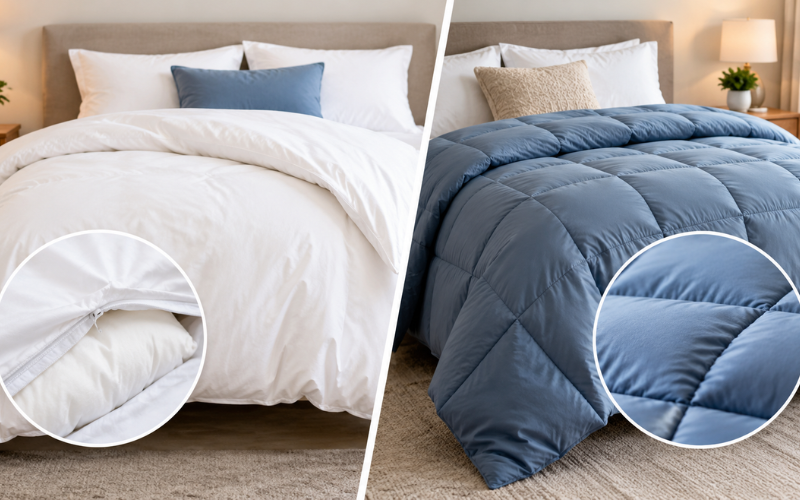
If you are wondering, “What is a duvet vs comforter?” the main difference is straightforward. A duvet is a filled bed covering generally used inside a removable cover. A comforter is a filled bed covering designed to be used without a separate cover. Both provide warmth, but their everyday care and styling options differ.
Neither choice is automatically better. The right option depends on how warm you sleep, how you handle laundry, and whether you enjoy changing your bedroom’s appearance. Understanding those practical differences helps you choose bedding that feels comfortable and fits your routine.
Duvets, Inserts, and Covers: Understanding the Pieces
A duvet contains insulating filling enclosed within a fabric shell. That filling might be down, feathers, wool, or a synthetic alternative. The finished item goes inside a separate cover before being placed on the bed.
“Duvet” and “duvet insert” usually refer to the same filled piece. Retailers often use the word “insert” to make it clear that the product belongs inside a cover. A listing for a duvet cover, however, usually does not include the filled insert.
Think of a duvet cover as a large pillowcase. It surrounds the insert, provides the visible color or pattern, and creates a removable surface for washing. Buttons, a zipper, or another closure keep its opening shut. Internal ties can connect to loops on the insert to help keep the corners aligned.
Check which fastenings are included before purchasing. A cover with ties is most useful when the insert has matching attachment points.
Product names are not completely consistent across brands or countries. Some items labeled “comforters” also have corner loops and work inside duvet covers. Read the description and package contents rather than relying on the product name alone.
How a Comforter Fits Into Your Bedding Setup
A comforter combines its filling and finished outer fabric into one item. Stitching holds the layers together and helps keep the filling distributed. You can spread it across the bed without first fitting it inside another cover.
Comforters are available individually or in coordinated bedding sets. A set might include matching pillow shams, while a larger package may also contain sheets. The number of pieces does not tell you everything about value, so check exactly what is included.
For example, matching decorative shams may be useful if you want a coordinated bedroom. They offer less practical value if you already have pillowcases you prefer and no plans to use decorative pillows.
A top sheet is optional with a comforter. It sits between your body and the comforter, providing a separate layer that is easier to wash. Some people like that arrangement; others find an extra sheet becomes tangled overnight.
Using a top sheet does not remove the need to clean the comforter. It simply changes which layer receives most direct contact during sleep.
Duvet vs Comforter at a Glance
The clearest comparison is how each setup works in ordinary use. Individual products vary, particularly in warmth, weight, and cleaning requirements.
| Feature | Duvet with a cover | Comforter |
| Construction | Filled insert inside a separate cover | Filling enclosed in a finished outer fabric |
| Removable cover | Normally part of the setup | Optional if the comforter fits a suitable cover |
| Warmth and weight | Depend on filling, construction, and cover | Depend on filling and construction |
| Washing | Cover and insert have separate care instructions | Entire comforter needs cleaning when soiled |
| Drying | Cover can be dried separately; insert may need more time | Bulky filling can make drying more demanding |
| Styling | Change the cover while keeping the insert | Keep the existing design or add a suitable cover |
| Daily upkeep | May need straightening inside its cover | No separate insert to realign |
| Costs | Budget for both insert and cover | Can be bought alone or within a bedding set |
For many households, the deciding factor is laundry. For others, avoiding the task of changing a duvet cover matters more. Consider which job you would rather manage regularly.
Warmth and Breathability Depend on More Than the Name
A duvet is not automatically warmer than a comforter. A lightweight summer duvet can provide less insulation than a thick winter comforter. Compare the actual products rather than treating either name as a warmth rating.
The filling material and amount both matter. Down can provide warmth without much weight, while other fillings offer different combinations of weight, softness, and insulation. Synthetic filling also varies considerably, so “down alternative” does not describe one fixed level of performance.
You may see “fill power” on down bedding. This describes how much space the down occupies for its weight. It helps explain loft and insulating potential, but it should be considered alongside the amount of filling and the product’s stated warmth level.
The outer fabric affects the feel of the bedding too. Cotton, linen, polyester, and fabric blends can feel different against the skin. With a duvet, remember that you are choosing both the insert’s shell and an additional cover.
If you sleep hot, look for a lightweight product and avoid adding unnecessary layers. If you sleep cold, consider a warmer filling level alongside your usual bedroom temperature. A cold bedroom and a heavily heated room call for different bedding, even during the same season.
A fluffy photograph cannot tell you how comfortable a product will feel at night. Styling, folding, and extra layers can make bedding look fuller than it is. Product measurements, materials, and warmth descriptions are more useful than appearance alone.
Washing and Everyday Care: What Each Option Involves
A duvet setup lets you remove the cover for routine washing while leaving the insert out of that load. This can make regular laundry easier, particularly when the alternative is handling a large filled comforter.
The trade-off comes afterward: the clean cover must go back onto the insert. If lifting, reaching, or managing large pieces of fabric is uncomfortable, this task deserves consideration before buying.
A comforter avoids that assembly step. However, when the comforter needs washing, you must handle the whole item. “Machine washable” does not necessarily mean it will fit your machine comfortably. Bedding needs room to move and rinse properly; tightly packing the drum can interfere with cleaning. Check both the bedding label and your appliance instructions.
Drying deserves equal attention. Follow the permitted method and temperature, and check that the filling is fully dry before putting the bedding away or returning it to the bed. A dry-feeling surface does not always mean the thickest sections are dry inside.
Spills also affect the cleaning workload. A removable duvet cover is convenient when a small mark stays on the surface. If liquid reaches the insert, cleaning the cover alone will not address it. Check both layers before deciding what needs attention.
Duvet inserts still require cleaning when needed, even when protected by covers. Some filled products need professional cleaning, while others permit washing at home. There is no single care method suitable for every duvet or comforter.
Before purchasing, picture an ordinary laundry day. If cleaning the item would require a trip to a larger machine or a professional cleaner, include that time and expense in your decision.
Appearance, Fit, and Keeping the Bed Tidy
A duvet offers flexibility because its visible design comes from the cover. You can keep an insert you find comfortable while switching from a patterned cover to a plain one, or changing the surface fabric with the season.
A comforter has its own finished appearance. That can make decorating simpler when you find a design you already like. You do not need to coordinate the size and appearance of two separate products.
For either option, check measurements instead of assuming that a size label guarantees the look you want. Two products described as “queen” may have different dimensions. Mattress depth also affects how far the bedding hangs down each side.
Measure the mattress and consider the amount of coverage you prefer. A deep mattress may need more generous coverage than a shallow one. If two people share the bed, enough width can matter more than achieving a particular decorative drape.
With a duvet, compare the insert’s dimensions with the cover’s dimensions. An oversized cover may leave loose fabric around the edges. An insert that is much larger than its cover may bunch or become difficult to spread evenly.
During daily bed-making, a duvet may need a shake and some corner adjustments. A comforter usually needs smoothing and centering. Neither arrangement stays perfectly tidy without attention, but a well-matched duvet and cover can reduce unnecessary repositioning.
Comparing the Full Cost of Each Setup
Compare complete setups rather than individual price tags. An insert may appear affordable until you add a cover. A comforter set may look expensive until you notice that it includes items you would otherwise buy separately.
For a duvet, start with the combined price of one suitable insert and one cover. A spare cover can be convenient on laundry day, but it is optional. There is no need to buy several designs immediately.
For a comforter, decide whether the additional pieces in a set serve a real purpose. A lower price per piece offers little benefit if some pieces remain unused in a cupboard.
Think about replacement costs as well. If a duvet cover becomes worn or no longer suits your room, you can replace that layer while keeping a usable insert. If a comforter’s outer fabric becomes damaged, there is no separate decorative layer to remove and replace.
Cleaning can also change the overall cost. A product that requires professional care may be less convenient for frequent use than one you can wash with your existing equipment.
Price alone does not establish durability. Look at fabric quality, secure stitching, closures, and clear care instructions. The more expensive option only offers better value if its features, comfort, and likely use justify the difference for you.
Choosing Between a Duvet and a Comforter
A duvet may suit you if you like changing the bed’s appearance without replacing its filling. It is also worth considering if you prefer washing a separate outer cover for routine care and do not mind putting that cover back on.
Its main drawbacks are the additional purchase, the cover-changing task, and the possibility of the insert moving inside. Good sizing and attachment points help, but they do not eliminate every adjustment.
A comforter may suit you if you want bedding that is ready to spread across the mattress. It offers a straightforward setup and can make sense when you are happy to keep the same design for a long time.
Its main limitation is handling the whole filled item when cleaning becomes necessary. That is easier to manage if the comforter is washable and your laundry equipment can accommodate it.
For a quick decision check, consider four questions: Does the product match your sleeping temperature? Can you clean it conveniently? Does it fit your bed properly? Are you comfortable with the complete cost?
If both options meet those needs, use daily preference as the deciding factor. Someone who dislikes fitting covers may enjoy a comforter more. Someone who enjoys changing colors but wants to keep the same familiar filling may prefer a duvet. There is no need to choose the more complicated setup unless it provides a benefit you value.
Common Questions About Duvets and Comforters
Can you put a comforter inside a duvet cover?
Yes, provided the comforter fits the cover and the combination feels comfortable. Some comforters include corner loops specifically for attaching cover ties. Without attachment points, the comforter may move around more easily. Check the dimensions of both pieces and remember that adding a cover changes the overall weight and feel.
Can you use a duvet insert without a cover?
You can, but check whether the manufacturer intends the insert to be used that way. Its shell may feel different from the surface fabric you would choose for direct contact. Using it uncovered also exposes the insert itself to body oils, spills, and everyday wear, making its cleaning requirements more relevant.
Do you need a top sheet with either option?
No. A top sheet is a personal preference with both duvets and comforters. It provides an extra washable layer between you and the bedding, but some sleepers prefer fewer layers. If you skip it, pay attention to the cleanliness of the duvet cover or comforter that touches your body directly.
Should a duvet insert and its cover be the same size?
Matching their stated dimensions is usually the safest starting point, unless the manufacturer recommends otherwise. Check the measurements rather than relying only on labels such as full, queen, or king. Small differences may be acceptable, but a large mismatch can cause empty edges, uneven filling, or bunching.
Which is easier to manage if you have pets?
It depends on the product and the mess. A washable duvet cover can be convenient for surface dirt or pet hair, while a washable comforter avoids the task of refitting a cover. If accidents are likely to soak through, consider how easily you can clean the filled item too. Durable, washable fabric matters more than the name.
Conclusion
The answer to “What is a duvet vs comforter?” comes down mainly to how the bedding is put together. A duvet normally pairs a filled insert with a removable cover; a comforter is ready to use as one finished piece.
Choose according to the work you are comfortable doing and the feel you want at night. A removable cover offers flexibility, while a comforter keeps setup simple. Before buying either, check its measurements, warmth level, total cost, and care label. Those details will influence everyday satisfaction far more than the product name.