
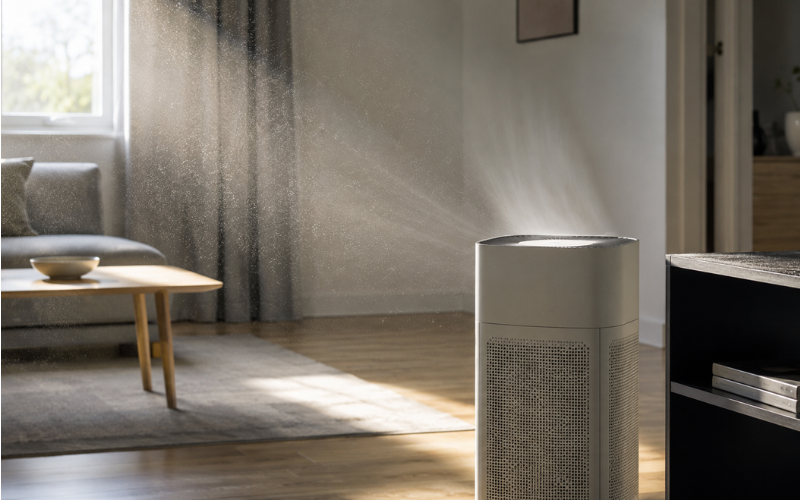
Will an air purifier help with dust? Yes, a good air purifier can reduce the amount of dust floating in your indoor air, but it will not completely remove all dust from your home. Understanding this difference is important if you are considering an air purifier mainly because your rooms, furniture, or other surfaces seem constantly dusty.
Household dust is a mixture of many tiny particles. It can contain skin flakes, fabric fibers, pollen, pet dander, soil, fine dirt, and other small particles brought indoors from outside. Some particles stay suspended in the air for a while, while heavier particles quickly settle onto floors, shelves, tables, and furniture.
This explains why dust returns even after you clean. Everyday activities such as walking across carpets, making the bed, opening windows, or allowing pets to move through a room can release more particles into the air.
An air purifier helps by repeatedly pulling room air through a filter. The filter captures many airborne particles before they have a chance to settle. However, a purifier cannot pick up dust that is already sitting on your bookshelf or underneath your sofa. For the best results, air purification needs to work alongside normal household cleaning.
How Air Purifiers Reduce Dust in Your Home
An air purifier works by using a fan to draw surrounding air into the machine. That air moves through one or more filters before cleaner air is released back into the room.
When dust is floating in the air, some of those particles enter the purifier with the airflow. A suitable particle filter catches them and keeps them from being released back into the room. As the purifier continues operating, it repeatedly filters the room’s air.
This process can gradually lower the amount of airborne dust and other particles present indoors. It may also mean that fewer small particles eventually land on nearby surfaces.
The important word is “reduce.” An air purifier does not stop dust from being created. People, pets, fabrics, carpets, outdoor air, and everyday activities continue introducing or producing particles.
So, if you are wondering will an air purifier help with dust around the house, the realistic answer is yes, particularly with fine airborne dust, but it should not be viewed as a replacement for cleaning.
Airborne Dust vs. Settled Dust: The Important Difference
Airborne dust consists of particles light enough to remain suspended in the air. These are the particles an air purifier has the best chance of capturing because they can travel through the machine.
Settled dust, on the other hand, has already landed on surfaces. Once dust is sitting on a desk, television, floor, windowsill, or piece of furniture, an air purifier cannot pull it directly from that surface.
Movement can sometimes send settled particles back into the air. Walking on a rug, shaking bedding, or using a dry duster may disturb dust and allow some of it to reach the purifier.
This is why an air purifier works best as part of a wider dust-control routine. Vacuuming, wiping surfaces, washing fabrics, and controlling sources of dust remain necessary even when the purifier is running every day.
The Types of Dust an Air Purifier Can Capture
This includes fine household dust, pollen, pet dander, small fabric fibers, carpet particles, and fine particulate matter. The exact amount removed depends on the particle size, filter quality, purifier airflow, and how often the particles actually reach the unit.
Dust mites need a little more explanation. The mites themselves commonly live in materials such as mattresses, carpets, and upholstered furniture. An air purifier is not a solution for removing dust mites from those surfaces. However, small pieces of dust mite debris and allergen-containing particles can become airborne and may then be captured by a suitable filter.
The same principle applies to other larger pieces of debris. A purifier is useful when particles are suspended in the air, but heavier material may settle too quickly to pass through its filter.
Choosing the Right Air Purifier for Dust
A purifier using a HEPA filter is generally a sensible choice for capturing small airborne particles. HEPA filters are designed for high-efficiency particle filtration and can capture very small particles passing through them.
Filter quality alone, however, is not enough. The purifier must also be capable of moving enough air for the size of your room. A small desktop unit may have limited effect when placed in a large open living area.
This is where CADR, or Clean Air Delivery Rate, can be helpful. In simple terms, CADR indicates how quickly a purifier can deliver filtered air for particular pollutants. When comparing machines for dust removal, check whether the manufacturer provides a dust CADR and whether the unit is recommended for your room size.
Also consider how often the purifier can filter the room’s air. Effective filtration depends on both a capable filter and enough airflow to bring dirty air into the unit.
How Much Dust Can an Air Purifier Actually Reduce?
There is no single percentage that applies to every home. How much dust an air purifier reduces depends heavily on the conditions in which it operates.
A properly sized purifier used regularly in a closed or controlled room will usually have a better opportunity to capture particles than a small purifier used occasionally in a large space. Filter condition matters too. A filter that is overdue for replacement may restrict airflow and make the unit less effective.
Your home’s dust sources also play a major role. A house beside a dusty road, for example, may receive new particles whenever doors or windows are opened. Homes with pets, carpets, fabric furniture, or frequent foot traffic can also have continuous sources of airborne particles.
Fan speed makes a difference because faster airflow generally allows more room air to pass through the filter. The trade-off is often increased noise and electricity use.
Best Air Purifier Placement for Controlling Dust
Put the purifier in a location where air can move freely into and out of the machine. Avoid squeezing it behind a sofa, hiding it beneath furniture, or placing objects directly in front of its air intake or outlet. Always follow the manufacturer’s recommended clearance around the unit.
If dust is most noticeable in your bedroom, using the purifier there may be more useful than placing it in a distant hallway. Similarly, a purifier used in a living area should be positioned where it can circulate air through the occupied part of the room.
The goal is not necessarily to put the machine directly beside every dusty surface. Instead, focus on good airflow and the room where you spend time or experience the biggest dust problem.
How Long Should You Run an Air Purifier for Dust?
Air purifiers generally work better when they have enough time to repeatedly filter the room’s air. If dust control is the goal, regular or continuous operation is usually more effective than switching the machine on for only a few minutes occasionally.
Many modern units offer automatic modes or several fan speeds. A higher setting can be useful when dust has recently been disturbed, such as after vacuuming, changing bedding, or opening windows. Lower speeds may be more comfortable for routine use or nighttime operation.
Do not expect the room to become permanently dust-free after the first day. Air filtration is an ongoing process because new particles are continually being introduced.
Why You May Still See Dust After Using an Air Purifier
One reason is that some dust particles are relatively large and heavy. They may fall onto a surface before the purifier’s airflow can reach them. An air purifier cannot capture particles that never enter the machine.
Your home also continues producing dust. Bedding, clothing, carpets, curtains, upholstered furniture, people, and pets all contribute particles. Outdoor dust can enter through doors, windows, gaps, and normal household traffic.
The purifier itself may also be part of the problem if it is too small for the room, placed in an obstructed area, or operated only occasionally.
Finally, filters need proper maintenance. Check them according to the manufacturer’s instructions. A heavily loaded filter may restrict airflow, while some units also have washable or replaceable pre-filters that collect larger debris.
Getting Better Dust Reduction From Your Air Purifier
Regular vacuuming can remove particles from carpets and floors before they become airborne again. If possible, use a vacuum designed to contain fine particles effectively rather than allowing them to escape back into the room.
For furniture and hard surfaces, damp dusting can be preferable to simply moving a dry cloth around. A slightly damp cloth helps collect particles instead of sending as many back into the air.
Wash bedding regularly and pay attention to curtains, rugs, upholstery, and other fabrics that collect particles. If outdoor dust is a major issue, keeping windows closed during particularly dusty conditions may also help.
Cleaning air vents and other areas where dust builds up can reduce additional sources. Together, these steps address settled dust while the air purifier deals with particles that remain airborne.
Air Purifier Mistakes That Can Make Dust Control Less Effective
One common mistake is choosing a purifier that is not powerful enough for the room. Even an excellent filter has limited value if very little room air passes through it.
Another issue is restricted airflow. Placing a unit directly against furniture, covering its vents, or hiding it in a corner can interfere with circulation.
Running the purifier only occasionally may also produce disappointing results in a home where dust is continuously being generated. Similarly, forgetting to clean or replace filters can reduce performance.
It is also worth focusing on the feature that matters most for dust: effective particle filtration combined with appropriate airflow. Extra features do not automatically make a purifier better at capturing dust.
Is an Air Purifier Worth It for a Dusty Home?
For many dusty homes, an air purifier can be a useful addition to regular cleaning. It may be particularly helpful in rooms where fine airborne particles are common or where outdoor dust, pets, carpets, and fabrics continually contribute to indoor particle levels.
However, expectations matter. Buying an air purifier does not mean you can stop vacuuming or dusting. It also cannot prevent skin cells, fibers, outdoor soil, and other materials from entering or being produced inside the home.
If most of your problem is thick settled dust, first look at possible sources and your cleaning routine. If the issue includes fine particles circulating through the air, a properly sized purifier with efficient particle filtration can provide an additional layer of control.
Conclusion
So, will an air purifier help with dust? Yes, it can help reduce airborne household dust and other small particles when the purifier has effective filtration, adequate airflow, and enough capacity for the room.
What it cannot do is remove every particle from your home or clean dust that has already settled on surfaces. Larger particles may also fall to the ground before they ever reach the purifier.
The most practical approach is to combine air purification with vacuuming, damp dusting, fabric cleaning, and control of outdoor dust. With realistic expectations and regular maintenance, an air purifier can become a useful part of keeping indoor air and your home cleaner.
FAQs
1. Will an air purifier stop dust from collecting on furniture?
It may reduce how quickly some fine airborne dust settles on furniture, but it cannot stop dust completely. New dust is constantly generated or brought indoors, and heavier particles can settle before reaching the purifier.
2. What type of air purifier is best for dust?
A purifier with effective HEPA particle filtration, adequate airflow, and a suitable capacity for the room is a strong option for dust. When available, comparing the unit’s dust CADR can also help you judge its particle-cleaning performance.
3. Should I run an air purifier all day to reduce dust?
Regular or continuous use generally gives the purifier more opportunities to capture airborne dust. The appropriate operating schedule and fan setting depend on your room, dust levels, noise preferences, and the manufacturer’s instructions.
4. Why is my room still dusty with an air purifier?
Dust may be entering from outdoors or coming from carpets, bedding, pets, clothing, and furniture. Some particles also settle too quickly for the purifier to capture. Poor placement, insufficient purifier capacity, or an overdue filter can further reduce performance.
5. Does an air purifier replace regular dusting and vacuuming?
No. Air purifiers and household cleaning perform different jobs. The purifier mainly targets particles passing through the air, while vacuuming and wiping surfaces remove dust that has already settled. Using both provides more complete dust control.