
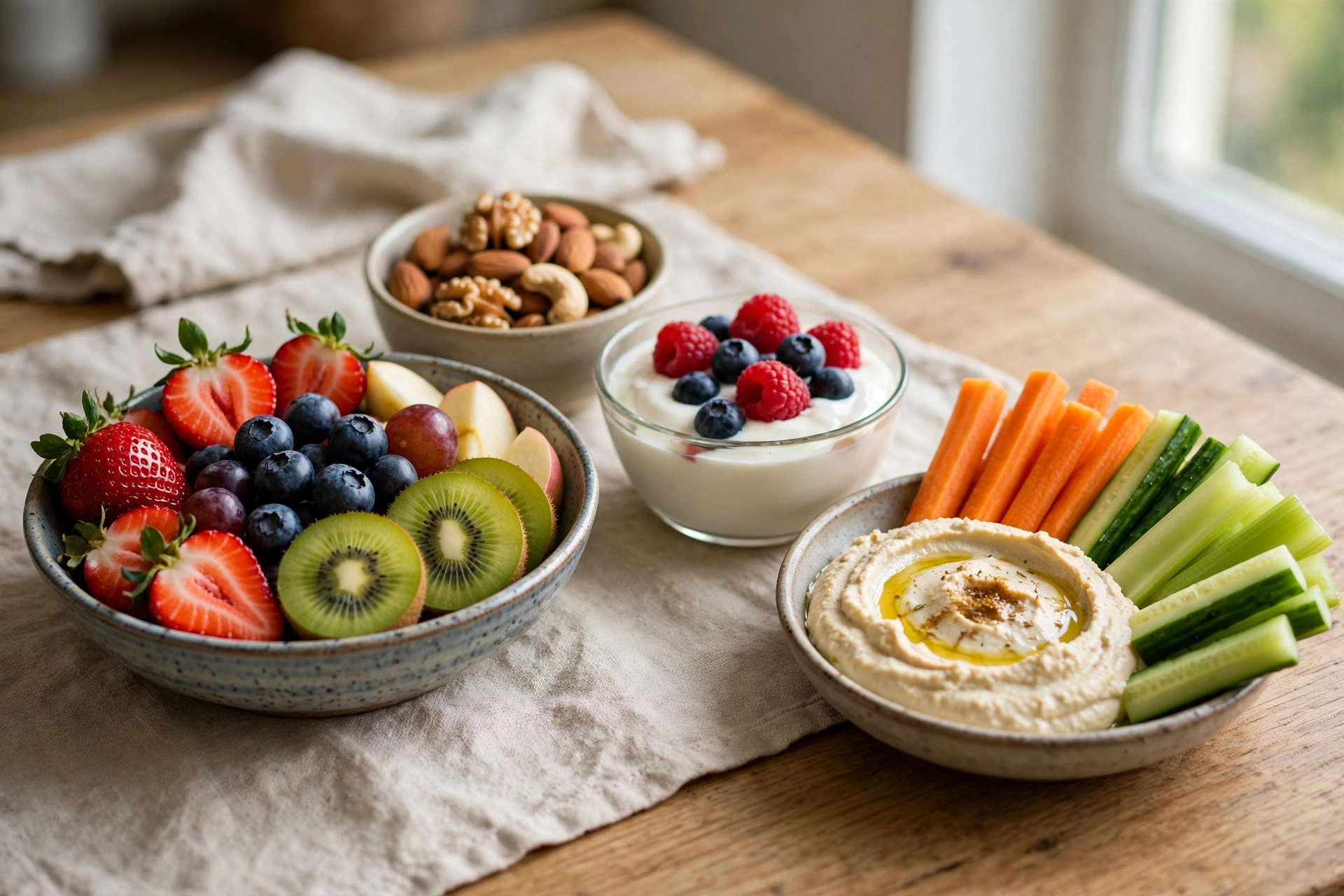
Snacks fill the gaps between meals, and those gaps show up in many parts of a day. A snack can be food eaten after school, during a break at work, on a train, or in the evening when the next meal is still an hour away. Healthy options for snacks work best when they are simple, satisfying, and easy to reach for at the moment hunger arrives.
This article stays with snacks only. It does not plan dinners or replace a main meal, and it does not offer medical advice. It looks at sweet and savory ideas, at snacks at home, at work, on the go, and for children. A snack only has to fit the moment and leave room for the next meal.
What Counts as a Healthy Snack
A healthy snack is a small amount of food eaten between meals that adds something useful to the day without crowding out the next meal. Fruit and vegetables are a strong starting point because they are simple to eat, easy to carry, and part of a varied daily pattern. A piece of fruit, a handful of berries, carrot sticks, cucumber slices, or pepper strips can work on their own or with a dip or spread.
Portion size matters as much as the food itself. A small bowl, a single piece of fruit, a small handful of nuts, or one slice of toast with a topping is often enough. Nuts and seeds are a clear example of why portions matter. A small handful is usually right. Labels can help with packaged snacks. Traffic light labels give a quick guide to fat, saturated fat, salt, and sugar. The NHS guide to healthier snacks gives practical ideas for homemade and store-bought snacks.
Sweet Healthy Options for Snacks
Sweet snacks do not have to mean candy, cake, or a sugary drink. Fruit gives sweetness in a form that also brings fiber and water, and it works in many simple combinations. Sliced apple with peanut butter is a classic pairing, and banana on whole-wheat toast suits a morning snack or an afternoon break. Berries with plain yogurt offer a cool, creamy contrast, and frozen berries work well when fresh berries are out of season.
Yogurt can be a base for several sweet snacks. Plain yogurt with sliced fruit, a little cinnamon, or a spoonful of oats can be filling without added sugar. Frozen yogurt bark, made by spreading yogurt on a tray, scattering berries over it, and freezing it, breaks into shards that feel like a treat on a warm day. Water, milk, or a drink with no added sugar is usually the simpler partner for a snack than a sugary drink.
Savory Healthy Options for Snacks
Savory snacks suit moments when something salty, crunchy, or warm feels more satisfying than fruit. Vegetable sticks with hummus are one of the most reliable choices. Carrot, cucumber, celery, and pepper sticks keep well for a short time, travel well in a small container, and give a satisfying crunch with a creamy dip.
Eggs, cheese, and beans give savory snacks more staying power. A hard-boiled egg with a few vegetable sticks is simple and portable. Rice cakes topped with cottage cheese and cherry tomatoes, or toasted whole-wheat pita with tuna and a yogurt dip, can work when the gap before the next meal is long. Roasted chickpeas seasoned with paprika, cumin, and coriander offer crunch without frying. Using herbs, spices, garlic, lemon juice, and vinegar for flavor helps keep salt in check. The British Heart Foundation collection of healthy snack ideas shows sweet and savory snacks built from whole foods.
Healthy Options for Snacks at Home
Home is the easiest place to snack well because the kitchen and fridge are close at hand. The habit that helps most is keeping ready-to-eat foods visible and easy to reach. A fruit bowl on the counter, a container of washed and cut vegetables in the fridge, and a small bowl of washed berries make a healthy choice the first thing seen when hunger arrives. Keeping packaged snacks high in salt, sugar, or fat out of easy reach removes a daily decision.
At home, snacks can take a little more effort without becoming a cooking project. Savory muffins with vegetables and cheese, baked at the weekend, can be eaten over several days. Serving a snack in a small bowl and sitting down to eat it helps the snack stay a snack, rather than an open-ended habit while watching television or working late.
Healthy Options for Snacks at Work
Work snacks need to survive a desk drawer, a shared fridge, and a busy schedule. The best work snacks need little preparation, have no strong smell, and make no mess. Fresh fruit is hard to beat for this purpose. An apple, a banana, a small bunch of grapes, or a pot of berries needs no preparation. A small pot of yogurt or a small bag of unsalted nuts can sit in a bag or drawer. Rice cakes with cottage cheese, prepared the night before, can be eaten cold at a desk.
Planning helps more at work than willpower does. Packing a snack with lunch, or keeping a small supply of shelf-stable snacks at work, means a snack is ready when hunger arrives, rather than leaving the choice to a vending machine at the hungriest moment. A small bag of trail mix made from nuts, seeds, and dried fruit, or a few oatcakes, can fill that role if portions stay small. When a meal will be late, yogurt with oats and fruit can bridge the gap more steadily than a sweet snack eaten alone.
Healthy Options for Snacks on the Go
Snacks on the go need to be portable, sturdy, and safe to eat without a plate or a kitchen. Fruit leads again here because it comes in its own packaging. Bananas, apples, satsumas, grapes, and small pots of berries travel well. A small sandwich made with whole-wheat bread, cheese and cucumber, peanut butter and banana, or hummus and grated carrot can be wrapped and eaten without fuss.
Travel days need a little more thought because food may sit in a warm bag for hours. Foods that spoil quickly, such as dairy foods, cooked eggs, and meat or fish fillings, need to stay cool, so a small cool bag is worth using on a long trip. For shorter trips, fruit, plain crackers, oatcakes, unsalted nuts, and popcorn in a sealed bag are safer choices that do not need chilling. Packing only as much as will be eaten, in small portions, avoids waste. For children traveling with adults, snacks should be easy to eat, not too messy, and cut into safe sizes. Whole nuts, whole grapes, and popcorn can be choking hazards for small children, so they should not be given to young children, and grapes should be cut lengthwise for younger children.
Healthy Options for Snacks for Children
Children often need snacks because they are growing and active, and the gap between meals can feel long. Snacks for children work best when they are built from the same foods adults eat, in smaller portions and in forms children can handle. Fruit and vegetables are the simplest choice, and the NHS notes that fruit and vegetable snacks are always the best choice for children. Fruit kebabs, cucumber shapes, cherry tomatoes, watermelon slices, and carrot sticks can be fun to eat.
Packaged snacks need a clear limit for children. The NHS advises aiming for no more than two packaged snacks a day for children, and choosing lower-fat, lower-sugar options when packaged snacks are used. Plain rice cakes with lower-fat cheese, lower-fat and lower-sugar fromage frais, and a crumpet are examples from the NHS guide. Checking labels helps, because many snacks marketed for children are high in sugar, salt, or saturated fat. Whole nuts should not be given to children under five, and nut rules at school should be followed. This article gives general ideas only.
How to Build a Snack That Keeps You Going
A snack that keeps you going usually combines more than one type of food. Pairing a fruit or vegetable with a source of protein or fiber tends to feel more satisfying than eating a single sweet or salty food alone. Apple slices with peanut butter, yogurt with berries and oats, vegetable sticks with hummus, and toast with banana and nut butter all follow the same simple pattern.
Fiber plays a useful part in snacks, and many snack foods already contain it. Whole fruit with its skin, vegetables, whole-wheat bread, oatcakes, oats, beans, nuts, and seeds all add fiber. A guide to fiber foods explains how fiber fits into everyday eating. Balance over the day matters more than balance in a single snack. A snack that leaves you comfortably full until the next meal is doing its job.
Shopping, Storage, and Simple Prep
Good snacking starts with shopping. A short list built around a few staples makes the weekly shop simpler and reduces impulse buys. Useful staples include fresh fruit, vegetables for sticks and salads, plain yogurt, cheese, eggs, whole-wheat bread, pita, oatcakes, rice cakes, oats, peanut butter with no added sugar or salt, hummus, canned chickpeas, and a small supply of unsalted nuts and seeds.
Storage and prep turn a shopping list into snacks that are actually eaten. Washing and cutting vegetables once, then storing them in a sealed container in the fridge, makes them ready for several days. Hard-boiling a few eggs, making hummus, or baking savory muffins at the weekend creates snacks for the week. Small containers and a cool bag for travel keep portions separate and fresh. Labeling containers with the date helps with food safety, and cooked foods should be cooled reasonably quickly and stored in clean containers. Ten minutes spent washing fruit, cutting vegetables, and portioning nuts into small bags can save many small decisions later in the week.
Common Snack Mistakes to Avoid
The most common snack mistake is eating without noticing. Snacks eaten straight from a large bag, while working or watching a screen, are easy to overeat because attention is elsewhere and the portion is unclear. Serving a snack in a small bowl and pausing to eat it helps the snack stay satisfying.
A third mistake is treating a drink as if it were not part of the snack. Sugary drinks can add a great deal of sugar to a snack session, and they do not satisfy hunger in the same way as food. Water is the simplest drink with a snack. Skipping meals and then relying on snacks to fill the gap is another mistake. Snacks bridge the space between meals; they are not meant to replace meals again and again. A related guide to healthy dinner ideas shows how main meals can be kept simple and balanced.
Frequently Asked Questions
What are some healthy options for snacks that need no cooking?
Fruit, yogurt, cheese, oatcakes, rice cakes, vegetable sticks with hummus, and a small handful of unsalted nuts all need no cooking. Apple slices with peanut butter, berries with yogurt, and cottage cheese with tomatoes on a rice cake are simple combinations that take only a few minutes.
How many snacks should children have each day?
Children often need one or two small snacks between meals, depending on age, activity, and the gap between meals. The NHS advises aiming for no more than two packaged snacks a day for children, with fruit and vegetable snacks as the best everyday choice. A doctor or registered dietitian can advise for a child with special dietary needs.
Are nuts a healthy snack?
Nuts can be a satisfying snack, and unsalted nuts without added sugar are the better choice. A small handful is usually enough, and they work well paired with fruit. Whole nuts should not be given to children under five, and nut rules at school should be followed.
What is a good snack to take to work?
Fruit, yogurt, cheese, oatcakes, and vegetable sticks with hummus travel well and need little preparation at work. A small sandwich, a pot of yogurt with fruit, or a small bag of trail mix can also work.
Can snacks be healthy if I have a health condition?
Snacks can be part of a balanced pattern of eating for many people, but individual needs vary. This article is general information only and does not give medical advice or a personal eating plan. Anyone with a health condition or special dietary need should speak to a doctor or a registered dietitian before making major changes. A routine check, such as the one described in the guide to the NHS Health Check, can be a useful chance to ask about general eating patterns.
Conclusion
Healthy options for snacks do not need special foods, strict rules, or a great deal of time. Fruit and vegetables, yogurt, eggs, cheese, whole grains, beans, nuts, and seeds, combined in simple pairs and served in small portions, can cover sweet and savory tastes at home, at work, on the go, and for children.
Start with one change that fits your routine. Wash and cut vegetables for the fridge, keep a fruit bowl where it can be seen, or pack a work snack the night before. Let that change become normal, then add another. Over time, those small choices add up to a snacking pattern that is satisfying, varied, and easy to keep.
General information note: This article is general information only and is not medical advice. It does not diagnose, treat, or advise on any health condition. If you have a health condition, a food allergy or intolerance, or you take regular medicine, speak to your doctor or a registered dietitian before making significant changes to your diet.