
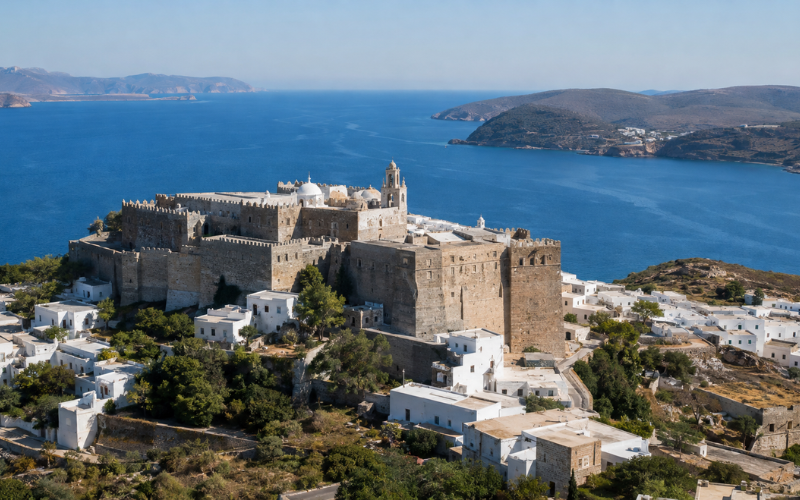
The island of Patmos in the Aegean Sea is a small Greek island known for its sacred history, traditional villages, rocky landscapes, and peaceful coastline. It belongs to the Dodecanese island group in southeastern Greece, although it lies near the northern edge of that region.
Patmos is especially important in Christianity because it is traditionally linked to Saint John and the Book of Revelation. However, the island offers more than religious landmarks. Visitors also find whitewashed houses, quiet beaches, walking paths, family-run restaurants, and wide views across the Aegean.
Where Patmos Is Located in the Aegean Sea
Patmos lies in the eastern Aegean Sea, west of the Turkish coast. It is part of Greece’s Dodecanese islands, near Lipsi, Leros, Kalymnos, and several smaller islands. Ferries connect it with other parts of the Dodecanese and with mainland Greece.
The island is compact, with a total land area of about 34 square kilometers. Its coastline includes narrow bays, rocky headlands, small coves, and sheltered beaches. Low hills rise across the island, while Chora and its monastery stand above the port of Skala.
Patmos does not have the broad, flat landscape of some Greek islands. Its irregular shape and hilly ground create changing sea views over short distances.
The Story of Patmos Through the Centuries
Patmos has been known since ancient times, although it was never a major center like Rhodes or Kos. Ancient remains suggest that people lived and worshipped on the island long before Christianity arrived.
During the Roman period, Patmos was remote enough to be associated with exile. Christian tradition places Saint John on the island near the end of the first century. Patmos later became part of the Byzantine Empire, and its religious importance grew after the foundation of the Monastery of Saint John in the 11th century.
The island also passed through periods of outside control and Ottoman rule. According to UNESCO, Chora grew gradually around the monastery and later welcomed families from Constantinople and Crete. Trade helped the settlement develop, and wealthy merchants built several of its large houses. This long history can still be seen in its churches, mansions, lanes, and fortified religious buildings.
Patmos and the Book of Revelation
The strongest historical association of Patmos is with the final book of the New Testament. The Book of Revelation states that a man named John was on Patmos because of his religious testimony. Christian tradition identifies him as Saint John the Theologian, also known as John the Evangelist.
Tradition says that John was exiled to the island during Roman rule, often dated to around AD 95. While living there, he is believed to have received the visions described in Revelation.
Historians and religious scholars do not all agree about John’s exact identity or every detail of the traditional account. Even so, the connection has made Patmos an important pilgrimage destination for centuries. Christian visitors come from many countries to pray, attend services, and see the places connected with the story.
The Cave of the Apocalypse
The Cave of the Apocalypse stands beside the road between Skala and Chora. According to Christian tradition, this is where Saint John received his visions and dictated the Book of Revelation to his follower Prochoros.
Today, the natural cave forms part of a religious complex containing chapels and monastic spaces. Its dark interior, rock surfaces, lamps, icons, and quiet setting create a simple but powerful atmosphere. The cave, Chora, and the Monastery of Saint John have been included together on the UNESCO World Heritage List since 1999.
Visitors should remember that the cave remains an active sacred place. Quiet behavior and modest clothing are appropriate. Rules about photography may vary, so instructions from staff should be followed.
The Monastery of Saint John the Theologian
The Monastery of Saint John the Theologian was founded in 1088 by the monk Christodoulos with support from Byzantine Emperor Alexios I Komnenos. Its heavy walls, towers, and position above Chora give it the appearance of a castle.
Inside are chapels, courtyards, religious paintings, icons, manuscripts, and objects used in worship. Some of the oldest parts date from the 11th century. The monastery’s library and collection reflect its long role as a center of Orthodox faith and learning.
The monastery has shaped much of Patmos’s identity. Chora developed around it, religious traditions grew under its influence, and its outline remains the island’s most recognizable landmark.
Chora: The Historic Heart of Patmos
Chora, sometimes written as Hora, is the historic capital of Patmos. It spreads around the monastery on a high hill overlooking the Aegean Sea.
Whitewashed houses, stone passages, small squares, vaulted paths, and narrow lanes give the settlement its traditional character. Several large homes were built by merchants, ship captains, and wealthy families. Their thick walls and enclosed courtyards provided protection from heat, wind, and past attacks.
Visitors can explore old churches, restored houses, small museums, windmills, and viewpoints. Chora becomes especially attractive in the early morning or evening, when temperatures are lower and its lanes are quieter.
Skala and the Island’s Main Harbor
Most visitors first see Patmos from Skala, the island’s main port and busiest settlement. Ferries, excursion boats, and private vessels arrive in its protected harbor.
Skala has hotels, restaurants, cafés, bakeries, shops, travel offices, vehicle rentals, and essential services. Its waterfront becomes lively during the summer, particularly when ferries or cruise boats arrive.
Local buses and taxis usually leave from the port area, making Skala a useful base for travelers without a car. The old path between Skala and Chora also offers an interesting walk, although parts of the route are steep.
Villages and Settlements Beyond Chora
Grikos is a quieter coastal settlement south of Skala. Its sheltered bay, waterfront accommodation, and nearby beaches make it popular with visitors seeking a relaxed setting. The large rock at Petra, also called Kalikatsou, is one of the area’s most noticeable natural features.
Kambos lies in the northern part of Patmos and includes both an inland village and a coastal area. The surrounding countryside has traditional homes, small churches, fields, and access to several beaches.
Smaller areas such as Sapsila and Netia show a more residential side of the island. These communities are less famous than Chora but help visitors understand everyday life on Patmos.
Beaches and Coastal Scenery of Patmos
The beaches on the island of Patmos in the Aegean Sea range from organized family beaches to isolated coves. Kambos is one of the most popular options because it has relatively shallow water and nearby facilities. Agriolivadi also offers convenient access, clear water, and places to eat.
Petra Beach is known for its pebbles, deep water, and view of Kalikatsou Rock. Lambi has colorful stones, while Psili Ammos offers a more remote experience. Psili Ammos is normally reached by walking or by boat, depending on the season.
Beach conditions can change with the wind. Some northern shores may become rough, while protected bays remain calmer. Visitors should check local conditions before swimming or taking a small boat.
Nature, Walking Trails, and Island Landscapes
Patmos has a dry Aegean landscape shaped by rocky hills, low plants, herbs, and a deeply cut coastline. Walking routes cross the countryside and connect settlements, religious sites, beaches, and viewpoints.
One well-known route follows the old path between Skala and Chora. Other walks lead toward Profitis Ilias, the highest point on the island, or through quieter northern and southern areas.
Summer heat can make hiking difficult during the middle of the day. Walkers should carry water, wear suitable shoes, and choose early morning or late afternoon whenever possible. Staying on marked paths also helps protect plants and fragile ground.
Traditional Life and Culture on Patmos
Religion remains an important part of life on Patmos. Orthodox Easter, Holy Week services, saints’ days, and local festivals bring residents and visitors together. Some ceremonies have been practiced for many generations and remain closely connected to the monastery.
The island also has a creative side. Music events, art exhibitions, traditional boatbuilding, and local crafts contribute to its cultural identity. Galleries and workshops can be found around Chora and Skala.
Outside the busiest months, life moves at a slower pace. Residents shop locally, meet in village squares, attend church, and maintain close ties with the sea.
Food and Local Flavors of Patmos
Food on Patmos reflects the wider Dodecanese region while keeping several local specialties. One of the best-known dishes is Patmian cheese pie, a rich baked pie usually made with a mixture of cheeses.
Menus may also include fresh fish, grilled octopus, stuffed vegetables, chickpea dishes, goat, seasonal greens, and simple salads. Local sweets include poungia, which are small filled pastries, and achladakia, almond sweets shaped like pears.
Dining is generally relaxed. Waterfront restaurants offer sea views, while village tavernas often focus on traditional recipes. Seasonal ingredients and the day’s catch may affect what is available.
The Best Time to Experience Patmos
Spring is a good time for walking, sightseeing, and enjoying mild temperatures. The countryside is greener, wildflowers may be visible, and religious visitors arrive around Orthodox Easter.
July and August bring the warmest weather, the greatest number of ferry connections, and the busiest beaches. Accommodation prices are usually higher, and Chora and Skala can feel crowded during popular travel dates.
September often combines warm sea temperatures with fewer visitors. October can also be pleasant, but ferry services, restaurants, and hotels may begin reducing their schedules. Winter is quiet, with fewer travel services and a greater chance of weather-related disruption.
How to Reach the Island of Patmos
Patmos has no airport, so all visitors complete the final part of their journey by sea. Ferries travel from Piraeus, the main port serving Athens. The official Greek tourism website gives a typical Piraeus-to-Patmos journey of approximately 7 to 12 hours, depending on the service and route.
Travelers can also fly to islands such as Kos, Rhodes, or Leros and continue by ferry when connections are available. Patmos has sea links with islands including Lipsi, Leros, Kalymnos, Kos, Rhodes, and Syros, although timetables change by season.
Tickets and schedules should be checked directly with ferry operators. Strong winds can delay or cancel services, so leaving extra time between ferries and flights is sensible.
Getting Around Patmos
Seasonal buses connect Skala with important places such as Chora, Grikos, and Kambos. Taxis are also available, although demand can be high when ferries arrive.
Cars, scooters, and bicycles can be rented in Skala. A small vehicle gives visitors more freedom to reach distant beaches, but some roads are narrow and winding. Scooter riders should have the proper licence and feel confident on hilly roads.
Where to Stay on Patmos
Skala is the most practical place to stay for ferry access, restaurants, shops, and public transport. It suits first-time visitors and anyone planning a short trip.
Chora offers historic surroundings, traditional architecture, and evening views, but its lanes and slopes may be difficult for people with limited mobility. Grikos provides a quieter seaside atmosphere south of the main port.
Kambos is useful for travelers who want to stay near a family-friendly beach and explore northern Patmos. The best choice depends on transport needs, preferred atmosphere, and the length of the visit.
A Practical Patmos Itinerary
A one-day visit should focus on the Cave of the Apocalypse, the Monastery of Saint John, Chora, and a short walk around Skala. Starting early helps avoid the strongest heat and larger visitor groups.
With two days, travelers can spend the first day exploring the religious and historical sites before using the second for Grikos, Petra, Kambos, or another beach. An evening in Chora provides a different experience from a daytime visit.
Three or more days allow time for coastal walks, smaller settlements, boat trips, local food, and quieter beaches. A slower schedule suits Patmos because many of its most memorable qualities come from its peaceful setting rather than a long list of attractions.
Essential Tips for Visiting Patmos Responsibly
Modest clothing should be worn at monasteries, churches, and the Cave of the Apocalypse. Shoulders and knees may need to be covered, and visitors should avoid loud conversations during services.
On beaches and walking routes, all rubbish should be taken away. Stones, plants, and objects from historic areas should remain where they are. Water and energy should also be used carefully because island resources can be limited.
Supporting family-run accommodation, tavernas, shops, and guides helps the local community. Travelers should also respect private homes in Chora and avoid blocking narrow streets while taking photographs.
Common Questions About the Island of Patmos in the Aegean Sea
Is Patmos mainly a religious destination?
Patmos is a major Christian pilgrimage destination, but religion is only one part of its appeal. Visitors also come for historic architecture, beaches, walking routes, food, coastal scenery, and a peaceful Greek island atmosphere.
How many days are enough for Patmos?
Two days are enough to see the main religious sites, Chora, Skala, and one or two beaches. Three to five days provide a more relaxed experience and allow time for walking, swimming, and exploring smaller settlements.
Is Patmos suitable for families?
Yes, Patmos can suit families, especially those who prefer calm surroundings and cultural activities. Kambos and other sheltered beaches may work well for children, although water conditions should always be checked locally.
Can Patmos be visited without renting a vehicle?
Yes. Visitors can stay in Skala and use buses, taxis, boats, or walking routes. Public transport schedules may be limited outside summer, so checking current times before planning each day is important.
Conclusion
The island of Patmos in the Aegean Sea brings together sacred history, traditional Greek architecture, rocky landscapes, and clear coastal waters. Its connection with the Book of Revelation gives it international religious importance, while Chora, Skala, the monastery, villages, and beaches reveal a broader island character.
Patmos is best experienced with patience and respect. Taking time to understand its living traditions, natural limits, and local communities allows visitors to appreciate why this small Dodecanese island continues to hold such a distinctive place in the Aegean.