
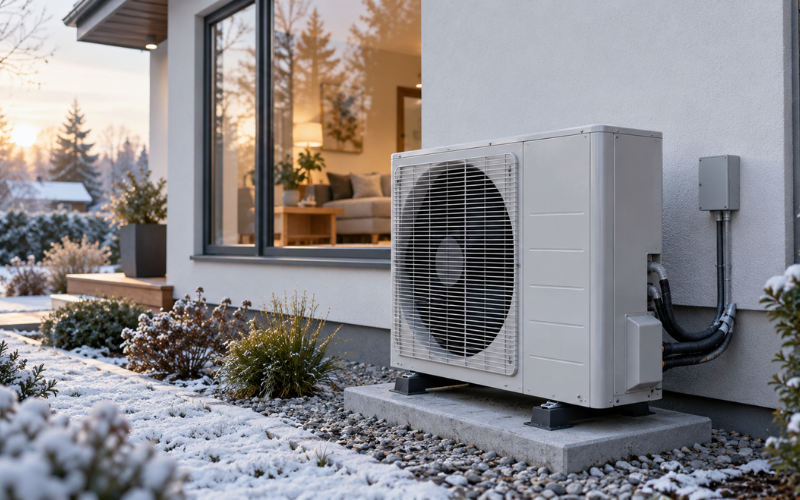
What is a heat pump, and why are more homeowners considering one? In simple terms, it is an electric system that moves heat from one place to another. During winter, it brings heat indoors. During summer, it reverses direction and removes heat from the building. One system can therefore provide both heating and cooling.
Modern models can be efficient across many climates. They may also reduce a household’s direct use of gas, oil, or propane. This guide explains how heat pumps work, their types, efficiency, costs, maintenance, and buying considerations.
How a Heat Pump Works
A furnace creates heat by burning fuel or using electric resistance. A heat pump instead transfers existing heat. Even cold outdoor air contains usable heat energy that the system can collect and move indoors.
Refrigerant circulates through the system and absorbs heat outside. The compressor increases its pressure and temperature, and the indoor unit releases that heat into the home. A fan then distributes the warmed air.
In cooling mode, a reversing valve changes the refrigerant flow. The system absorbs indoor heat and releases it outside, much like an air conditioner. ENERGY STAR explains that this reversible process allows an air-source heat pump to handle both heating and cooling.
The Main Parts of a Heat Pump System
Most systems have an outdoor unit and one or more indoor units. The outdoor unit contains a coil, fan, and compressor. The indoor air handler uses another coil and fan to deliver heated or cooled air.
The compressor moves and pressurizes the refrigerant. An expansion valve lowers its pressure so it can absorb heat again. A reversing valve switches the system between heating and cooling.
A thermostat and electronic controls manage operation. Variable-speed compressors and fans can adjust their output to match demand, supporting steadier temperatures and quieter operation.
Common Types of Heat Pumps
Air-Source Heat Pumps
An air-source heat pump exchanges heat with outdoor air. It can connect to central ductwork and is generally easier to install than a geothermal system, although outdoor temperature affects its performance.
Ground-Source or Geothermal Heat Pumps
A ground-source heat pump exchanges heat with the earth through buried pipes. Stable underground temperatures support efficient operation, but drilling or excavation makes installation more expensive.
Water-Source Heat Pumps
A water-source system uses a body of water or shared water loop. Water quality, access, permits, and environmental rules determine whether it is practical.
Ductless Mini-Split Heat Pumps
A ductless mini-split connects an outdoor unit to indoor units without conventional ducts. It suits additions, older homes, and rooms that need separate temperature control.
Hybrid Heat Pump Systems
A hybrid system combines a heat pump with a furnace. Controls choose the heat source according to weather, energy prices, and system settings.
Heat Pumps Compared with Furnaces and Air Conditioners
A furnace heats but does not cool, while a central air conditioner cools but does not heat. A heat pump performs both jobs because its refrigerant cycle can run in either direction.
Heat pumps often use less electricity than electric resistance heaters. ENERGY STAR says a certified air-source model can deliver up to three times as much heat energy as the electricity it consumes. Savings compared with a gas furnace depend on fuel prices, climate, and equipment efficiency.
A ducted heat pump may reuse existing ducts, while a mini-split avoids them. Electrical or duct upgrades may still be necessary. Colder areas also require careful equipment selection and backup-heat planning.
Heat Pump Efficiency and Energy Ratings
Several ratings help buyers compare models. Coefficient of Performance, or COP, compares the useful heat delivered with the electricity used at a particular operating condition. A COP of 3 means the unit delivers three units of heat for each unit of electricity consumed at that test point.
SEER2 describes cooling efficiency across a typical cooling season, while HSPF2 describes heating efficiency across a heating season. Higher figures generally indicate greater efficiency, but ratings are laboratory comparisons rather than promises about a particular utility bill. The U.S. Department of Energy notes that SEER2 and HSPF2 replaced the earlier SEER and HSPF measures under updated testing methods.
Compare models of the same type and suitable capacity. EnergyGuide labels and independent certifications help, but actual use also depends on climate, insulation, settings, duct condition, maintenance, and backup heat.
Heat Pump Performance in Cold Weather
Modern cold-climate heat pumps can work below freezing. Advanced compressors help retain capacity as temperatures fall. ENERGY STAR tests qualifying cold-climate air-source models at 5°F, or about -15°C, although exact operating ranges vary.
Efficiency and output usually fall in colder air. Some homes therefore use electric resistance strips, a furnace, or another heater during extreme weather. Not every system needs backup heat, but the installer should assess it.
Frost may collect on the outdoor coil in cold, damp weather. A brief defrost cycle clears it and may pause heating. Frequent or prolonged defrosting can signal a problem.
Where Heat Pumps Work Best
Heat pumps can work in mild, hot, and cold regions when the equipment is selected for the climate. A cold area calls for a model with verified low-temperature performance. In a hot region, cooling efficiency and humidity control may matter more.
Good insulation and air sealing reduce heating and cooling demand. Existing ducts should be checked for leaks and correct sizing; where ducts do not exist, a ductless design may be more practical.
Floor area alone cannot determine capacity. Windows, ceiling height, shade, air leakage, local weather, outdoor space, electrical capacity, and energy prices all matter. Older homes may benefit from insulation or electrical upgrades first.
Heat Pump Installation Basics
A good installation begins with a room-by-room heating and cooling calculation. Guessing from floor area or simply matching the old equipment can lead to poor results. ENERGY STAR recommends professional sizing, commonly performed in the United States with a Manual J calculation.
The contractor selects the right type, capacity, and performance range. The outdoor unit needs free airflow and protection from snow, leaves, and roof runoff. Indoor units should distribute air evenly.
Installation may involve refrigerant lines, drainage, wiring, duct repairs, and a thermostat. The installer should then test airflow, refrigerant performance, controls, and backup settings. Even highly rated equipment performs poorly when installed incorrectly.
Heat Pump Costs and Potential Savings
There is no single reliable heat pump price. The total depends on the system type, capacity, efficiency, brand, labor rates, ductwork, electrical work, permits, and site access. A single-zone mini-split may cost much less than a whole-home ducted or geothermal system.
Savings depend on the system being replaced. Compare local energy prices, expected demand, maintenance, and backup-heat use. Request written estimates based on the same scope.
Rebates and tax programs change frequently. The IRS states that the U.S. Energy Efficient Home Improvement Credit covered qualifying work placed in service through December 31, 2025. For a 2026 installation, check current federal, state, local, manufacturer, and utility programs. Elsewhere, consult the relevant energy or tax authority.
Benefits of Using a Heat Pump
The clearest benefit is that one system can heat and cool. In suitable conditions, it can also use less energy than electric resistance heating. Variable-speed models can provide long, gentle operating cycles that support even temperatures and steady humidity control.
An electric heat pump produces no combustion gases inside the home. This removes the need to store heating oil or propane and avoids direct indoor emissions from fuel burning. Ducted, ductless, geothermal, and hybrid options also give homeowners several ways to adapt the technology to different buildings.
Limitations to Consider
The purchase and installation cost can be substantial, especially if a home needs new ducts, electrical upgrades, drilling, or several indoor units. Performance depends heavily on proper sizing and installation. An oversized unit may cycle too often, while an undersized one may struggle during severe weather.
Heat pumps depend on electricity, so an outage stops normal operation unless the home has suitable backup power or another heat source. Outdoor temperature can affect air-source performance, and some systems require auxiliary heat. The outdoor fan and indoor air movement may also be noticeable, although careful placement and modern equipment can reduce noise.
Heat Pump Maintenance and Expected Lifespan
Routine care protects efficiency and comfort. Clean or replace filters according to the manufacturer’s instructions, keep the outdoor coil clear of leaves and debris, and make sure vents or indoor heads are not blocked. Condensate drains should remain open, and unusual ice, odors, leaks, or sounds should be investigated.
A technician can inspect electrical connections, coils, fans, refrigerant performance, drainage, controls, and duct airflow. Follow the manufacturer’s service schedule and leave refrigerant work to trained professionals.
The Department of Energy uses about 15 years as an average planning life for residential air-source heat pumps. Actual life depends on climate, use, installation, maintenance, and equipment quality. Geothermal systems may last longer.
How to Tell Whether a Heat Pump Is Right for Your Home
Start with the home’s heating and cooling needs, not a particular product. Consider the local climate, building condition, current fuel, electricity price, ductwork, and available space. An energy assessment can reveal insulation and air-sealing improvements that may reduce the size and cost of the new system.
Ask several qualified contractors for a load calculation, model numbers, efficiency ratings, low-temperature data, warranty details, and a complete scope. In cold regions, ask when backup heat will run. Compare total value, not only the lowest quote.
Common Heat Pump Myths and Misunderstandings
One common myth is that heat pumps cannot work in cold climates. Modern cold-climate units can operate at very low temperatures, although correct selection and backup planning remain important. Another is that heat pumps only provide heating; most residential space-conditioning models also cool.
A home does not always need new ductwork because mini-splits can serve rooms directly, and some central systems can use suitable existing ducts. Backup heat is not universal; the need depends on the climate, home, model, and design. Finally, bigger is not automatically better. Oversized equipment can cycle frequently, reduce comfort, and waste the capability of a variable-speed system.
Conclusion
So, what is a heat pump? It is an electric heating and cooling system that transfers heat rather than creating all of it directly. By reversing its operating cycle, it can warm a building in winter and cool it in summer.
A heat pump can be efficient and practical, but it is not a one-size-fits-all purchase. Climate, insulation, sizing, electricity prices, installation quality, and incentives shape the result. A home assessment and detailed professional quotes provide the best basis for a decision.
FAQs
1. Does a heat pump use gas or electricity?
Most residential heat pumps use electricity to power the compressor, fans, and controls. A hybrid system also includes a gas, oil, or propane furnace that can provide backup heat.
2. Can a heat pump replace both a furnace and an air conditioner?
Yes. A properly designed heat pump can provide both heating and cooling. Whether it can fully replace a furnace depends on the climate, the home’s heating load, and the selected unit’s low-temperature capacity.
3. Does a heat pump run continuously?
It may run for long periods, especially in cold or hot weather. Variable-speed systems are designed to operate steadily at lower output. Continuous operation is not automatically a fault, but failure to reach the set temperature may require service.
4. How much electricity does a heat pump use?
Usage depends on capacity, efficiency, climate, insulation, settings, and backup heat. Estimate it using a load calculation, model data, and the local electricity rate.
5. How long does a heat pump last?
An air-source model is often planned around an average life of about 15 years. Installation, maintenance, operating conditions, and timely repairs affect longevity.