
A home fitness routine with no equipment uses your body weight and simple movements to help you stay active. Instead of lifting dumbbells or using machines, you work through exercises such as squats, push-ups, bridges, and marching. You can adjust these movements to suit your fitness level and the space available.
Bodyweight exercises can develop strength when they challenge your muscles. Steady movements such as brisk marching support cardiovascular fitness, while controlled movements help you practice balance and move comfortably through your available range.
You do not need an exhausting workout to make a useful start. A manageable session that you repeat regularly gives you a foundation to build on. The following routine combines strength and cardio in a practical format, with room to adjust the pace, exercise difficulty, and recovery time.
Set Up Your Space and Choose Your Workout Length
Find enough room to move comfortably
Choose a clear area where you can stretch your arms, step sideways, and lie down without hitting furniture. Remove loose objects and check that the floor gives you enough grip. Avoid exercising in socks on a slippery surface.
Keep the room comfortably ventilated and place water nearby. A mat is optional, although floor exercises should feel comfortable on your knees and back. Position your phone or timer where you can check it without repeatedly twisting your neck.
Choose a 10-, 20-, or 30-minute session
Choose a workout length that fits your day. Ten minutes can work as a brief movement session, while 20 minutes gives you time for a warm-up, a short circuit, and a cooldown. Thirty minutes allows more practice and longer rests.
For a shorter workout, reduce the number of exercises or rounds rather than rushing through them. For a longer session, add activity gradually. You do not need to fill every extra minute with harder exercise.
Warm Up Before Your Home Workout
Gentle marching and side steps
Begin by marching gently on the spot. Keep your steps comfortable and let your arms swing naturally. Gradually increase your pace, then add side steps to introduce movement in another direction.
The aim is to ease into activity rather than become tired before the workout starts. The NHS provides a warm-up lasting at least six minutes and recommends extending it when needed. Use that as a practical starting point for this routine.
Controlled arm circles, hip movements, and shallow squats
Follow your marching with small arm circles and gentle shoulder movements. Shift your weight from side to side, then practice a few shallow squats.
Keep each movement smooth and within a comfortable range. Start with smaller movements before gradually making them larger. This also gives you a chance to notice whether an exercise needs adjusting before you begin the main circuit.
Build Your Routine Around These Bodyweight Exercises
Squats for lower-body strength
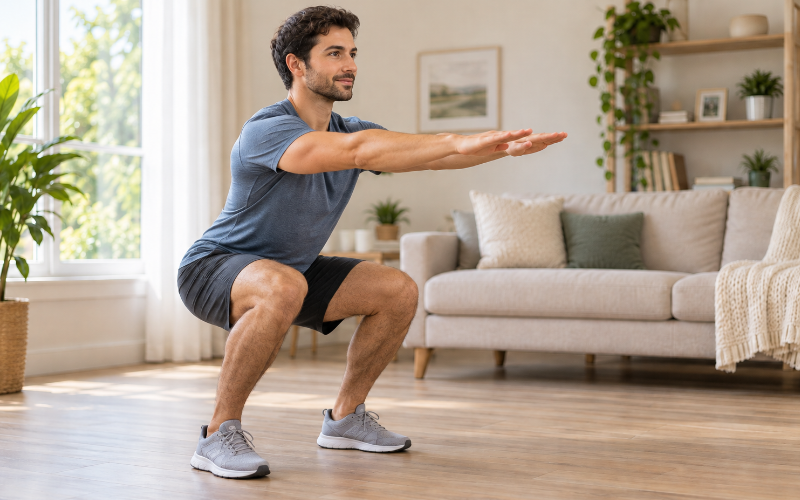
Stand with your feet roughly shoulder-width apart, adjusting the position until it feels comfortable. Bend your hips and knees as though you are lowering toward a seat. Keep your heels down and let your knees move in the same direction as your toes.
Lower only as far as you can control, then press through your feet to stand. A shallow squat is a useful starting option. Focus on steady movement rather than reaching a particular depth.
Wall or floor push-ups for upper-body strength
For a wall push-up, place your palms against a sturdy wall at about shoulder height, slightly wider than your shoulders. Step back a comfortable distance. Bend your elbows to bring your chest toward the wall, then push away.
Keep your body aligned rather than leading with your head or hips. Floor push-ups are a harder option when wall push-ups become easy. Choose the version that allows controlled repetitions, and breathe throughout the movement.
Glute bridges for hips and glutes
Lie on your back with your knees bent and feet flat on the floor, about hip-width apart. Keep your arms relaxed beside you.
Gently tighten your stomach and buttock muscles, then raise your hips until your shoulders, hips, and knees form an approximately straight line. Avoid lifting so high that your lower back arches. Pause briefly and lower slowly. The movement should come from your hips rather than from pushing your back upward.
Bird dogs and dead bugs for core control
For a bird dog, start on your hands and knees. Slowly reach one arm forward and the opposite leg backward while keeping your trunk steady. Return to the starting position and switch sides. Begin with just an arm or leg if the combined movement feels difficult.
For a dead bug, lie on your back with your arms raised and your hips and knees bent. Slowly lower one heel toward the floor, then return and switch. Add the opposite arm reach when you can keep your back comfortable and your movement controlled.
Brisk marching or step jacks for cardio
Brisk marching increases the pace without requiring much space. Swing your arms and lift your feet to a comfortable height.
For step jacks, step one foot sideways while raising your arms, return to the middle, and alternate sides. Keep your arm height comfortable. During moderate-intensity cardio, you should generally be able to talk but not sing. Slow down if the effort becomes greater than intended.
Put It Together: A 20-Minute Home Fitness Routine With No Equipment
Warm-up and exercise order
This sample home fitness routine with no equipment uses six minutes for warming up, twelve minutes for the main circuit, and two minutes for cooling down.
Start the circuit with squats, followed by wall push-ups and brisk marching. Move to the floor for glute bridges, bird dogs, and dead bugs. This order groups the floor exercises together so you spend less time repeatedly getting up and down.
Practice unfamiliar movements before starting the timer. The session is a template you can adapt, rather than a requirement to complete every exercise.
Work intervals, rest periods, and circuit rounds
Give each exercise a one-minute slot. Exercise for up to 30 seconds, then use the remaining 30 seconds to rest and prepare for the next movement. Six exercises make one six-minute round. Repeat once for twelve minutes.
For bird dogs and dead bugs, alternate sides slowly within the work period. Stop the set before your control breaks down, even if time remains.
The rest period includes changing position. If you need longer to get up safely or settle onto the floor, take it. Extend the workout or shorten the next interval rather than hurry. Beginners can use 20 seconds of movement and 40 seconds of rest within the same format.
A short cooldown
If you enjoy gentle stretching, add it afterward without forcing the position or bouncing. Allow a longer cooldown if you still feel breathless. The 20-minute schedule is a convenient guide, but your comfort and recovery matter more than finishing at an exact time.
Adjust the Routine to Your Fitness Level
Beginner variations with shorter sets and more rest
Begin with the easiest version you can perform comfortably. That might mean shallow squats, wall push-ups, small bridges, and slow marching.
For bird dogs, move one limb at a time. For dead bugs, start with small heel movements and keep your arms still. Complete one circuit round if two feels excessive. Your first sessions should help you learn the movements and understand how much effort you can manage.
Harder variations using tempo, pauses, and range of motion
When the routine feels consistently manageable, increase the challenge through better control. Lower into a squat more slowly, pause briefly during a bridge, or progress toward a harder push-up variation.
A larger movement range can also make an exercise more demanding, provided it remains comfortable. Change one feature at a time. Adding speed, deeper movements, and longer intervals together makes it harder to judge what you can handle.
Quiet, low-impact options without jumping
Jumping is optional. Brisk marching and step jacks can provide cardio activity while keeping one foot on the floor.
Use deliberate foot placement to reduce noise, especially in an upstairs room. You can increase effort through a slightly quicker pace or more arm movement without jumping. Choose movements that suit your joints, balance, and surroundings rather than assuming a louder workout is more effective.
Plan Your Workout Week Around Recovery
Alternate workout days with lighter movement
Start with two circuit sessions on nonconsecutive days, such as Monday and Thursday. Between sessions, choose comfortable walking, gentle mobility work, or lighter marching.
For general health, adults are advised to work toward at least 150 minutes of moderate-intensity aerobic activity each week and muscle-strengthening activity on at least two days. This short circuit can contribute, but its rest periods and gentle movements do not automatically count as moderate-intensity cardio.
Repeat a manageable schedule consistently
Choose workout times that connect naturally with your day. You might exercise before your morning shower, after finishing work, or during a predictable break.
Keep the schedule simple enough to repeat during a busy week. If you miss a session, return at your next practical opportunity. There is no need to double the next workout to make up for it.
Adjust when soreness or fatigue affects movement
Mild muscle soreness can occur after unfamiliar exercise. However, soreness that changes how you walk, squat, or raise your arms is a reason to reduce the workload.
Choose lighter movement or rest until you can move comfortably. Poor sleep and general fatigue can also affect a session. Adjusting your routine on those days helps you maintain control instead of forcing the same performance every time.
Keep Making Progress Without Adding Equipment
Track repetitions, workout time, and exercise control
Record a few useful details after each workout: which variations you used, how many controlled repetitions you completed, and how demanding the session felt.
Progress can mean performing the same routine with steadier balance, smoother breathing, or fewer pauses. These changes matter even when your repetition count stays the same. Compare sessions over several weeks rather than judging yourself by one unusually strong or difficult day.
Increase one challenge at a time
Once your current routine feels manageable across several sessions, choose one small change. You could add a few repetitions, increase a work interval from 30 to 35 seconds, or select a slightly harder variation.
Keep the other parts of the workout similar while you assess that change. If your technique worsens or recovery becomes difficult, return to the previous level. Progress does not need to happen every workout.
Recognize the limits of bodyweight-only training
Bodyweight training offers a convenient starting point, but it has limitations. Stronger legs may eventually need more resistance than basic squats provide. Pulling movements for the back and arms are also difficult to train progressively without equipment.
Bird dogs help you practice trunk control, but they do not replace rows or other resisted pulling exercises. Treat this routine as a useful foundation. If your goals become more demanding, you may eventually benefit from additional exercise options.
Avoid Common Mistakes During Home Workouts
Rushing repetitions or sacrificing form
A timer tells you when an interval ends; it does not tell you how many repetitions you must complete. Move at a pace that lets you control the full exercise.
Watch for signs that you are rushing, such as bouncing through squats or letting your hips sag during push-ups. Pause and reset when needed. Fewer controlled repetitions are a better choice than continuing with a movement you can no longer manage.
Skipping rest to make every workout harder
Rest helps you begin the next exercise with enough energy and attention to perform it well. Removing every break can turn a manageable routine into a session where technique quickly deteriorates.
Use the planned recovery periods, especially while learning. As your fitness improves, you can adjust them gradually. Finishing completely exhausted is not a requirement for a worthwhile workout.
Pushing through pain
Muscle effort and pain are different experiences. Stop an exercise if it causes sharp pain, joint pain, dizziness, or makes you feel unwell. Do not repeatedly test a painful movement during the same session. The NHS also advises stopping exercise if you experience pain or become unwell.
If you have an injury or health condition that affects exercise, ask a qualified healthcare professional about suitable adjustments. Persistent or recurring symptoms deserve attention rather than a harder training plan.
Conclusion
A home fitness routine with no equipment can make regular exercise easier to fit into everyday life. A clear space, familiar movements, and a manageable schedule are enough to get started.
Use the 20-minute routine as a starting point, adapting the exercises and rest periods to your current ability. Focus on controlled movement, allow recovery, and increase the challenge gradually. The most useful routine is one you can perform comfortably, repeat consistently, and adjust as your fitness develops.
FAQs
1. Can you build muscle with a home fitness routine without equipment?
Yes, bodyweight exercises can help build muscle when they provide enough challenge, particularly for beginners. Over time, you need to increase the difficulty to keep progressing. Some muscle groups are harder to challenge without external resistance, especially the muscles used in pulling movements.
2. Is a 20-minute home workout enough?
Twenty minutes can provide a useful exercise session and help you establish a regular habit. Whether it is enough overall depends on your goals, the workout intensity, and your activity during the rest of the week. A short circuit is one contribution to your broader activity routine.
3. Can I do this no-equipment routine every day?
You do not need to repeat the full circuit daily. Start with nonconsecutive workout days and use lighter walking or mobility work between them. Your muscles need time to recover from challenging sessions. Adjust frequency according to how well you recover and how comfortably you move.
4. How long does it take to notice progress?
There is no fixed timeline. You may first notice that movements feel more familiar or that you need fewer pauses. Strength, stamina, and visible changes develop at different rates. Track your performance over several weeks and avoid using appearance as your only measure of progress.
5. What if I cannot complete the whole routine?
Shorten the work intervals, choose easier variations, or complete one round. You can also spend a session practicing a few movements without following the timer. Begin with an amount you can manage comfortably, then build gradually as your control and confidence improve.