
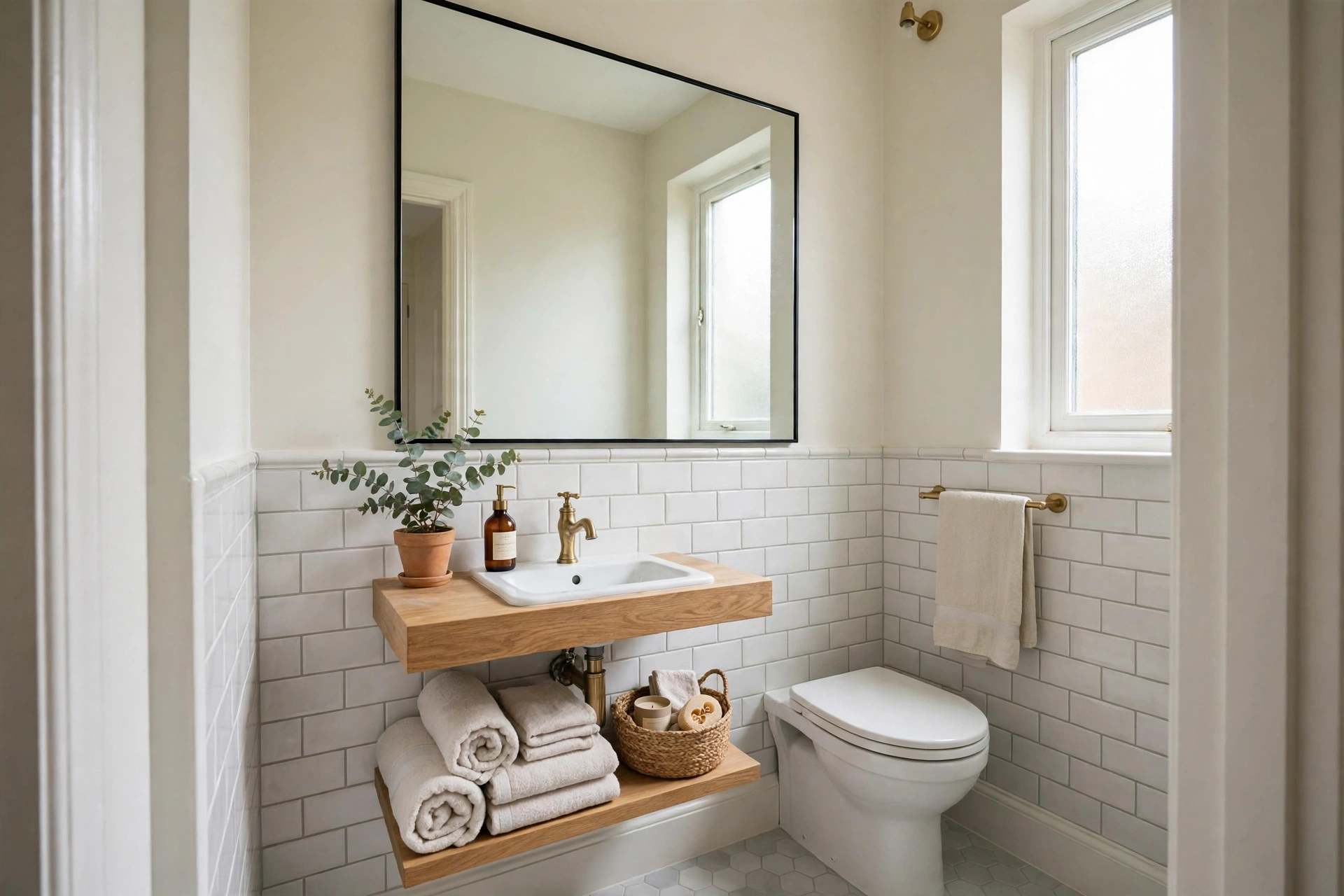
A small bathroom can be one of the hardest rooms in a home to get right. There is so much that has to fit into so little space, and every choice seems to matter more because there is nowhere for a mistake to hide. A colour that looks soft in a large room can feel cold in a small one. A cabinet that seems useful in a shop can crowd the only clear wall. A busy tile that looks full of character on a sample can make the whole room feel restless once it covers the walls. Yet a small bathroom does not have to feel like a compromise. Some of the calmest, most welcoming bathrooms are small, because every part of the room has been thought about, and nothing is there simply to fill space.
The best bathroom decorating ideas for small rooms start from a simple idea. The aim is not to make the room look bigger by trickery, but to make it feel easier to use and calmer to be in. That usually means fewer competing colours, clearer surfaces, light used well, and storage that keeps everyday things out of sight without making the room feel closed in. It does not have to mean a full refit, and it does not have to mean everything white and plain. A small room can carry pattern, colour and character, as long as those choices are given room to breathe and are not all competing at once. This guide works through the decisions in the order that helps most, from how the room is used, through colour and light, to storage, fittings and the finishing touches that make the difference between a room that works and a room that feels finished.
Start With How the Room Is Really Used
Before choosing a colour or a tile, it helps to spend a little time noticing how the bathroom is actually used. A family bathroom that serves children in the morning, guests at weekends and everyone in between has different needs from a small en-suite that is mostly used for a quick shower and getting ready for work. A downstairs cloakroom, used briefly by visitors, can be bolder and simpler, because it does not need to hold towels, medicines and cleaning products for a whole household. The room that has to do the most work needs the clearest thinking, because every extra item left out on display will make it feel smaller.
Think about the moments that feel awkward. Is the door blocked by a towel rail, or does it catch on the bath mat? Is there nowhere sensible to put a phone, a glass of water or a book while someone is in the bath? Do bottles gather around the basin because there is no shelf within easy reach? These small frustrations point to what decorating needs to solve. A shelf in the right place, a hook at the right height, or a mirror cabinet that holds the things used every morning can change how the room feels more than a new colour ever will. It is worth writing down the three things that annoy you most about the room as it is now, and letting those three things lead the plan, rather than starting with a picture of someone else’s bathroom and trying to copy it.
It also helps to be honest about what will not change. If the bath must stay because it is the only bath in the home, decorating should work with it rather than pretend it is not there. If the window is small and faces a wall, light will need to come from fittings and reflective surfaces rather than from daylight alone. If the room is rented, changes will need to be reversible, and paint, mirrors, textiles and freestanding storage will matter more than tiles and fitted units. A plan that respects these limits is far more likely to be finished, and far more likely to still feel right a year later, than a plan that depends on everything changing at once.
Colour That Opens the Room Up Without Washing It Out
Colour does a lot of work in a small bathroom, and the usual advice to use only white is only half the story. Light colours do reflect light and can make a room feel more open, especially soft whites, pale greys, gentle blues and warm creams. They also make it easier to see the shape of the room clearly, which helps a small space feel tidy rather than busy. But a room decorated entirely in cold white, with white tiles, a white suite and white towels, can feel clinical and flat, particularly on a grey day when there is little natural light. Warmth matters as much as lightness, and a warm white, a soft stone tone or a pale sage can feel more welcoming than a brilliant white that throws every shadow into sharp relief.
One useful way to think about colour is to choose one main colour for the walls and large surfaces, one supporting colour for towels, a blind or a plant pot, and one darker accent that appears in small amounts, perhaps in a picture frame, a soap dish or the edge of a mirror. Keeping the palette tight in this way stops the eye from jumping from one strong colour to another, which is what often makes a small room feel restless. If you love a deeper colour, consider using it with confidence on one wall, or all over in a small cloakroom, rather than in patches. A single deep wall, balanced by pale tiles and a large mirror, can give a small bathroom depth and character, while the same colour broken up into small areas can look unsettled. The same is true of pattern. One patterned surface, such as a tiled splashback or a bold wallpaper on one wall, can be the focus of the room, while the other surfaces stay calm and let it shine.
Paint and wallpaper need to suit a wet room. In a bathroom, ordinary emulsion can mark, peel or grow mould where steam gathers, so it is worth choosing a paint made for bathrooms or kitchens, and following the maker’s guidance on preparation and drying time. Wallpaper can work beautifully in a small bathroom, particularly away from direct splashes, but it should be chosen for damp conditions and sealed or hung where steam will not lift its edges. Whichever finish you choose, test it in the room itself, in daylight and in evening light, because bathroom lighting can change a colour a great deal. A shade that looks calm in a shop can look green, pink or grey under a cool bathroom light, and a small sample on the wall, lived with for a few days, will tell you more than any number of pictures.
Light, Mirrors and the Feeling of Extra Space
Light is the single most powerful tool in a small bathroom, and it is often the one that is left until last. A single harsh ceiling light can flatten the room, throw shadows under the eyes when someone looks in the mirror, and make every surface look harder than it is. Layered light works far better. A bright, even light for the room as a whole, softer light around the mirror for washing and getting ready, and perhaps a low, warm light for an evening bath, will make the same room feel larger, calmer and more useful at different times of day. The light around the mirror matters most of all. Light that comes from the sides of the mirror, or from above it in a soft, even wash, lights the face without harsh shadows, while a single light behind the head leaves the face in shade and the room feeling gloomy.
Mirrors do more than help with getting ready. A large mirror, or a mirror cabinet that stretches across the wall above the basin, reflects light around the room and gives the eye a sense of depth beyond the wall. It works best when it reflects something pleasant, such as a window, a pale wall or a plant, rather than a cluttered shelf or the back of a door. A round mirror can soften the hard lines of tiles and a rectangular suite, while a mirror that reaches close to the ceiling can make the room feel taller. If the mirror is also storage, it solves two problems at once, but it should be chosen for its size and position first, and its storage second, because a mirror that is too small or too high will not give the room the lift it needs.
Natural light should be welcomed wherever it is available. A bathroom window that is covered with a heavy blind or a frosted film that blocks most of the light will make the room feel smaller even on a bright day. A simple roller blind, a light voile or a window film that gives privacy while still letting light through will usually serve the room better. Where there is no window, or only a very small one, reflective surfaces become even more important. Gloss tiles, a glass shower screen and a pale floor will bounce the light that is there, while dark, matt surfaces will absorb it. The aim is not to make the room glitter, but to let the light move around it, so that no corner feels forgotten.
Tiles, Walls and Floors That Work Together
Tiles, walls and floors are best chosen together, because in a small bathroom they are all visible at once and they all affect how large the room feels. Large tiles, with fewer grout lines, can give a calmer surface than many small tiles, because the eye is not stopped by a grid at every turn. That does not mean small tiles never work. A small mosaic in a shower area, or a patterned tile used as a single feature, can add character without overwhelming the room, as long as the rest of the surfaces stay quiet. What usually makes a small bathroom feel busy is not the size of the tile, but the number of different tiles, colours and patterns competing in one small space. Two finishes, used with confidence, will almost always feel calmer than four finishes used in small amounts.
Continuity helps a great deal. Using the same tile, or a very similar tone, on the floor and on part of the walls can blur the line where the wall meets the floor, which makes the room feel less boxed in. Carrying the floor tile up one wall, or using the wall tile as a splashback that runs the full length of the bath, can have the same effect. Where the floor and the walls are very different, the room can feel cut into pieces, and each piece can feel smaller than the whole. This is also why the floor matters so much. A floor that is practical, easy to clean and not slippery when wet will be used every day, and its colour will set the tone for everything above it. A very dark floor can ground the room and look smart, but it will show water marks and dust more clearly, and it can make the room feel smaller if the walls are also dark. A mid-toned or pale floor, with a matt or lightly textured finish for grip, is often the easiest choice to live with.
For a closer look at flooring in a compact room, the Homes & Gardens small bathroom flooring ideas show how waterproof, anti-slip choices can still add pattern and colour, including slip resistance and care. The same thinking applies to walls. A surface that is easy to wipe down, that does not trap moisture behind it, and that can be repaired without redoing the whole room will serve a small bathroom far better than a surface chosen for looks alone. Grout, in particular, deserves thought. A grout colour close to the tile colour will look calmer and show marks less, while a strongly contrasting grout will draw attention to every line and can make a small room feel more divided than it is.
Storage That Hides the Clutter and Keeps the Calm
Storage is where small bathrooms are won or lost. A room with no storage will always look untidy, because the things that belong in a bathroom have nowhere to go. A room with too much storage, in the form of bulky cabinets and freestanding units, will feel crowded, because every unit takes floor space and breaks up the walls. The answer is usually storage that uses the walls and the height of the room, rather than the floor. A tall, narrow cabinet in a corner, shelves above the door or above the toilet, and a recessed niche in a shower wall can hold a great deal without taking up the space where people stand and move. A niche, in particular, is worth considering during any refit, because it holds shampoo and soap at hand height without a caddy hanging from the shower or bottles gathering on the bath edge.
Closed storage keeps the calm, while open storage shows everything. In a small bathroom, it is usually best to keep most things behind a door or in a basket, and to leave only a few things on show, such as a plant, a folded towel or a favourite soap. A mirror cabinet above the basin is the hardest-working piece of storage in most small bathrooms, because it holds the things used every morning and evening within easy reach, and it keeps the basin clear. A vanity unit under the basin does the same for larger items, and a wall-hung unit, with clear floor beneath it, will make the room feel larger than a unit that sits on the floor. If the basin is small, a narrow shelf or a small cabinet beside it can be more useful than a wide unit that crowds the room.
It helps to sort what is stored into what is used every day, what is used every week, and what is rarely used at all. Everyday things deserve the easiest reach, in the mirror cabinet or on a small shelf by the basin. Weekly things, such as spare towels and cleaning products, can live higher up or in a taller cabinet. Rarely used things, such as spare toilet rolls bought in bulk or seasonal items, do not need to live in the bathroom at all, and moving them elsewhere can free up a surprising amount of space. Baskets and boxes help within cabinets, because they stop small items from spreading and make it easier to lift a whole group of things out to clean behind them. Labelling is rarely needed in a bathroom, but grouping like with like, and keeping a regular place for each group, will keep the room feeling calm without any extra effort.
Choosing Fittings That Fit the Room, Not Just the Catalogue
Fittings that look generous in a showroom can overwhelm a small bathroom, so scale matters more than style. A basin that is a little smaller than standard, a toilet with a short projection from the wall, and a bath that is shorter or narrower than a standard bath can each give back precious centimetres, and those centimetres add up to a room that is easier to move around in. A wall-hung toilet and basin, with the floor clear beneath them, can make the room feel larger, because more floor is visible, and cleaning becomes easier as well. A corner basin can be a sensible answer in a very tight cloakroom, where a standard basin would block the door or the way to the toilet. The key is to measure the room, the door swing and the space needed to use each fitting comfortably, before falling in love with a particular design.
The choice between a bath and a shower is one of the biggest decisions in a small bathroom, and it should be made on how the room is used rather than on fashion alone. A shower over the bath can give both options in the same footprint, and a clear glass screen, rather than a curtain, will let the eye travel to the far wall and make the room feel larger. A walk-in shower, with no tray step and a single glass panel, can feel lighter and more open, but it needs careful waterproofing and drainage, and it may not suit a home where a bath is needed for children or for resale. If the bath must stay, a shower bath with a wider end for showering can be a good compromise, giving more room to stand without taking up more floor. Whatever is chosen, the glass should be easy to clean, the screen should not block the light, and the fittings should be placed so that water stays where it belongs.
Taps, handles and accessories should be chosen for ease of use as well as looks. A single lever tap is easier to use with wet hands than separate hot and cold taps, and a tap that is too tall for the basin will splash. Wall-mounted taps can free up space on a small basin, but they need the plumbing to be in the right place and they should be fitted by someone who understands the wall construction. A heated towel rail, mounted on a wall that would otherwise be empty, can warm towels and help the room dry out, while also acting as a useful rail for damp towels. It should be placed where it does not block the door or the mirror, and where towels hung on it will not drip onto the floor in the main walkway.
The Small Details That Make a Bathroom Feel Finished
Once the large decisions are made, it is the small details that make a small bathroom feel finished rather than merely functional. Towels are one of the easiest details to get right, and one of the easiest to get wrong. Two or three towels in colours that belong to the room’s palette, folded neatly and hung where they can dry, will look calmer than a pile of towels in every colour. A single bath mat, in a colour that matches the towels, placed where feet land after a shower, will feel more considered than several small mats. A plant that likes humidity, such as a fern or a pothos in a pot that suits the room, can soften hard tiles and bring life to a corner, as long as it has enough light and is not left to drop leaves into the bath.
Art and decoration need a light touch in a small bathroom. One framed print, hung where it can be seen from the door, can give the room personality, while several small pictures can make the walls feel crowded. A print should be chosen for damp conditions, or hung where steam will not reach it directly, and its frame should suit the other finishes in the room. A scented candle, a reed diffuser or a small vase of fresh flowers can make the room feel cared for, but they should be placed where they will not be knocked over or damaged by water. The aim is for the room to feel personal without feeling full. If a detail does not add comfort, colour or calm, it is probably better left out, and the room will feel larger for its absence.
Budget ideas can be just as effective as a full refit, and they are often the best place to start. Repainting a vanity unit, swapping handles, adding a new mirror, changing the shower curtain for a glass screen, or replacing a tired bath mat and towels can refresh a small bathroom in a weekend. The Ideal Home collection of budget small bathroom ideas shows how paint, panels, wallpaper and clever reuse can change a room without a large spend, including using large-format tiles and statement wallpaper in small amounts. The lesson from those ideas is not to do everything at once, but to choose one change that will be seen every day, do it well, and live with it before deciding what comes next. A small bathroom that is changed in small, thoughtful steps will usually end up feeling more personal than one that is changed all at once to match a picture.
Keeping a Small Bathroom Looking Good Day to Day
A small bathroom shows neglect quickly, because there is so little space for dust, limescale and clutter to hide. A short daily routine, rather than an occasional deep clean, will keep it looking good with very little effort. Wiping the basin and taps after use, squeegeeing the shower glass, hanging towels so they can dry, and putting bottles back where they belong will stop the room from looking tired by the end of the week. A weekly clean, with attention to grout, seals and the floor edges, will keep mould and limescale from taking hold, and it will also give a chance to notice small problems, such as a loose seal or a dripping tap, before they become larger ones.
Ventilation is part of keeping the room looking good, and it is also part of keeping it healthy. A bathroom that stays damp will grow mould on grout and paint, and it will smell musty no matter how well it is decorated. An extractor fan that runs during and after a shower or bath, a window opened for a short time after use, and a trickle vent left open where one is fitted will all help the room dry out. Towels and bath mats should be allowed to dry fully, and a heated towel rail, if fitted, can help with this. If condensation appears on the mirror and walls every time the room is used, and does not clear quickly, the ventilation may need attention, and it is worth asking a professional to check the fan and the airflow before redecorating, because new paint and tiles will not solve a ventilation problem on their own.
It is also worth thinking about how the room will age. A small bathroom decorated with timeless colours and simple finishes will be easier to refresh in a few years than one decorated with a very specific trend. Towels, a blind, a plant and a picture can be changed cheaply when tastes change, while tiles and a suite are far more costly to change. Choosing a calm base, and letting personality come through in the things that are easy to change, gives the room a longer life and makes it easier to keep looking good. A small bathroom that is easy to clean, easy to ventilate and easy to update will feel like a pleasure to use, rather than a problem to be solved, and that is the real test of whether the decorating has worked.
Frequently Asked Questions
Can dark colours work in a small bathroom?
Yes, dark colours can work very well, as long as they are used with confidence and balanced by good light and pale surfaces elsewhere. A single dark wall, or a small cloakroom decorated all over in a deep colour, can feel rich and intentional, especially with a large mirror, warm light and pale towels. What usually makes a dark colour feel oppressive is poor light, clutter and several competing colours, rather than the colour itself. If you are unsure, try the colour on one wall first, live with it for a few days in daylight and evening light, and then decide whether to take it further.
Do I need to replace the bath to make the room feel bigger?
No, replacing the bath is rarely the first step. A clear glass screen instead of a curtain, a pale surround, a tidy bath edge with nothing stored on it, and a mirror that reflects light across the room can make the same bath feel far less dominant. A shower over the bath, or a shower bath with a wider standing area, can also help without removing the bath altogether. The bath should only be removed if it is rarely used, if a shower would genuinely serve the household better, or if the room needs the space for another essential fitting, and that decision should take account of children, guests and future needs as well as looks.
How do I stop a small bathroom feeling damp and stuffy?
The most important step is ventilation. Use an extractor fan during and after showers and baths, open a window briefly afterwards if there is one, and leave any trickle vent open. Hang towels and mats so they can dry, wipe down wet surfaces, and avoid drying clothes in the bathroom. If condensation lingers, seals look blackened, or paint peels, ask a professional to check the fan, the ducting and the airflow, because decorating over a damp problem will not solve it. Good ventilation, kept up every day, will do more for the feel of the room than any single decorating choice.
What is the easiest low-cost change?
The easiest low-cost change is usually to clear the surfaces, add a large mirror if the one there is small, and refresh towels and a bath mat in colours that belong together. Repainting a vanity unit or a wall in a colour made for bathrooms, swapping handles, and adding a plant can also refresh the room in a weekend without any plumbing work. Start with the change you will see every time you walk in, do it well, and live with it before spending more. A room that is calm and clear will often feel new without any major work at all.
How much should I change at once?
It is usually best to change one layer at a time. Start with colour, light and clutter, because those affect how the room feels every day and they are the easiest to reverse. Then look at storage and fittings, which need more planning and cost. Finally, consider tiles and a refit, if they are still needed. Changing everything at once can be overwhelming, expensive and hard to undo if a choice does not work in the room. Small, thoughtful steps, each lived with for a while, will lead to a bathroom that suits the household, rather than one that simply matches a picture.
Conclusion
Small bathroom decorating ideas work best when they start with the room as it is, and with the people who use it every day. A calm palette, light used well, storage that hides the everyday clutter, fittings that fit the space, and a few finishing touches chosen with care will do far more than a long list of trends. The room does not need to be larger to feel better. It needs to be clearer, calmer and easier to use, so that the eye can rest and the body can move without bumping into something at every turn. Start with the change that will be noticed most, whether that is a larger mirror, a clearer surface or a warmer light, and let the rest of the room follow from there. A small bathroom, decorated with thought and kept with a little daily care, can feel like one of the most peaceful rooms in the home.